
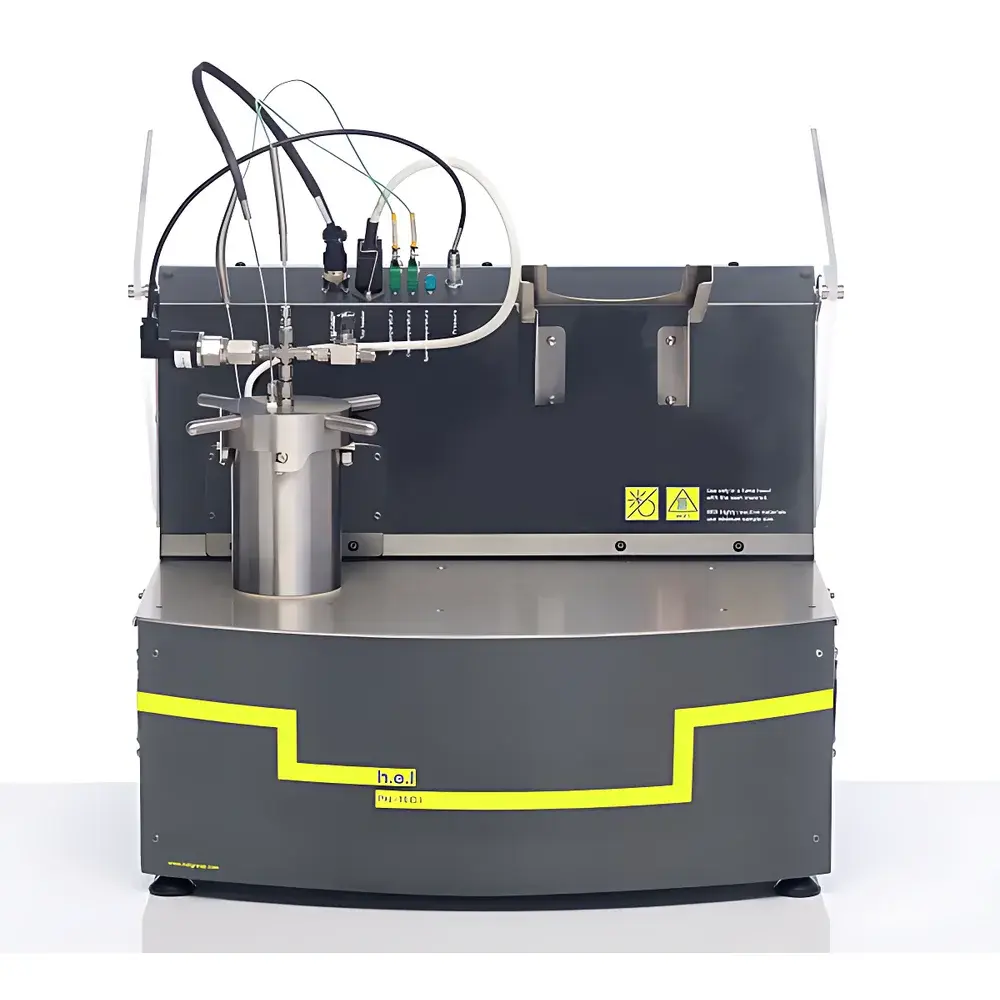
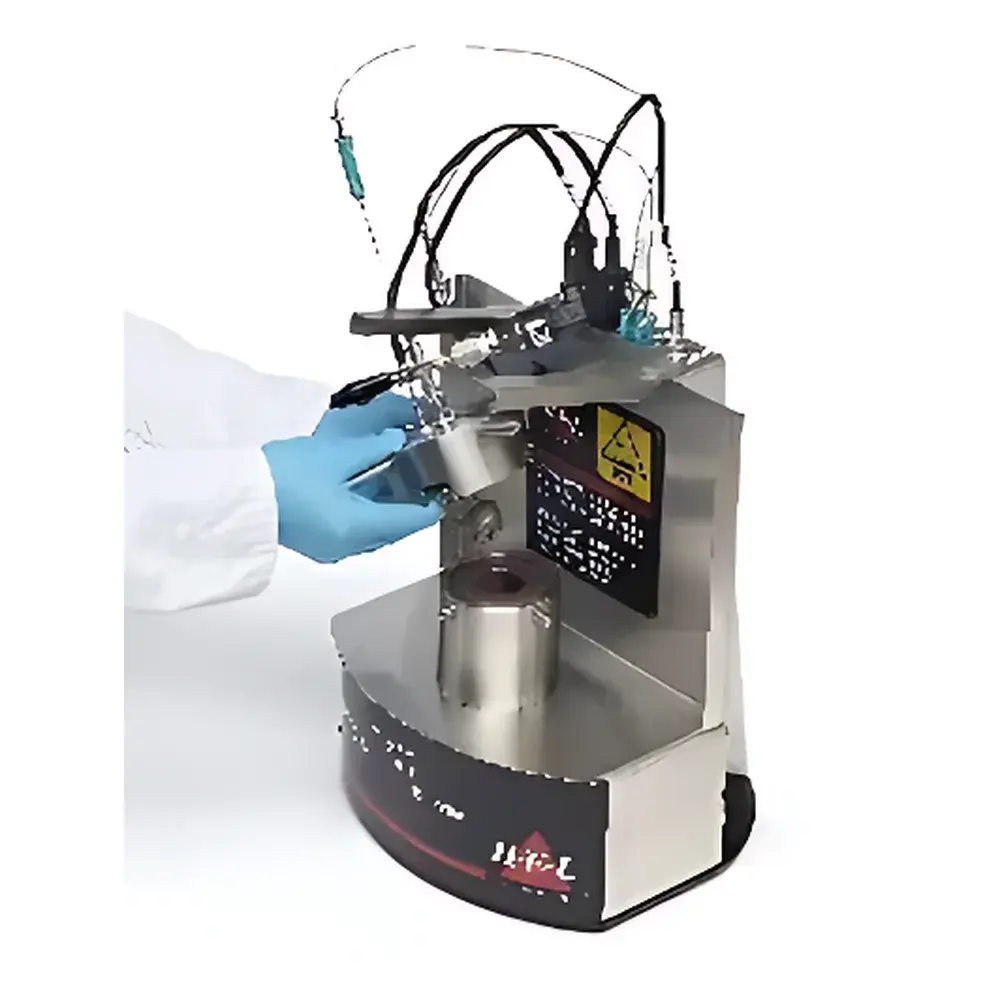
HEL Phi-TEC I Adiabatic Accelerating Calorimeter
| Brand | H.E.L |
|---|---|
| Origin | United Kingdom |
| Model | Phi-TEC I |
| Instrument Type | Adiabatic Accelerating Calorimeter |
| Measurement Mode | Adiabatic Calorimetry |
| Temperature Range | −60 °C to 500 °C |
| Temperature Resolution | 0.005 K |
| Temperature Accuracy (direct sample mode) | ±0.01 °C |
| Temperature Stability (isothermal mode) | ±0.001 °C |
| Heat Capacity | ~10,000 J/K |
| Sample Mass Range | 0.5–80 g |
| Pressure Range | 0–300 bar (optional up to 1000 bar) |
| Pressure Accuracy | ±0.05% FS |
| Pressure Resolution | 0.01 bar |
| Exothermic Detection Sensitivity | 0.005–0.2 °C/min |
| φ-factor (low-φ cell) | ≤1.05 |
| Stirring | Electromagnetic, 0–500 rpm (mechanical stirrer optional) |
| Operating Modes | HWS (Heat-Wait-Search), RAMP, ISO |
| External/Inner Dewar Volume | 10 mL each |
| Single-Sample Test Duration | ~600 min |
| Dimensions | 30 cm × 37 cm × 50 cm |
| Power Supply | 220 V AC, 13 A |
Overview
The HEL Phi-TEC I Adiabatic Accelerating Calorimeter is an engineered platform for high-fidelity thermal safety assessment of reactive chemical systems under near-perfect adiabatic conditions. Based on the principle of heat balance compensation—where measured temperature rise is dynamically corrected for conductive and convective losses—the Phi-TEC I enables true direct sample temperature measurement via integrated thermocouples embedded in the reaction cell. This eliminates reliance on outer-cell wall sensing (a limitation of conventional ARC systems), significantly improving onset detection sensitivity—particularly critical for gas-evolving or heterogeneous reactions where early exothermic events may be masked by thermal lag. The system operates across an extended temperature range from −60 °C to 500 °C, supported by a proprietary jacketed cooling design that achieves ultra-low temperatures without auxiliary hardware or software modifications. Its adiabatic tracking capability maintains φ ≤ 1.05 across full pressure ranges (up to 300 bar standard, extendable to 1000 bar), ensuring kinetic data integrity under industrially relevant process conditions.
Key Features
- Direct sample temperature sensing: Dual thermocouples contact the sample matrix directly, enabling sub-0.01 °C accuracy in onset determination and minimizing φ-factor dependency—essential for reliable decomposition onset (Tonset) and time-to-maximum-rate (TMRad) prediction.
- Fully automated adiabatic compensation: Real-time correction for conduction and convection losses across the entire operational range—including cryogenic regimes—without manual calibration or empty-cell runs. Compensation coefficients are derived empirically from system geometry and thermal boundary conditions.
- Integrated continuous addition capability: Supports controlled liquid/gas dosing during adiabatic testing—a unique feature absent in traditional ARC instruments—enabling hazard evaluation of semi-batch, fed-batch, and gas-liquid reaction scenarios (e.g., nitration, hydrogenation, chlorination).
- Multi-mode operation: Configurable protocols include Heat-Wait-Search (HWS), linear RAMP, and ISOthermal modes—each compliant with ASTM E1981, UN TDG Appendix 3, and EU CLP Annex I methodologies.
- Stirring versatility: Standard electromagnetic stirring (0–500 rpm) ensures homogeneity; optional mechanical stirring replicates industrial agitator profiles for non-Newtonian or multiphase systems.
- Robust pressure monitoring: High-resolution pressure transducers (0.01 bar resolution, ±0.05% FS accuracy) track gas evolution kinetics synchronously with thermal data, supporting pressure-driven runaway analysis per ISO 80079-20-1.
Sample Compatibility & Compliance
The Phi-TEC I accommodates diverse material classes—including solids, liquids, slurries, pastes, and multiphase mixtures (gas/liquid, liquid/liquid, solid/liquid)—with sample masses ranging from 0.5 g to 80 g. Its low-φ stainless-steel reaction cells (φ ≤ 1.05) maintain adiabatic fidelity even at elevated pressures, satisfying requirements for GHS Category 1 self-heating substances (UN Test N.4) and Class 1 explosives screening (UN Test Series 3). Data outputs comply with regulatory frameworks including FDA 21 CFR Part 11 (audit trail, electronic signature support), EU REACH Annex VII–X, and ICH Q5C stability guidelines. All thermal kinetic parameters—activation energy (Ea), pre-exponential factor (A), reaction order (n), adiabatic temperature rise (ΔTad), and enthalpy change (ΔH)—are derived using ISO 11358-1 validated numerical integration algorithms.
Software & Data Management
Control and analysis are performed via HEL’s proprietary THT (Thermal Hazard Technology) software suite, which provides GLP-compliant workflow management, real-time adiabatic deviation monitoring, and automated kinetic modeling (e.g., nth-order, autocatalytic, multi-step mechanisms). Raw sensor data—including temperature, pressure, stir speed, and dosing volume—is timestamped and stored in encrypted binary format with SHA-256 hash verification. Export options include CSV, PDF reports, and XML files compatible with LIMS integration. Audit trails record all user actions, parameter changes, and calibration events in accordance with 21 CFR Part 11 requirements. Batch processing supports comparative hazard ranking across compound libraries using TMRad, MTSR (maximum temperature of synthesis reaction), and SADT (self-accelerating decomposition temperature) metrics.
Applications
- Thermal stability screening of active pharmaceutical ingredients (APIs), intermediates, and excipients per ICH Q1A–Q1E guidelines.
- Hazard evaluation of battery electrolytes, cathode/anode materials, and thermal runaway propagation in Li-ion cells.
- Process safety studies for petrochemical oxidation, polymerization, and nitration reactions—supporting CCPS Process Safety Metrics and Dow Fire & Explosion Index inputs.
- Decomposition kinetics of energetic materials (propellants, pyrotechnics, explosives) per STANAG 4147 and NATO AEP-55.
- Environmental fate analysis of agrochemicals and soil contaminants under simulated landfill or composting conditions.
- Validation of computational models (e.g., DSC-based kinetic extrapolation, CFD thermal runaway simulations) using experimentally anchored Ea and ΔH values.
FAQ
How does the Phi-TEC I differ from conventional ARC systems in onset detection accuracy?
The Phi-TEC I measures temperature directly at the sample interface using embedded thermocouples, whereas conventional ARC relies on outer-cell wall sensing. This reduces thermal inertia effects and improves onset detection sensitivity by up to 10×—especially for low-energy, gas-evolving, or diffusion-limited reactions.
Can the Phi-TEC I perform tests below −40 °C without external cryogenic hardware?
Yes. Its integrated cooling jacket architecture allows stable operation down to −60 °C using only a standard recirculating chiller—no LN2 or custom refrigeration units required.
Is pressure-rated operation validated across the full temperature range?
Yes. Low-φ cells maintain structural integrity and adiabatic performance from −60 °C to 500 °C at pressures up to 300 bar (1000 bar option available), verified per ASME BPVC Section VIII Div. 1.
Does the system support regulatory submissions to EMA, FDA, or OECD?
All generated kinetic reports include metadata traceability, instrument qualification records (IQ/OQ/PQ), and raw data archives compliant with ALCOA+ principles—fully acceptable for dossier submission under ICH, REACH, and CLP frameworks.
What sample preparation protocols are recommended for heterogeneous mixtures?
Mechanical stirring is advised for slurries, suspensions, or immiscible liquid pairs; sample homogenization prior to loading and precise mass/volume documentation are required to ensure reproducible φ-factor calculation and kinetic interpretation.



