
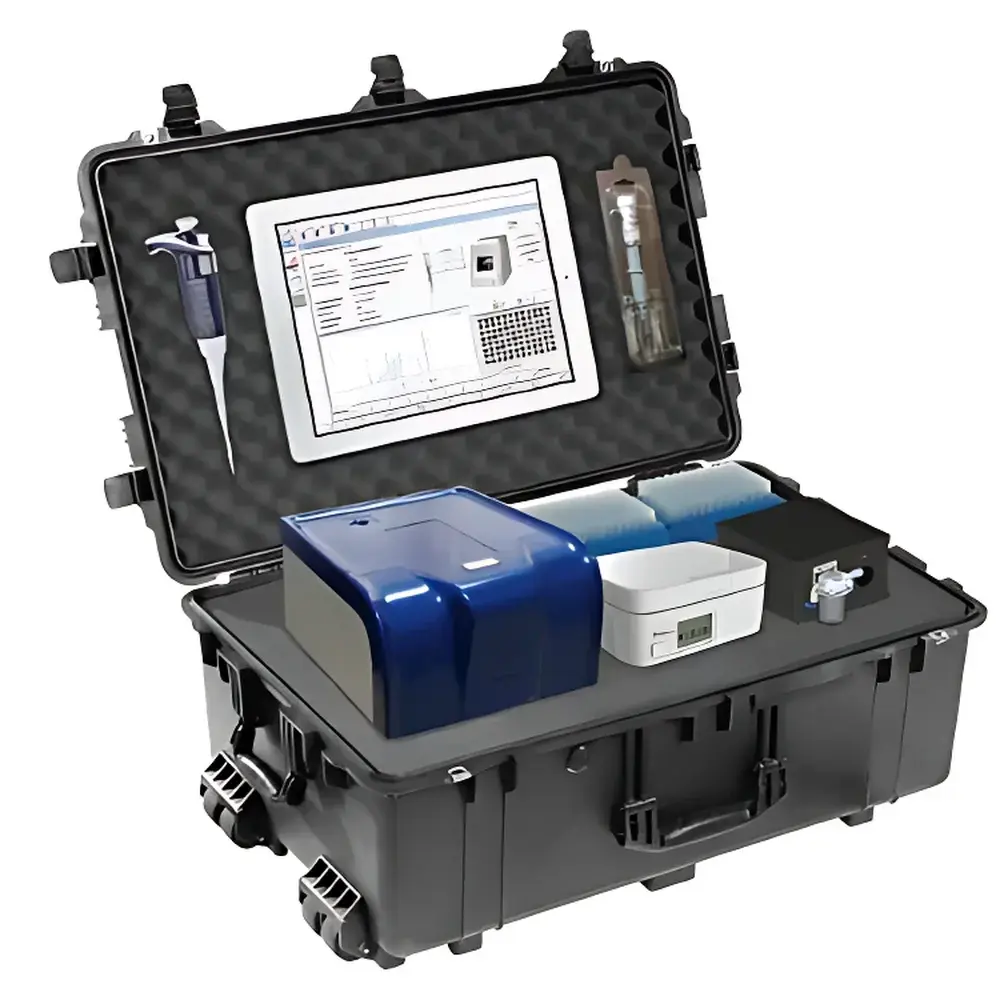
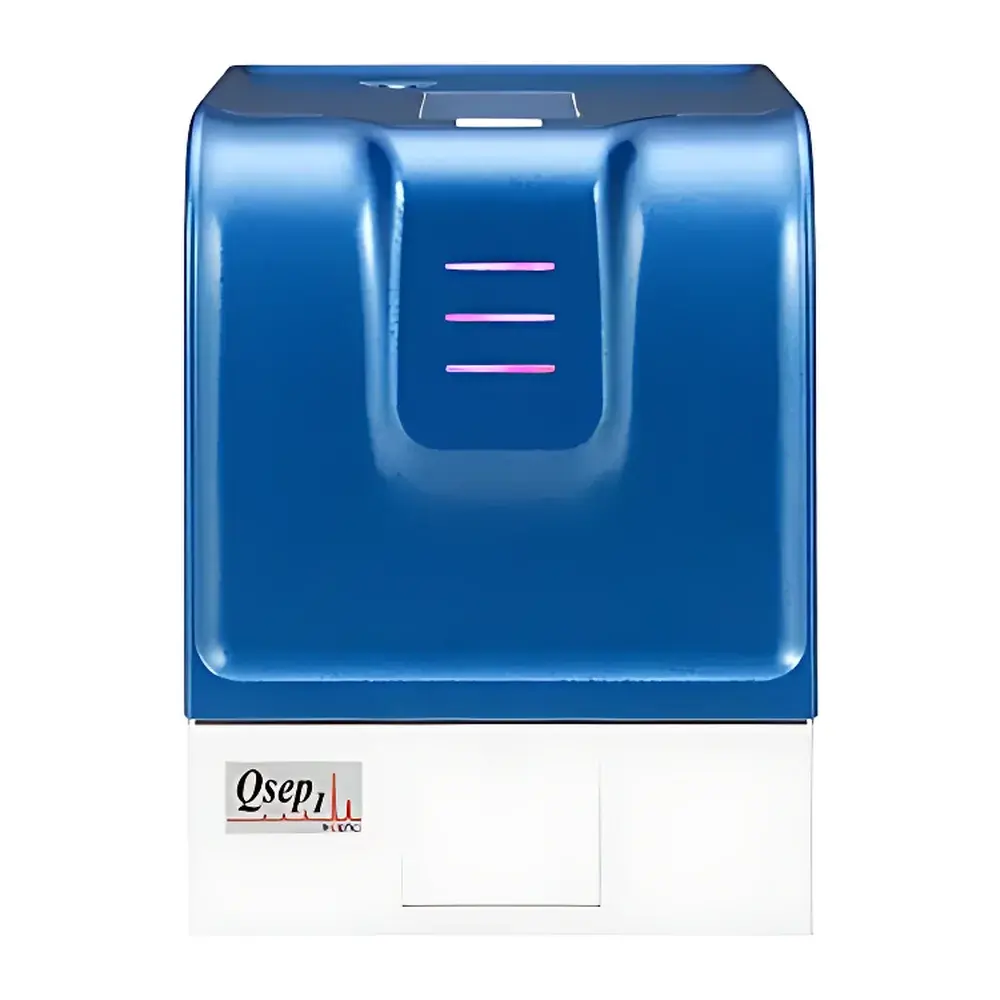
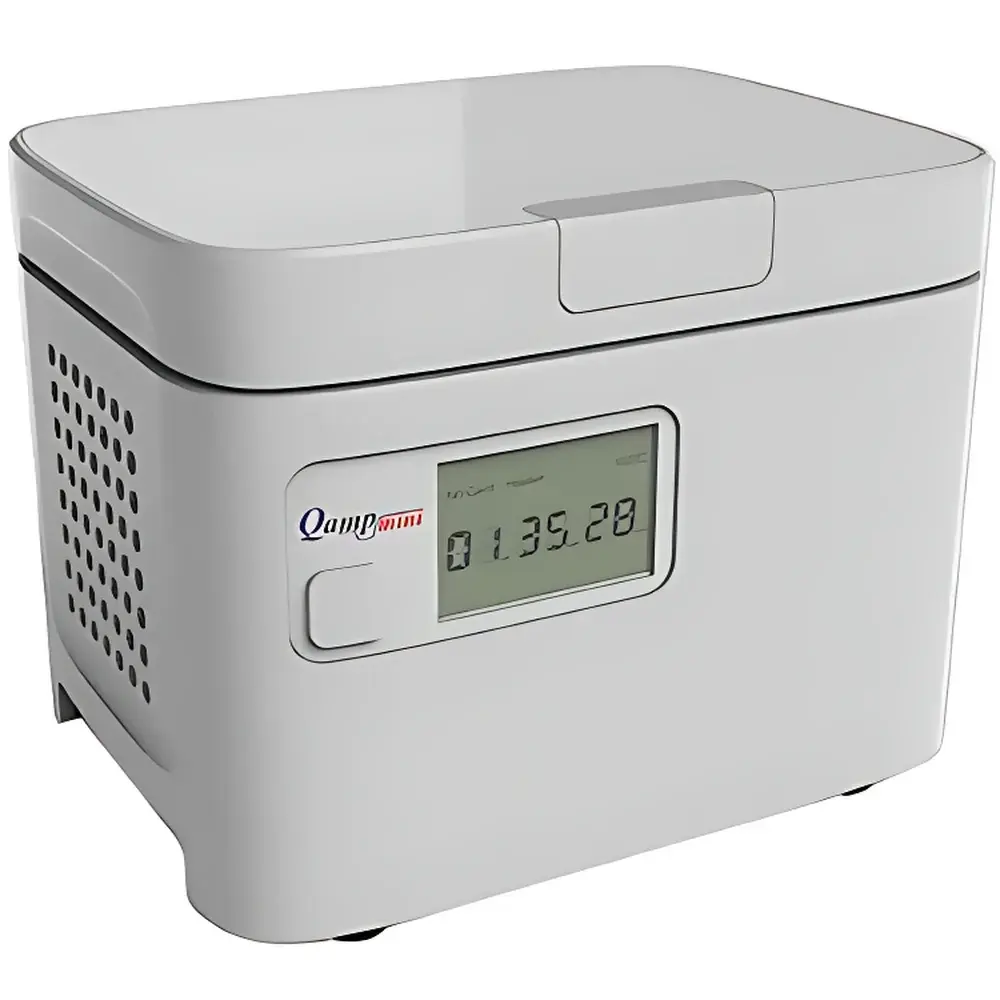
Bioptic Qsep Mini Portable Nucleic Acid and Protein Fragment Analyzer
| Brand | Bioptic |
|---|---|
| Model | Qsep Mini |
| Origin | Jiangsu, China |
| Instrument Category | Ultra-micro Nucleic Acid and Protein Analyzer |
| Sample Volume Requirement | 1 µL |
| Analyte Types | DNA, Proteins |
| DNA Detection Limit | pg-level |
| Module Options | 8-, 12-, or 19-sample capacity |
| Disposables | Pre-cast, single-use gel cartridges |
Overview
The Bioptic Qsep Mini is a field-deployable, cartridge-based capillary electrophoresis (CE) system engineered for rapid, high-resolution analysis of nucleic acid and protein fragments. Unlike conventional slab-gel electrophoresis—requiring manual gel casting, staining, destaining, imaging, and post-hoc sizing calibration—the Qsep Mini integrates sample loading, separation, fluorescence detection, and automated fragment sizing into a single, self-contained platform. It operates on the principle of electrokinetic separation within polymer-filled capillaries embedded in disposable gel cartridges, enabling reproducible mobility-based sizing with sub-5% coefficient of variation (CV) across repeated runs. Designed for environments where infrastructure, power stability, or lab space is constrained—including field clinics, mobile biosurveillance units, agricultural extension labs, and point-of-collection forensic screening—the Qsep Mini delivers laboratory-grade resolution without reliance on benchtop infrastructure or specialized electrophoresis expertise.
Key Features
- Ultra-low sample consumption: Compatible with as little as 1 µL of unpurified or purified DNA or protein lysate, minimizing precious sample loss and eliminating dilution steps.
- Modular throughput flexibility: Interchangeable cartridge modules support 8-, 12-, or 19-sample parallel analysis per run, allowing optimization between speed and batch size without hardware modification.
- Pre-cast, single-use gel cartridges: Eliminate gel preparation, buffer equilibration, and post-run disposal hazards; each cartridge contains calibrated size standards and optimized separation matrix, ensuring inter-run consistency and reducing carryover risk.
- Integrated optical detection: Built-in LED excitation and CCD-based fluorescence imaging enable real-time signal capture during electrophoretic migration, supporting both SYBR®- and ethidium bromide-compatible dyes.
- Embedded sizing algorithm: On-device software automatically aligns electropherogram peaks against internal ladder markers, calculates fragment sizes in base pairs (bp) or kilodaltons (kDa), and exports annotated .csv and .pdf reports.
- Ruggedized portable form factor: Weighing under 3.2 kg with integrated battery option (optional), the unit meets IEC 60529 IP54 rating for dust and splash resistance, suitable for transport and operation in non-temperature-controlled environments.
Sample Compatibility & Compliance
The Qsep Mini accepts a broad range of biological samples without prior purification: crude PCR products, restriction digests, plasmid preps, sheared genomic DNA, and denatured protein lysates (e.g., SDS-PAGE–compatible extracts). Its pg-level DNA detection limit supports applications such as low-input genotyping, CRISPR editing validation, and pathogen amplicon screening. The system complies with ISO/IEC 17025 requirements for test method validation when used with certified reference materials. All disposable cartridges are manufactured under ISO 13485-certified processes and labeled with lot-specific performance validation data. While not FDA-cleared as an IVD device, the platform supports GLP-compliant documentation workflows via timestamped audit logs, user access controls, and exportable raw electropherograms—enabling alignment with 21 CFR Part 11 principles for electronic records when deployed in regulated QC/QA settings.
Software & Data Management
The Qsep Control Suite (v3.2+) provides cross-platform desktop and tablet interface for instrument control, real-time run monitoring, and post-acquisition analysis. Raw data files (.qsd) retain full electropherogram trace metadata—including voltage profiles, temperature logs, and photometric gain settings—for retrospective troubleshooting. Export formats include FAIR-compliant .mzML derivatives for proteomics integration, FASTA-aligned sequence ladders for NGS library QC, and MIAME-compliant annotation for microarray validation workflows. Data integrity safeguards include automatic checksum generation, encrypted local storage, and optional cloud synchronization with configurable retention policies. Audit trails record all user actions—including parameter edits, cartridge lot entry, and report generation—with immutable timestamps and operator ID binding.
Applications
- Field-deployable molecular diagnostics: Rapid verification of amplification success in resource-limited malaria or TB testing programs.
- CRISPR-Cas9 editing validation: Direct assessment of indel profiles from T7E1 or SURVEYOR assays without cloning or Sanger sequencing.
- NGS library quality control: Fast assessment of adapter dimer contamination, insert size distribution, and fragmentation efficiency prior to sequencing.
- Protein expression screening: Semi-quantitative evaluation of recombinant protein yield and degradation patterns in E. coli or insect cell lysates.
- Educational laboratories: Hands-on CE training with standardized, safe, and repeatable experiments—eliminating acrylamide handling and UV transillumination exposure.
- Agricultural biotech: On-site GMO screening via event-specific PCR fragment sizing and multiplexed trait verification.
FAQ
Does the Qsep Mini require external calibration standards for every run?
No. Each pre-cast cartridge includes factory-validated internal size standards; calibration is performed automatically during run initialization.
Can the system distinguish between supercoiled, linear, and nicked plasmid isoforms?
Yes—under optimized buffer and voltage conditions, the Qsep Mini resolves topological variants with ≥1.5x baseline separation (Rs), particularly when using high-concentration polymer matrices.
Is raw electropherogram data accessible for third-party analysis?
Yes. Unprocessed .qsd files contain full analog signal traces and can be imported into open-source tools such as BioPython’s electrophoresis module or R packages like ‘gelMap’.
What maintenance is required beyond cartridge replacement?
Annual optical alignment verification and capillary flush protocol (using manufacturer-supplied cleaning solution) are recommended; no user-serviceable optics or fluidics components exist.
How does the Qsep Mini compare to microfluidic chip-based systems (e.g., Agilent Bioanalyzer)?
Unlike chip-based platforms requiring proprietary reagents and fixed channel counts, the Qsep Mini offers modular throughput scaling, broader dye compatibility, and lower per-sample consumable cost due to standardized cartridge design.
Related Products




