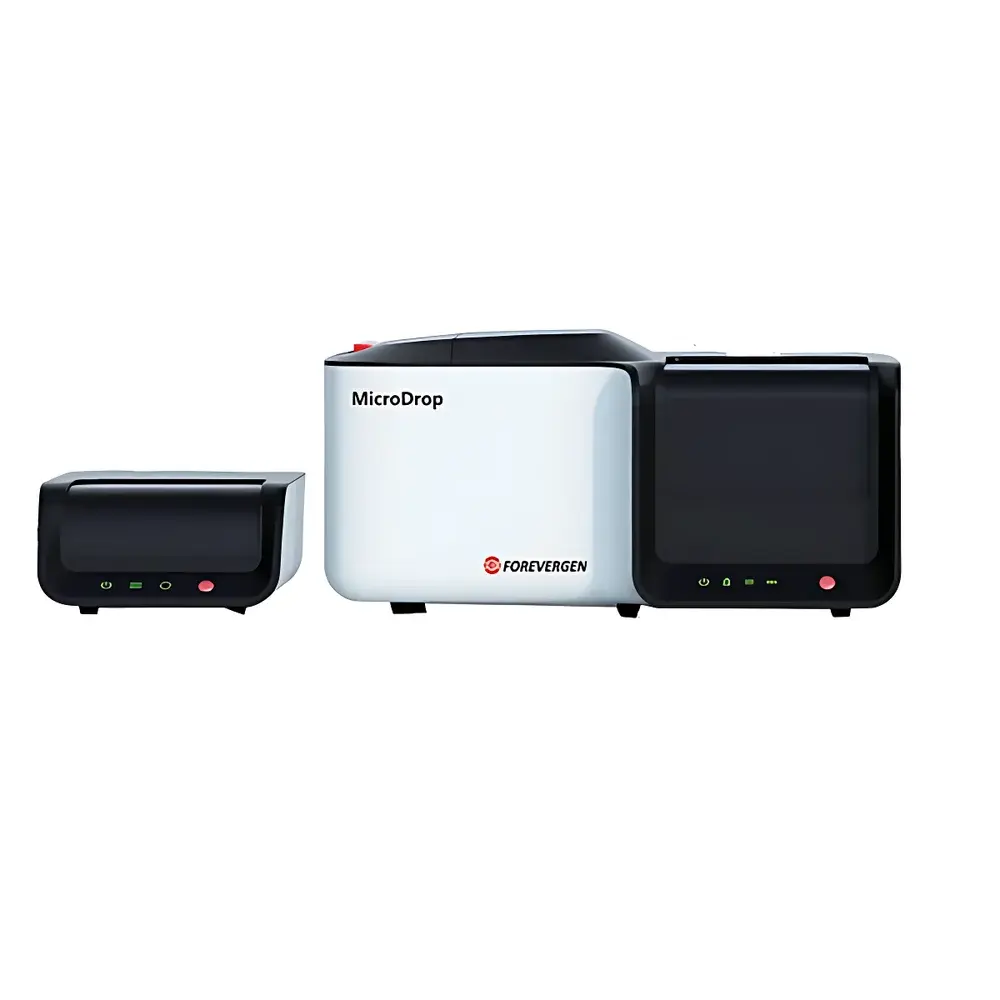
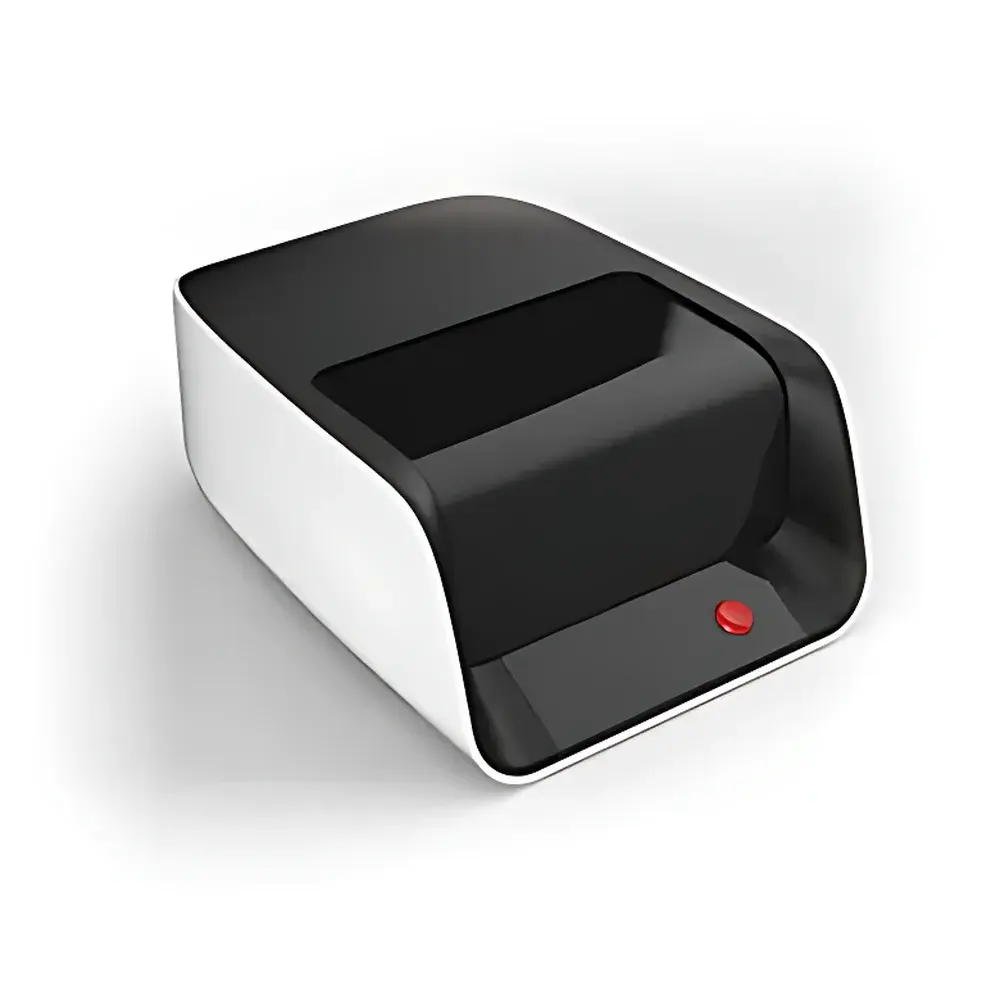
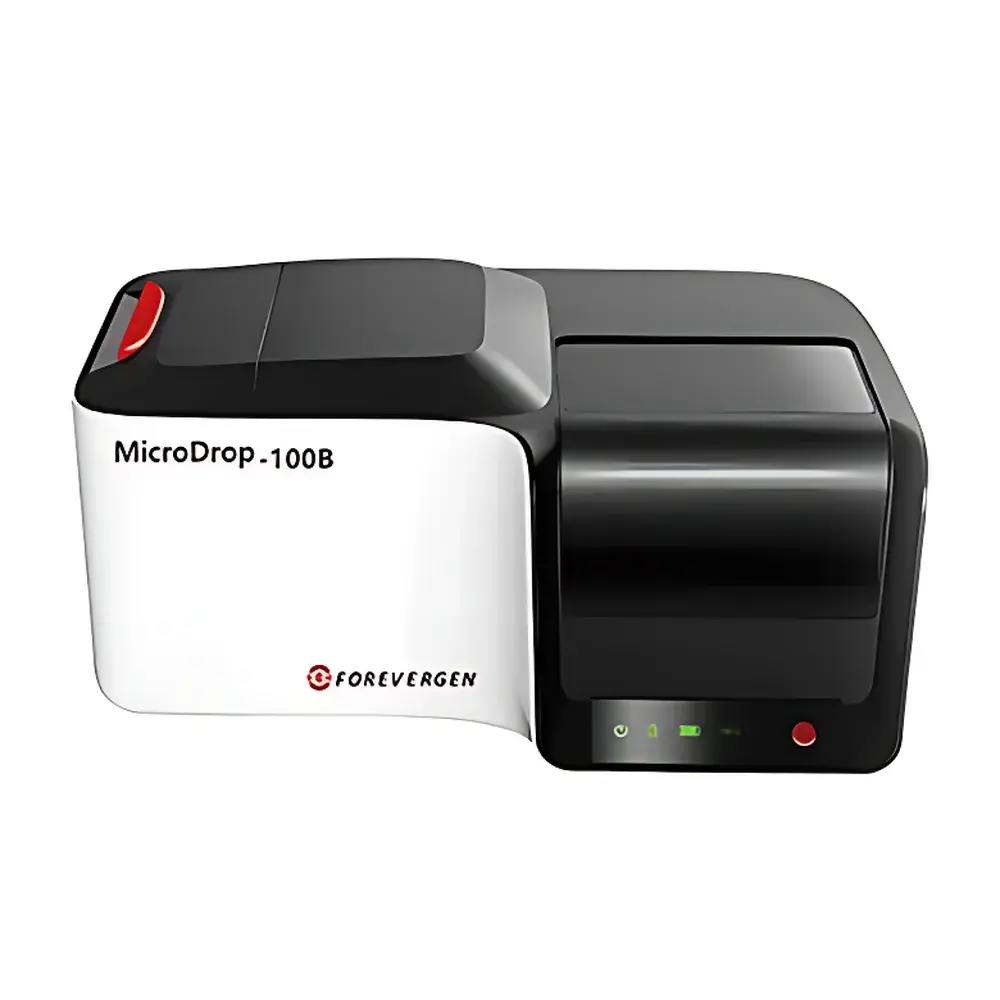
Forevergen MicroDrop-100 Droplet Digital PCR System
| Brand | Forevergen |
|---|---|
| Origin | Guangdong, China |
| Manufacturer Type | Authorized Distributor |
| Country of Origin | China |
| Model | MicroDrop-100 |
| Instrument Type | Droplet Digital PCR System |
| Sample Volume | 20 µL |
| Microdroplets per Reaction | 100,000 |
| Droplet Generation Time | 2 min/chip |
| Throughput (Prep) | 1–8 samples/chip |
| Throughput (Detection) | 1–96 samples/run |
| Linear Dynamic Range | 6 logs |
| Sensitivity | 0.01% (1 in 10,000) |
| Detection Channels | FAM, HEX (VIC) |
| Dimensions (MicroDrop-100A) | 300 × 400 × 145 mm |
| Dimensions (MD Detector) | 700 × 500 × 325 mm |
| Software | QuantDrop Analysis Suite |
Overview
The Forevergen MicroDrop-100 Droplet Digital PCR System is a fully integrated, domestically developed digital PCR platform engineered for absolute nucleic acid quantification without reliance on standard curves or cycle threshold (Ct) values. Based on the principle of compartmentalized endpoint PCR amplification—where a 20 µL reaction mixture is partitioned into ~100,000 nanoliter-scale aqueous microdroplets within an oil phase—the system enables binary (positive/negative) fluorescence detection post-amplification. Quantification is derived from Poisson statistical modeling of positive droplet counts, yielding copy number concentration with high precision and low inter-run variability. Designed for compliance with ISO/IEC 17025–aligned laboratory practices and compatible with GLP/GMP-relevant data integrity requirements, the MicroDrop-100 supports traceable, auditable workflows essential for clinical assay development, regulatory submissions, and reference method validation.
Key Features
- Fully autonomous droplet generation: MicroDrop-100A prepares up to eight 20 µL samples per chip in ≤2 minutes, producing uniform 100,000 microdroplets per reaction with minimal manual intervention.
- High-fidelity dual-channel optical detection: MD Detector performs automated, closed-system fluorescence readout across FAM and HEX (VIC) channels, supporting both intercalating dyes (e.g., EvaGreen) and hydrolysis probe chemistries.
- Extended linear dynamic range: Capable of quantifying targets across six orders of magnitude (1–10⁶ copies/µL), with analytical sensitivity down to 0.01% mutant allele frequency—enabling robust rare-variant detection in cfDNA, FFPE, and other inhibitor-rich matrices.
- Open-platform architecture: Compatible with third-party master mixes, primers, and probes; validated for multiplex ddPCR assays using spectral unmixing algorithms embedded in QuantDrop software.
- End-to-end contamination control: Integrated sealed-chip workflow eliminates aerosol carryover; all fluidic paths are single-use and disposable, satisfying ISO 20387 biobanking and CLIA-level pre-analytical requirements.
Sample Compatibility & Compliance
The MicroDrop-100 accepts input nucleic acids from diverse sources including plasma, serum, whole blood, FFPE tissue lysates, cell culture supernatants, and environmental swabs. Its partitioning-based quantification strategy mitigates PCR inhibition effects commonly observed in complex biological matrices—making it suitable for direct analysis of crude extracts without extensive purification. The system complies with key international standards relevant to molecular diagnostics, including ISO 13485 (medical device quality management), ISO/IEC 17025 (testing laboratory competence), and supports audit-ready data handling per FDA 21 CFR Part 11 when configured with electronic signature-enabled QuantDrop software. All hardware components are CE-marked for in vitro diagnostic use (IVDR Class B pending), and assay protocols align with CNAS-accredited methods for GMO screening (GB/T 38519), pathogen detection (SN/T 1193), and tumor biomarker quantification (WS/T 640–2018).
Software & Data Management
QuantDrop Analysis Software provides a validated, Windows-based interface for instrument control, droplet classification, Poisson correction, copy number calculation, and statistical reporting. It includes built-in QC metrics (droplet count uniformity, fluorescence amplitude distribution, cluster separation index) and supports batch processing of up to 96 samples with customizable report templates (PDF, CSV, Excel). Audit trail functionality records user actions, parameter changes, and result exports with time stamps and operator IDs—ensuring compliance with GLP, GCP, and clinical laboratory accreditation frameworks. Raw FCS 3.0-compatible fluorescence data files are retained for reanalysis, and software updates follow a documented change control process compliant with ICH GCP E6(R3) Annex 11 expectations.
Applications
- Clinical Diagnostics: Liquid biopsy applications including early cancer detection (EGFR, KRAS, BRAF mutations), MRD monitoring post-treatment, non-invasive prenatal testing (NIPT) for fetal aneuploidy, and quantitative viral load assessment (HBV DNA, HIV RNA).
- Food & Agricultural Safety: Certified detection of genetically modified organisms (GMOs) per GB/T 38519–2020; species identification in meat products; and pathogen quantification (Salmonella, Listeria monocytogenes) in food matrices.
- Life Science Research: CRISPR editing efficiency validation, single-cell gene expression profiling, DNA methylation quantification via methylation-specific ddPCR, and low-abundance transcript detection in heterogeneous tissues.
- Public Health & Border Control: High-sensitivity pathogen surveillance in wastewater, rapid quarantine screening for emerging viruses, and zoonotic agent identification in animal-derived imports.
FAQ
What is the minimum required DNA input for reliable quantification?
For most applications, ≥1 ng of high-quality genomic DNA or ≥100 copies of target template is recommended. Lower inputs are feasible with optimized library prep and probe design.
Can the system perform multiplex ddPCR with more than two targets?
Yes—QuantDrop supports spectral unmixing of ≥3 fluorophores when used with compatible dyes (e.g., FAM, HEX, Cy5) and appropriate optical filters.
Is the MicroDrop-100 compatible with existing qPCR assay designs?
Most TaqMan probe-based qPCR assays can be directly adapted; primer/probe concentrations may require empirical optimization due to endpoint vs. real-time detection differences.
Does the system meet regulatory requirements for clinical laboratory use?
The platform supports validation documentation packages aligned with CLIA, CAP, and ISO 15189 requirements; full IVDR certification is underway.
How is data security and traceability ensured during analysis?
QuantDrop enforces role-based access control, encrypted local storage, immutable audit logs, and export controls compliant with HIPAA and GDPR data handling principles.
Related Products