
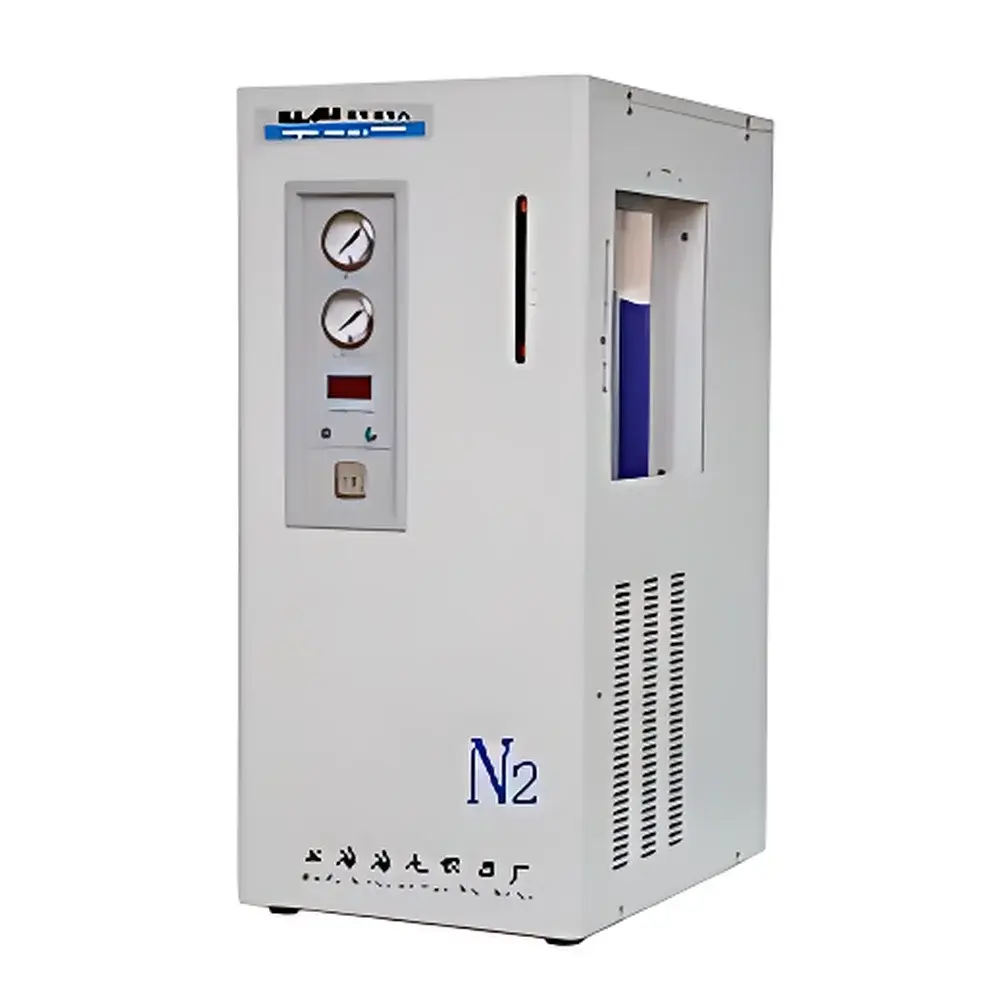
HLN-10LG Nitrogen Generator by Hualan (Shanghai)
| Origin | Shanghai, China |
|---|---|
| Manufacturer Type | Authorized Distributor |
| Origin Category | Domestic (PRC) |
| Model | HLN-10LG |
| Pricing | Available Upon Request |
| Purity | >95.995% N₂ |
| Flow Rate | 0–10 L/min |
| Output Pressure | 0–0.5 MPa (factory-set at 0.4 MPa) |
| Power Supply | 220 V ±10%, 50 Hz ±5% |
| Max. Power Consumption | 80 W |
| Operating Environment | 10–40 °C, ≤85% RH |
| Warranty | 1-year system warranty |
Overview
The HLN-10LG Nitrogen Generator is a compact, membrane-based gas separation system engineered for continuous on-site nitrogen production from compressed air. It operates on the principle of selective permeation—leveraging differences in gas solubility and diffusivity across polymeric hollow-fiber membranes. Under a controlled pressure differential across the membrane, fast-permeating gases—including water vapor, CO₂, O₂, and trace hydrocarbons—rapidly migrate through the fiber walls and are vented as permeate, while slower-permeating nitrogen molecules remain in the retentate stream. This physical separation mechanism requires no consumables, chemical reagents, or cryogenic cooling, delivering a stable, dry nitrogen stream with purity exceeding 95.995% (v/v) at nominal flow conditions. Designed for integration into analytical laboratories, QC environments, and small-scale industrial processes, the HLN-10LG eliminates dependency on high-pressure nitrogen cylinders—reducing logistical overhead, safety risks associated with cylinder handling, and long-term operational costs.
Key Features
- Membrane-Based Separation Architecture: Utilizes proprietary asymmetric hollow-fiber membranes with optimized selectivity for O₂/N₂ and H₂O/N₂ pairs, ensuring consistent performance without moving parts or regeneration cycles.
- Scalable Modular Design: Supports incremental capacity expansion via parallel membrane module integration—enabling seamless adaptation to evolving gas demand without system replacement.
- Compact Footprint & Plug-and-Play Operation: Occupies less than 0.15 m² floor space; requires only a clean, oil-free compressed air feed (dew point ≤ −40 °C), standard AC power, and minimal operator training.
- Stable Pressure & Flow Control: Integrated back-pressure regulator maintains constant output pressure up to 0.5 MPa (adjustable); digital flowmeter enables precise real-time monitoring within ±2% full-scale accuracy.
- Low Energy Consumption: Rated at ≤80 W under continuous operation—significantly lower than PSA-based alternatives of comparable output—supporting sustainability goals and reducing thermal load in temperature-sensitive lab spaces.
- Robust Environmental Tolerance: Certified for reliable operation across ambient temperatures from 10 to 40 °C and relative humidity ≤85%, with integrated coalescing pre-filtration to protect membrane integrity against particulate and aerosol ingress.
Sample Compatibility & Compliance
The HLN-10LG delivers nitrogen suitable for a broad range of non-critical and semi-critical applications where ultra-high purity (<99.999%) is not mandated. Its output meets ASTM D6866-22 requirements for carbon-free carrier gas in elemental analyzers and satisfies ISO 8573-1:2010 Class 4/4/2 air quality specifications when paired with appropriate upstream filtration. While not certified for medical-grade or semiconductor-grade use, it complies with general laboratory safety standards (IEC 61010-1) and supports GLP-compliant workflows through traceable operating parameters and documented maintenance intervals. The unit does not require FDA 21 CFR Part 11 compliance out-of-the-box but can be validated per internal SOPs for regulated QC/QA environments.
Software & Data Management
The HLN-10LG operates as a standalone analog-controlled instrument with no embedded microprocessor or digital interface. All operational parameters—including inlet pressure, outlet pressure, and flow rate—are monitored via calibrated mechanical gauges and a visual-flow indicator. For laboratories requiring audit-ready records, optional analog signal outputs (0–5 V or 4–20 mA) are available for integration with building management systems (BMS) or SCADA platforms. Users may log operational data manually or via external data acquisition hardware; maintenance history—including filter replacement dates and membrane service intervals—is tracked using the included logbook template aligned with ISO/IEC 17025 documentation practices.
Applications
- Carrier and purge gas for GC, GC-MS, and TOC analyzers where oxygen interference must be minimized but <99.999% purity is unnecessary.
- Blanketing and inerting during sample preparation, solvent evaporation, and reagent storage in pharmaceutical and chemical labs.
- Instrument air supply for FTIR, UV-Vis, and atomic absorption spectrometers requiring low-moisture, particle-free nitrogen.
- Process gas for small-scale packaging line validation, leak testing, and soldering atmospheres in R&D settings.
- Backup nitrogen source during cylinder shortages or delivery delays—ensuring continuity of critical assays and calibration procedures.
FAQ
What compressed air quality is required for optimal membrane performance?
Oil-free, desiccated air with a dew point ≤ −40 °C and particulate filtration to ≤0.01 µm is strongly recommended. A two-stage coalescing + adsorption dryer is advised upstream of the generator.
Can the HLN-10LG produce nitrogen at purities above 99%?
No—membrane technology inherently trades purity for flow rate. At >99% N₂, output flow drops significantly due to exponential decline in permeation selectivity; this model is optimized for the 95.995–99% range at rated 10 L/min.
Is the membrane module replaceable in the field?
Yes—the hollow-fiber membrane cartridge is a user-serviceable component with standardized mounting. Replacement requires no specialized tools and can be completed in under 15 minutes following the provided torque-spec procedure.
Does the unit include an oxygen analyzer for real-time purity verification?
No—oxygen content is inferred from design-calibrated flow/pressure curves. Optional OEM-integrated electrochemical O₂ sensors (0–1000 ppm range) are available as a factory-installed upgrade.
How does ambient temperature affect output stability?
Within the specified 10–40 °C range, thermal drift in flow and purity is <±0.3% per 10 °C change; outside this range, membrane permeability shifts may cause measurable deviation in both parameters.



