
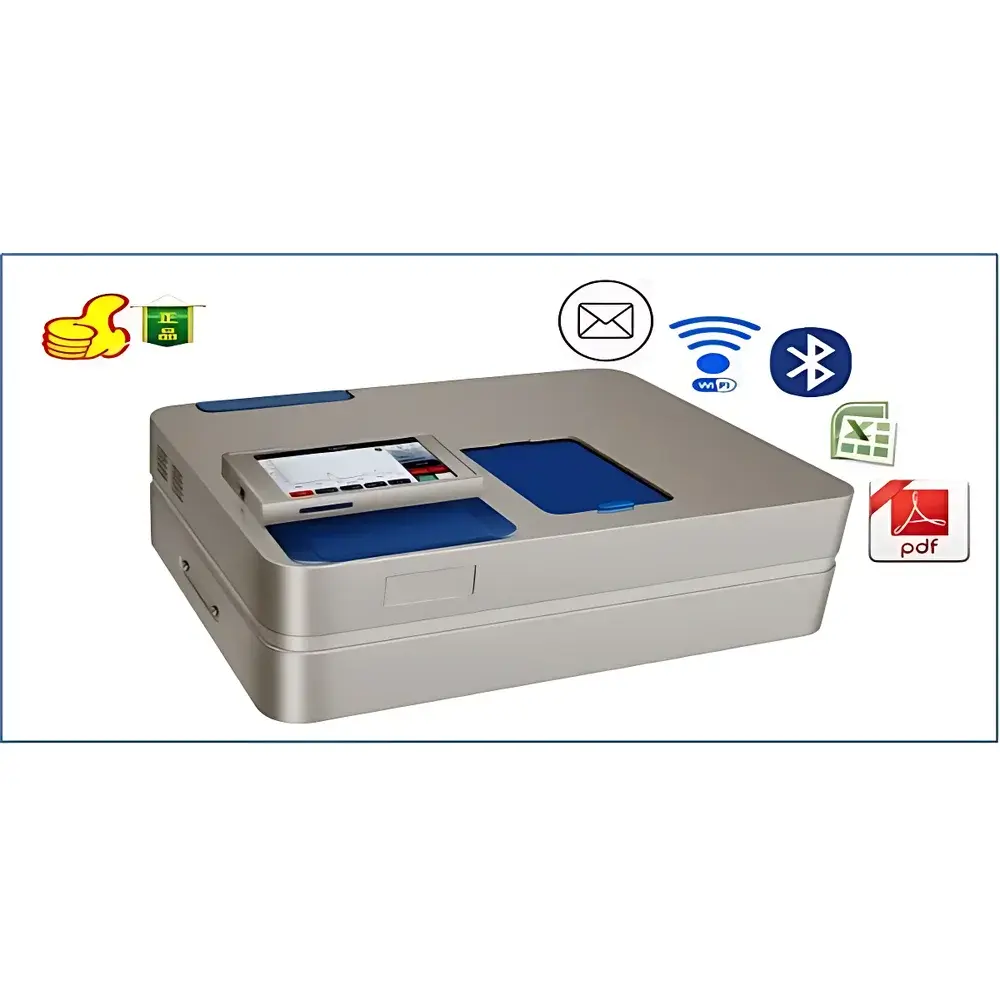
Hailong TU-1901AS Advanced Dual-Beam Ultraviolet-Visible Spectrophotometer
| Brand | Hailong |
|---|---|
| Origin | Shanghai, China |
| Model | TU-1901AS / TU-1901B / TU-1901plus / TU-1901S / TU-1901 |
| Optical System | Dual-beam |
| Detector | Photomultiplier Tube (PMT) |
| Wavelength Range | 190–1100 nm |
| Spectral Bandwidth | 0.1–5 nm (model-dependent) |
| Wavelength Accuracy | ±0.1 nm (@ 656.1 nm D₂ line), ±0.3 nm (full range) |
| Stray Light | ≤0.02% T (at 220 nm with NaI |
| Photometric Accuracy | ±0.002 A (0–0.5 A), ±0.3% T (0–100% T) |
| Photometric Repeatability | ±0.001 A (0–0.5 A), ±0.15% T (0–100% T) |
| Baseline Flatness | ±0.0005 A |
| Baseline Drift | ±0.0005 A/h |
| Noise | ±0.0003 A (500 nm, 0 A, 2 nm bandwidth) |
| Display | 8-inch true-color capacitive touchscreen |
| Data Output | USB 3.0 ×3, Ethernet, Wi-Fi, Bluetooth, Email/PDF/Excel export |
Overview
The Hailong TU-1901AS is an advanced dual-beam ultraviolet-visible (UV-Vis) spectrophotometer engineered for high-precision quantitative and qualitative analysis in regulated and research laboratory environments. Based on the fundamental principle of Beer–Lambert law absorption spectroscopy, the instrument measures sample transmittance (T%), absorbance (A), and concentration (C) across a broad spectral range from 190 nm to 1100 nm. Its dual-beam optical architecture continuously compares sample and reference beam intensities in real time, effectively compensating for source fluctuation, detector drift, and environmental variability—ensuring superior photometric stability and long-term measurement reproducibility. The system integrates a high-efficiency 1600 lines/mm holographic grating, a precision Czerny–Turner monochromator with 350 mm focal length, and a thermally stabilized imported photomultiplier tube (PMT) detector to deliver low-noise, high-sensitivity detection down to ±0.0003 A RMS noise. Designed for compliance-critical workflows, the TU-1901AS supports GLP (Good Laboratory Practice) self-validation protocols for wavelength and photometric accuracy verification, generating auditable calibration reports traceable to NIST-traceable standards.
Key Features
- Dual-beam optical path with real-time background correction and automatic baseline compensation
- Modular lamp design: externally replaceable deuterium and tungsten-halogen lamps with auto-optical alignment—no internal recalibration or mechanical adjustment required
- Imported ozone-reduced deuterium lamp and OSRAM long-life tungsten lamp with intelligent lamp-hour monitoring and predictive lifetime logging
- 8-inch capacitive touchscreen interface with multilingual support (English/Chinese), intuitive icon-driven navigation, and embedded method library management
- Variable slit bandwidth selection (0.1–5 nm, model-dependent) enabling optimization of resolution vs. signal-to-noise ratio for diverse sample types
- Large sample compartment accommodating cuvettes from 5 mm to 100 mm pathlength, including microvolume adapters and solid-sample holders (optional)
- Integrated connectivity suite: triple USB 3.0 ports, 10/100 Mbps Ethernet, IEEE 802.11 b/g/n Wi-Fi, and Bluetooth 4.2 for secure wireless data transfer and remote diagnostics
- Onboard data export in native PDF, Excel (.xlsx), and CSV formats—direct email transmission supported via SMTP configuration
Sample Compatibility & Compliance
The TU-1901AS accommodates liquid, suspension, and thin-film samples using standard quartz, fused silica, or UV-grade glass cuvettes. Its wide 190–1100 nm spectral coverage enables applications ranging from nucleic acid quantification (260 nm) and protein assay (280 nm) to colorimetric enzyme kinetics (405–630 nm) and near-IR material characterization (up to 1100 nm). Instrument performance conforms to key international standards including ASTM E275 (spectrophotometer terminology), ISO 9001 (quality management), and USP (UV-Vis spectrophotometry). The GLP self-diagnostic function allows users to perform routine wavelength accuracy checks (using holmium oxide or didymium filters) and photometric linearity validation per ICH Q2(R2) guidelines. Audit trail functionality—including operator ID, timestamped method execution, and raw data versioning—is configurable to meet FDA 21 CFR Part 11 requirements when paired with compliant LIMS or ELN software.
Software & Data Management
The embedded firmware supports full spectral scanning, kinetic assays, multi-wavelength quantitation, and derivative spectroscopy. Data acquisition and processing are performed in real time with adjustable scan speed (high/medium/low, up to 4100 nm/min), smoothing algorithms, and peak detection. All spectra and results are stored locally on internal flash memory (≥8 GB) and simultaneously mirrored to connected USB drives. Exported files include metadata such as instrument ID, lamp usage hours, calibration date, and user-defined annotations—ensuring full traceability. The system supports seamless integration with third-party laboratory informatics platforms via HL7, ASTM E1384, or custom API endpoints. Firmware updates are delivered over-the-air via encrypted HTTPS, preserving data integrity and regulatory compliance throughout the instrument lifecycle.
Applications
- Pharmaceutical QC: Assay of active pharmaceutical ingredients (APIs), dissolution testing, excipient compatibility studies
- Clinical chemistry: Serum bilirubin, creatinine, uric acid, and enzymatic activity assays (e.g., ALT, AST, ALP)
- Environmental analysis: Nitrate, phosphate, heavy metal chelates (e.g., Fe-phenanthroline), and organic pollutant screening
- Materials science: Bandgap determination of semiconductors, nanoparticle surface plasmon resonance, thin-film thickness calculation
- Academic research: Ligand-binding kinetics, DNA melting temperature (Tm) profiling, redox reaction monitoring
- Food & beverage: Color index (CIE L*a*b*), antioxidant capacity (FRAP/DPPH), preservative quantification (sorbates, benzoates)
FAQ
Does the TU-1901AS support 21 CFR Part 11-compliant electronic signatures?
Yes—when deployed with validated third-party ELN/LIMS software and configured with role-based access control, audit trail logging, and digital signature modules, the instrument meets core technical requirements of 21 CFR Part 11.
Can the instrument be operated without a PC?
Yes—the built-in touchscreen interface provides full standalone operation for all measurement modes, data review, report generation, and system diagnostics.
What is the typical lamp lifetime under standard operating conditions?
Deuterium lamp: ≥2000 hours; Tungsten-halogen lamp: ≥5000 hours. Real-time lamp-hour tracking is displayed and logged automatically.
Is the optical path purged for UV measurements below 200 nm?
No external purge is required—the sealed optical bench and high-transmission quartz optics enable stable operation down to 190 nm in ambient air; optional nitrogen purge accessory available for extended UV stability.
How frequently should wavelength calibration be performed?
Per GLP best practices: before each analytical session for critical applications; at minimum daily for routine QC; verified using certified holmium oxide reference filters traceable to NIST SRM 2034.
Related Products





