
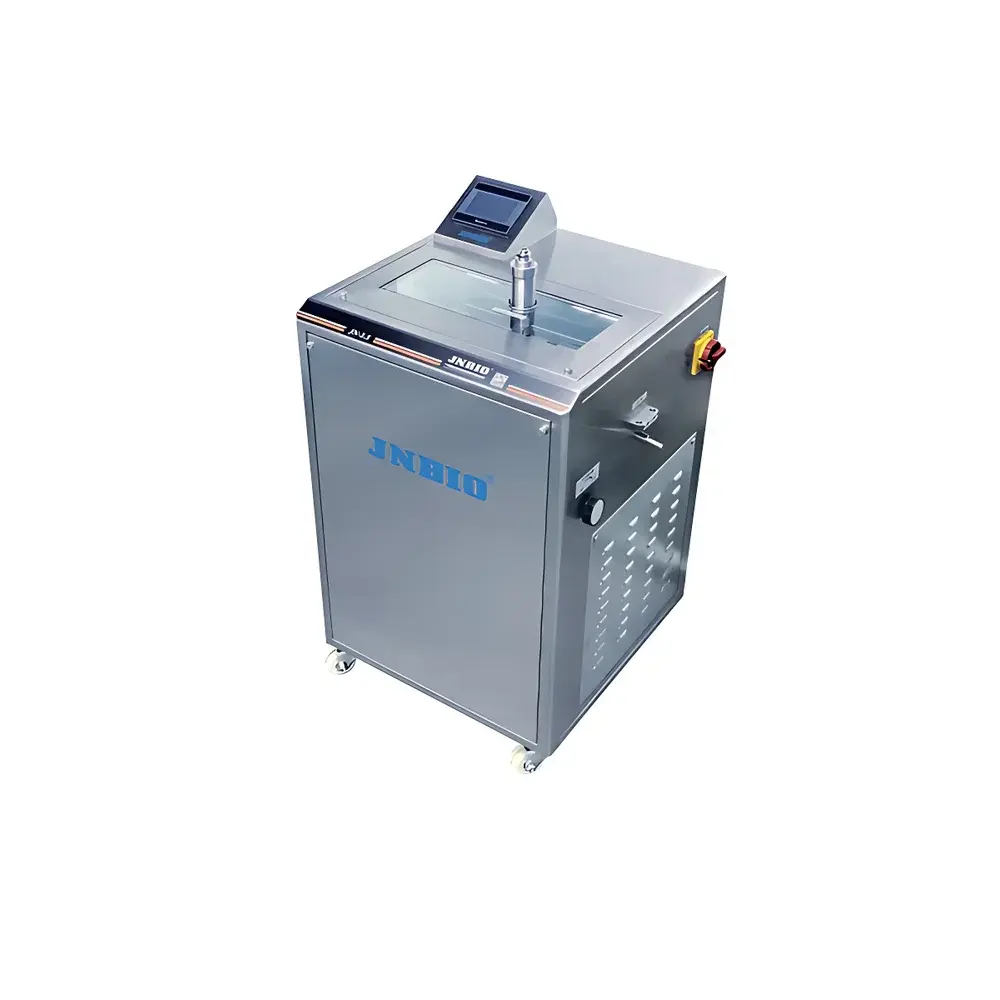
JNBIO JN-2.5C Low-Temperature Ultra-High-Pressure Continuous-Flow Cell Disruptor
| Brand | JNBIO (Guangzhou JNBIO) |
|---|---|
| Origin | Guangdong, China |
| Manufacturer Type | Authorized Distributor |
| Product Category | Domestic |
| Model | JN-2.5C |
| Instrument Type | High-Pressure Homogenizer / Cell Disruptor |
| Operating Pressure Range | 0–207 MPa (0–2070 bar) |
| Maximum Flow Rate at Max Pressure | 2.5 L/h (42 mL/min) |
| Minimum Sample Volume | 5 mL |
| Power Supply | 220 V AC |
| Main Motor | 1.5 kW, Refrigeration Compressor: 0.75 kW |
| Integrated Chilled Circulation Bath | Maintains sample path at 4–6 °C throughout feed, homogenization, and discharge stages |
| Dimensions (mm) | Host Unit: W560 × D580 × H872 |
| Chiller Unit | W525 × D635 × H870 |
| Net Weight | Host ~148 kg, Chiller ~148 kg |
| Construction | Mirror-Polished 316L Stainless Steel Fluid Path |
| Valve Material | Industrial-Grade Diamond-Coated Homogenization Valve |
| Control System | PLC-Based with 7-inch Touchscreen HMI |
| Data Logging | Real-time pressure curve, operational logs (7-day retention), alarm history (7-day retention), user-accessible audit trail |
| Compliance Features | CIP/SIP Capable, GMP-Aligned Operation Log & User Authentication, Emergency Stop, Pressure Overload Protection, Password-Protected Access Levels |
Overview
The JNBIO JN-2.5C is an ultra-high-pressure continuous-flow cell disruptor engineered for reproducible, low-temperature lysis of microbial, mammalian, and plant cells under strictly controlled thermal and mechanical conditions. It operates on the principle of microfluidic shear and cavitation-induced disruption: pressurized sample slurry is accelerated through a precisely engineered diamond-coated homogenization valve, generating intense hydrodynamic forces—including turbulent eddies, localized pressure differentials, and transient cavitation bubbles—that rupture cellular membranes while preserving subcellular integrity and biomolecular activity. Unlike piston-driven or pneumatic systems, the JN-2.5C employs a closed-loop hydraulic drive system that maintains constant pressure during operation, enabling seamless start/stop cycles without pressure decay—critical for multi-batch processing and process development workflows in structural biology and biopharmaceutical upstream processing.
Key Features
- Ultra-stable hydraulic powertrain delivering consistent 0–207 MPa (0–2070 bar) pressure across full flow range (up to 2.5 L/h at maximum pressure)
- Integrated refrigerated circulation system maintaining the entire fluid path—including inlet tubing, homogenization chamber, and outlet manifold—at 4–6 °C continuously, eliminating thermal denaturation and enabling >4-hour uninterrupted operation
- Minimal dead volume design: 5 mL minimum sample requirement with <1 mL residual volume, optimized for precious research-grade samples
- Diamond-coated homogenization valve offering >50× longer service life versus ceramic or tungsten carbide alternatives, ensuring stable particle size distribution and minimizing metallic leaching
- Metal-to-metal sealing architecture (316L stainless steel) eliminates elastomeric O-rings from high-pressure zones—removing a primary source of particulate contamination and routine maintenance downtime
- Patented negative-pressure priming system enables rapid, bubble-free loading of up to several hundred milliliters without manual venting; automated recirculation mode supports iterative lysis optimization
- Full CIP (Clean-in-Place) and SIP (Steam-in-Place) compatibility via mirror-polished 316L stainless steel wetted surfaces and autoclavable valve assemblies
- PLC-controlled touchscreen interface (7-inch HMI) with real-time pressure waveform visualization, configurable user access levels, and encrypted 7-day operational log storage aligned with FDA 21 CFR Part 11 data integrity expectations
Sample Compatibility & Compliance
The JN-2.5C accommodates a broad spectrum of biological matrices—including Gram-negative and Gram-positive bacteria (e.g., E. coli, Bacillus subtilis), yeast (S. cerevisiae, P. pastoris), insect and mammalian suspension cells, and plant protoplasts—without requiring pre-lysis enzymatic treatment. Its low-temperature, high-shear mechanism minimizes protease activation and nucleic acid shearing, supporting downstream applications in protein purification, inclusion body recovery, metabolite extraction, and viral vector production. The system conforms to ISO 22442 (biological safety of medical devices), ASTM F2391 (sterilization validation), and supports GLP/GMP documentation requirements through time-stamped, password-protected audit trails, alarm event logging, and electronic signature-ready operation records.
Software & Data Management
The embedded control firmware provides deterministic real-time monitoring of critical parameters: system pressure, homogenization pressure, coolant temperature, motor current draw, and cycle count. All operational events—including manual interventions, pressure setpoint changes, alarm triggers, and emergency stops—are timestamped and stored locally on non-volatile memory with automatic 7-day rollover. Exportable CSV logs include pressure vs. time profiles, enabling correlation with post-lysis assay results (e.g., SDS-PAGE band intensity, enzyme activity assays). Optional Ethernet connectivity supports integration into laboratory information management systems (LIMS) for centralized device monitoring and compliance reporting.
Applications
- High-yield extraction of intracellular proteins and enzymes from recombinant microbial hosts
- Preparation of native membrane protein complexes for cryo-EM and X-ray crystallography
- Production of subcellular fractions (e.g., organelles, ribosomes) with minimal cross-contamination
- Disruption of tough-walled organisms (e.g., Mycobacterium, fungal hyphae) without chemical or enzymatic pretreatment
- Process development and scale-down modeling for industrial homogenization processes compliant with ICH Q5A and Q5D guidelines
- Routine QC lysis in biomanufacturing environments where batch traceability and equipment qualification are mandated
FAQ
What is the maximum recommended operating duration before maintenance?
With continuous chilled operation at 4–6 °C, the JN-2.5C supports uninterrupted runs exceeding 4 hours; routine inspection of valve wear and coolant level is advised after every 50 operating hours.
Is the system compatible with sterile processing environments?
Yes—the fully drainable 316L stainless steel fluid path, SIP-capable design, and absence of non-metallic seals enable validation per ASME BPE and EU Annex 1 requirements.
Can pressure be adjusted dynamically during a run?
Yes—pressure setpoints can be modified in real time via touchscreen interface without interrupting flow or compromising system stability, facilitating gradient lysis protocols.
Does the system meet regulatory requirements for pharmaceutical manufacturing?
It supports GMP-aligned operation through electronic audit trails, user authentication, alarm logging, and data retention policies consistent with FDA 21 CFR Part 11 and EU GMP Annex 11 expectations.
What validation documentation is provided?
Factory calibration certificates (pressure transducers, temperature sensors), IQ/OQ protocol templates, and material traceability reports for all wetted components are supplied with each unit.
Related Products



