
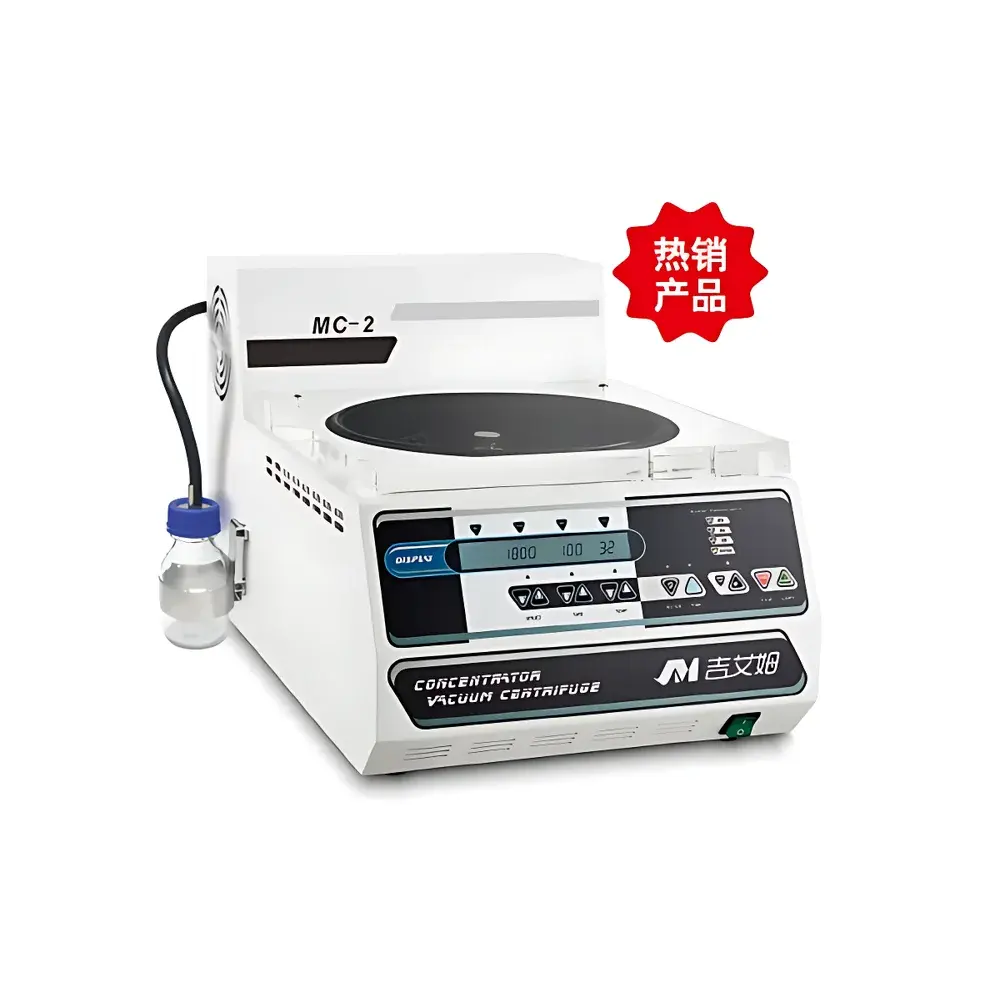
GiAim MC-2 Integrated Vacuum Centrifugal Concentrator
| Brand | GiAim |
|---|---|
| Origin | Beijing, China |
| Manufacturer Type | Authorized Distributor |
| Country of Origin | China |
| Model | MC-2 |
| Instrument Type | Vacuum Centrifugal Concentrator |
| Temperature Range | Ambient +5°C to 70°C |
| Rotational Speed | 300–1800 rpm |
| Max Relative Centrifugal Force (RCF) | 390 × g |
| Timer Range | 0–9999 min |
| Vacuum Pump Flow Rate | 28 L/min |
| Ultimate Vacuum | <13 mbar |
| Noise Level | ≤60 dB(A) |
| Total Power Consumption | 750 W |
| Dimensions (L×D×H) | 578×360×353 mm |
| Weight | 38 kg |
| Chamber Coating | PTFE (Teflon®)-coated |
| Tubing Material | PTFE |
| Control Interface | One-touch Start/Stop |
| Safety Features | Automatic Venting on Power Loss, Nitrogen Purge Capability with Inlet Filter |
Overview
The GiAim MC-2 Integrated Vacuum Centrifugal Concentrator is an engineered solution for rapid, gentle, and reproducible concentration and drying of low-volume biological and chemical samples under reduced pressure. It combines vacuum evaporation with controlled centrifugation—leveraging the principle of vapor pressure depression and rotational force—to prevent sample splattering, foaming, or thermal degradation during solvent removal. Unlike standalone vacuum pumps or non-centrifugal dryers, the MC-2 integrates a corrosion-resistant diaphragm vacuum pump directly into the instrument chassis, eliminating external tubing, manifold complexity, and footprint inefficiency. Its operational envelope spans ambient +5°C to 70°C, enabling precise thermal management for heat-sensitive analytes including nucleic acids, proteins, metabolites, and small-molecule pharmaceuticals. Designed for compliance-driven environments, the system supports traceable, repeatable workflows compatible with GLP and GMP-aligned laboratory practices.
Key Features
- Integrated high-flow corrosion-resistant diaphragm pump (28 L/min), eliminating external vacuum sources and reducing system footprint by >40% versus modular configurations.
- PTFE-coated centrifuge chamber and fully PTFE fluid path components ensure long-term resistance to aggressive solvents (e.g., ethanol, acetone, acetonitrile, chloroform) and acidic/basic vapors.
- Electromagnetic drive system with brushless AC frequency-controlled motor delivers silent operation (≤60 dB[A]) and zero maintenance over extended service intervals.
- Four preset temperature shortcuts (Room Temp, 30°C, 45°C, 60°C) enable rapid method selection without manual setpoint entry—reducing operator error and improving inter-user consistency.
- Adjustable rotational speed (300–1800 rpm) allows optimization of RCF (up to 390 × g) to balance evaporation rate against sample integrity—critical for viscous or foam-prone matrices.
- Automatic venting upon power interruption prevents vacuum collapse-induced sample rehydration or cross-contamination; optional nitrogen purge inlet with particulate/chemical filter supports inert-atmosphere processing.
Sample Compatibility & Compliance
The MC-2 accommodates standard microcentrifuge tubes (0.2–50 mL), PCR strips, deep-well plates, and custom rotors (optional). It is routinely deployed in nucleic acid purification workflows—including post-PCR cleanup, cDNA labeling, and microarray sample preparation—as well as in pre-analytical processing for LC-MS, NMR, and enzymatic assays. The PTFE-based wetted materials meet USP Class VI biocompatibility requirements, and the sealed chamber design complies with ISO 15195:2018 recommendations for containment of volatile organic compounds. While not certified to IEC 61010-1 Annex BB for hazardous area use, the system incorporates dual redundant safety interlocks (lid sensor + vacuum threshold monitoring) and conforms to CE marking directives for laboratory equipment (2014/30/EU EMC, 2014/35/EU LVD).
Software & Data Management
The MC-2 operates via an embedded microcontroller interface with real-time display of vacuum level, temperature, speed, and elapsed time. All parameters are stored locally with timestamped logs (non-volatile memory, 10,000-cycle retention). Though no PC connectivity is built-in, the timer and thermal profiles support audit-ready documentation per FDA 21 CFR Part 11 when paired with external lab information management systems (LIMS) via manual log export. Optional RS-232 or USB-to-serial adapters enable integration into automated platforms requiring TTL-level trigger signals for start/stop synchronization.
Applications
- DNA/RNA concentration and buffer exchange prior to electrophoresis, sequencing library prep, or microinjection.
- Removal of volatile labeling reagents (e.g., Cy3/Cy5 NHS esters, Alexa Fluor dyes) from cDNA after reverse transcription.
- Drying of aqueous PCR products for downstream lyophilization or storage at –20°C.
- Concentration of dilute protein solutions (e.g., immunoprecipitates, affinity-purified enzymes) without denaturation.
- Desalting and solvent exchange of synthetic oligonucleotides, peptides, and metabolite standards prior to mass spectrometry analysis.
- Preparative-scale concentration of natural product extracts in phytochemistry and pharmacognosy labs.
FAQ
Does the MC-2 support remote monitoring or Ethernet connectivity?
No—the MC-2 uses a standalone control panel with local parameter logging only. Networked data export requires external serial-to-USB conversion and third-party scripting.
Can the instrument handle chlorinated solvents such as chloroform or DCM?
Yes—its PTFE-coated chamber and all-fluid-path PTFE tubing provide full compatibility with halogenated organics, provided vacuum pump oil (if used in auxiliary systems) is chemically resistant.
Is rotor balancing required before each run?
Yes—while the electromagnetic drive minimizes vibration, proper tube/plate symmetry remains essential to maintain RCF accuracy and prevent premature bearing wear.
What maintenance intervals are recommended for the integrated vacuum pump?
The diaphragm pump requires no routine oil changes; however, inlet filter replacement is advised every 6 months under continuous use, and pump membrane inspection is recommended annually.
Does the MC-2 comply with ISO/IEC 17025 calibration requirements?
The unit does not include factory-calibrated traceable sensors, but temperature and vacuum outputs can be verified using NIST-traceable handheld probes per ISO/IEC 17025 Section 6.4.1.



