
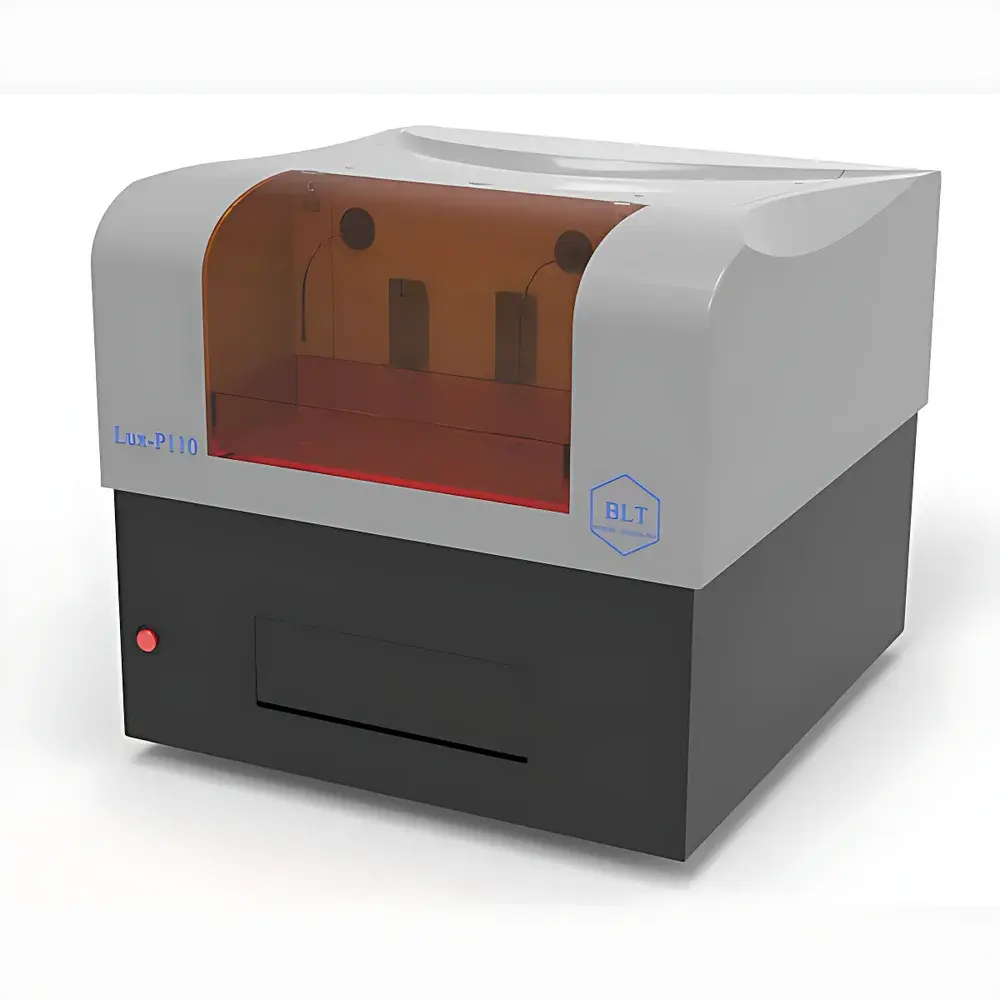
BioLight Lux-P110 High-Sensitivity Microplate Luminometer
| Brand | BioLight |
|---|---|
| Model | Lux-P110 |
| Detection Principle | Photon counting via cooled photomultiplier tube (PMT) |
| Dynamic Range | ≥ 7 decades (typical for high-end luminometers) |
| Sensitivity | ≤ 10 amol ATP (firefly luciferase assay, 96-well plate) |
| Read Modes | Flash & Glow luminescence |
| Plate Formats | 6–1536-well microplates |
| Temperature Control | Ambient to 45 °C (±0.5 °C uniformity) |
| Integrated Injector | Dual-channel, programmable, in-situ dispensing |
| Shaking | Tri-mode (linear, orbital, circular) with six speed settings (200–1200 rpm) |
| Detector | Thermoelectrically cooled PMT (−20 °C operating temperature) |
| Software | LuxWin v5.x with FDA 21 CFR Part 11-compliant audit trail, GLP/GMP reporting templates, and kinetic/endpoint/multiple-injection protocols |
| Compliance | ISO/IEC 17025-aligned validation support, ASTM E2578-21 referenced for luminometer performance verification |
| Data Export | CSV, XML, PDF, Excel-compatible formats |
Overview
The BioLight Lux-P110 High-Sensitivity Microplate Luminometer is an engineered solution for quantitative detection of chemiluminescent and bioluminescent signals across life science research, pharmaceutical development, and clinical assay laboratories. Utilizing a thermoelectrically cooled photomultiplier tube (PMT) operating at −20 °C, the instrument achieves sub-attomole sensitivity by minimizing thermal noise and maximizing photon capture efficiency. Its optical architecture employs a low-stray-light path design with precision aperture control and reflective shielding—reducing spatial crosstalk between adjacent wells and enabling reliable detection in high-density formats (up to 1536-well). The Lux-P110 supports both flash-type (e.g., firefly luciferase) and glow-type (e.g., Renilla luciferase, alkaline phosphatase–AMPPD) reactions with programmable integration times ranging from 0.1 ms to 10 s per well. Designed for reproducibility in regulated environments, it meets foundational requirements for method validation under ISO/IEC 17025 and aligns with ASTM E2578-21 guidelines for luminometer performance assessment.
Key Features
- Cooled PMT detector (−20 °C) delivering stable gain and low dark current for consistent signal-to-noise ratios across extended run times
- Integrated dual-channel auto-injector with precise 5–200 µL dispensing volume control, enabling synchronized reagent addition and measurement initiation
- Microplate temperature regulation from ambient to 45 °C (±0.5 °C), supporting enzyme kinetics, cell-based assays, and thermosensitive reporter systems
- Tri-mode shaker (linear, orbital, circular) with six programmable speeds (200–1200 rpm) ensures homogeneous mixing without splashing or edge effects
- Optimized light-tight chamber with active vibration damping and electromagnetic shielding to suppress environmental interference
- Modular firmware architecture allowing field-upgradable protocols and compatibility with third-party liquid handlers via RS232/USB/Ethernet interfaces
Sample Compatibility & Compliance
The Lux-P110 accommodates standard ANSI/SBS-compliant microplates (6–1536-well), including white opaque, black, and clear-bottom plates optimized for luminescence detection. It supports assays requiring coelenterazine, D-luciferin, AMPPD, LumiPhos, and other commercial substrates. Instrument qualification documentation includes IQ/OQ templates aligned with GxP expectations. LuxWin software provides full 21 CFR Part 11 compliance—including electronic signatures, role-based access control, immutable audit trails, and secure data archiving—making it suitable for GLP and GMP workflows. Validation support includes linearity verification per CLSI EP6-A, precision testing per CLSI EP5-A3, and limit-of-detection determination per ICH Q2(R2).
Software & Data Management
LuxWin v5.x is a Windows-based platform offering protocol-driven operation, real-time kinetic plotting, multi-parameter curve fitting (e.g., sigmoidal, exponential decay), and customizable report generation. Users can define complex multi-step protocols involving pre-read incubation, injection-triggered kinetics, post-injection delays, and temperature ramping. Raw data are stored in encrypted SQLite databases with timestamped metadata (operator ID, plate barcode, environmental logs). Export options include CSV (for statistical packages), XML (for LIMS integration), PDF (for regulatory submission), and Excel-compatible workbooks with embedded formulas. Batch processing supports plate mapping, background subtraction, Z’-factor calculation, and CV analysis—all traceable through version-controlled script execution logs.
Applications
- Reporter gene assays (firefly/Renilla dual-luciferase, NanoLuc)
- Cell viability and cytotoxicity screening (ATP-based, caspase-3/7 luminescent substrates)
- Immunodetection using HRP- or AP-conjugated antibodies with chemiluminescent substrates
- Intracellular calcium flux monitoring via aequorin or BRET-based biosensors
- Microbial load quantification (e.g., endotoxin detection, hygiene monitoring)
- Enzyme activity profiling (e.g., kinases, proteases, phosphatases) using luminescent coupled assays
- BRET/BRET2 and NanoBRET assays for protein–protein interaction studies
- High-throughput screening of compound libraries in oncology, neurology, and infectious disease research
FAQ
What is the minimum detectable ATP concentration using the Lux-P110 in a standard 96-well assay?
Under optimized conditions (firefly luciferase, 100 µL reaction volume, 1 s integration), the typical LOD is ≤ 10 amol per well.
Does the Lux-P110 support kinetic measurements after multiple reagent injections?
Yes—up to three independent injection events per well, with user-defined delay intervals and read windows.
Can LuxWin software be validated for use in FDA-regulated submissions?
Yes—software validation packages include installation qualification (IQ), operational qualification (OQ), and performance qualification (PQ) test scripts compliant with 21 CFR Part 11 Annex 11.
Is remote monitoring or networked operation supported?
The system supports Ethernet connectivity, allowing centralized control via LAN/WAN and integration with enterprise LIMS or ELN platforms.
How is temperature uniformity verified across the microplate surface?
Built-in PT100 sensors monitor block temperature at four corners and center; calibration certificates include thermal mapping reports per ISO 13485 Annex A.




