
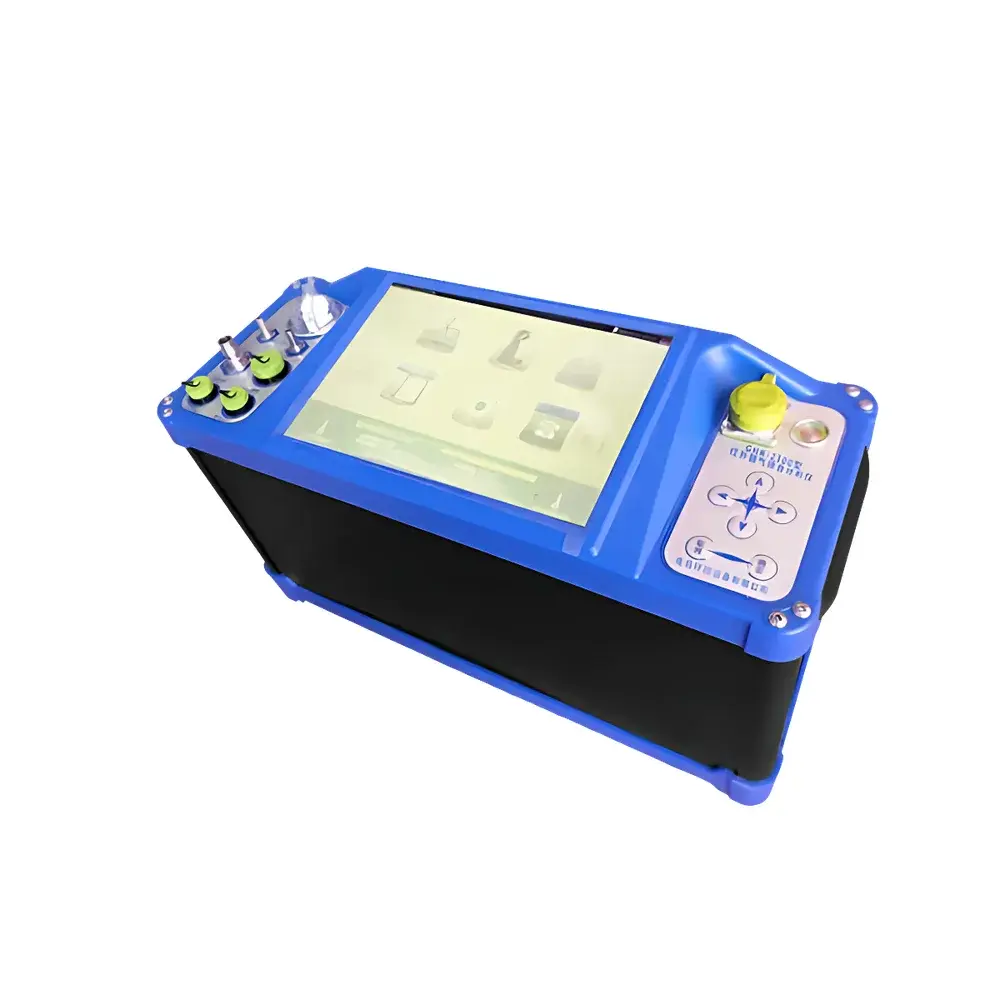
HUANKONG GHK-2300 Infrared Flue Gas Multi-Component Analyzer
| Brand | HUANKONG |
|---|---|
| Origin | Shandong, China |
| Manufacturer Type | Direct Manufacturer |
| Country of Origin | China |
| Model | GHK-2300 |
| Instrument Type | Flue Gas Sampling and Analysis System |
| Sampling Flow Rate | 1.0 L/min |
| Flue Gas Velocity Range | 1–45 m/s |
| Measurement Principle | Non-Dispersive Infrared (NDIR) Absorption |
| Key Measured Gases | SO₂, NOₓ (NO/NO₂), CO₂, CO, H₂S, O₂, CH₄, N₂O |
| Integrated Humidity Sensor | Yes |
| Operating Temperature Range | –20 °C to 50 °C |
| Power Supply | DC 12–26 V / AC 80–260 V |
| Battery Runtime | >4 h (host + probe) |
| Data Storage | High-Capacity Internal Memory with USB Export |
| Connectivity | Bluetooth (printer), Optional IoT Module for Remote Transmission |
Overview
The HUANKONG GHK-2300 Infrared Flue Gas Multi-Component Analyzer is an integrated, field-deployable instrument engineered for accurate, real-time quantification of gaseous pollutants and thermal parameters in industrial flue gas streams. It operates on the principle of non-dispersive infrared (NDIR) absorption spectroscopy — a well-established, reference-grade methodology standardized under multiple Chinese environmental regulatory protocols including HJ 629–2011 (SO₂), HJ 692–2014 (NOₓ), HJ 870–2017 (CO₂), HJ/T 44–1999 (CO), and JJG 968–2002 (instrument verification). Designed for compliance-driven applications at stationary emission sources, the GHK-2300 simultaneously measures up to eight key components — SO₂, NO, NO₂, CO₂, CO, H₂S, O₂, CH₄, and N₂O — without cross-interference, leveraging spectrally selective optical filters and temperature-stabilized detectors. Its architecture integrates sampling, conditioning, and analysis into a single portable platform, minimizing transport losses and ensuring traceable, reproducible results aligned with HJ/T 397–2007 (technical specifications for fixed-source emission monitoring) and GB/T 16157–1996 (particulate and gaseous pollutant sampling methodology).
Key Features
- Tri-functional probe assembly combining Pitot tube, gas sampling tube, and pre-conditioner — with 360° rotatable Pitot orientation for optimal alignment in ducts of variable geometry.
- Dual-stage flue gas pretreatment system (optional): semiconductor cooler + hydrophobic membrane dryer, achieving dew point reduction to ≤5 °C while minimizing water-soluble gas loss (e.g., SO₂, NH₃) — critical for high-humidity stacks (>15% v/v).
- Titanium alloy inner sampling tube: corrosion-resistant up to 200 °C, inert toward acidic condensates, low surface adsorption, and lightweight for extended operator handling.
- Integrated quadruple cable: combines thermocouple (flue temperature), RS232/RS485 communication, DC power, and gas conduit — terminated with push-to-connect fittings for rapid field deployment and leak-tight integrity.
- Real-time humidity compensation: built-in capacitive humidity sensor triggers automatic shutdown if flue moisture exceeds safe operational threshold, preventing optical window fogging and detector saturation.
- Industrial-grade 7-inch color TFT touchscreen with glove-compatible touch sensitivity and physical keypad backup — firmware includes anti-glare interface, multi-level password protection, and audit trail logging for GLP-aligned workflows.
- Wide-input power architecture (DC 12–26 V / AC 80–260 V) with reverse polarity, overvoltage, and overcurrent protection — suitable for generator-powered sites and grid-unstable environments.
- EMC-hardened enclosure per IEC 61326-1:2020 and electrostatic discharge (ESD) shielding compliant with IEC 61000-4-2 Level 4 — validated for use near VFDs, welding equipment, and high-voltage switchgear.
Sample Compatibility & Compliance
The GHK-2300 is validated for use across diverse stack conditions: temperatures from 0 °C to 200 °C (probe-rated), velocities from 1 to 45 m/s, and particulate loadings ≤500 mg/m³ (with standard filter). Its NDIR measurement cells are calibrated against certified reference gases traceable to NIM (National Institute of Metrology, China) and meet linearity requirements per HJ/T 397–2007 Annex B. The system supports method-defined sampling isokineticity via Pitot-static differential pressure feedback and auto-compensated flow control. All hardware and firmware comply with GB/T 16157–1996 for simultaneous particulate and gaseous sampling, and data integrity conforms to basic ALCOA+ principles (Attributable, Legible, Contemporaneous, Original, Accurate, Complete, Consistent, Enduring, Available) — enabling use in regulatory reporting, internal QA/QC audits, and third-party verification.
Software & Data Management
Onboard firmware provides real-time concentration display, minute-averaged values, and cumulative averages (1-, 5-, 15-, and 60-minute windows). All measurements are timestamped and stored in non-volatile memory with ≥100,000 data points capacity. Data export is supported via USB 2.0 mass storage mode (FAT32 formatted drives), generating CSV files compatible with Excel, LabVIEW, and LIMS platforms. Bluetooth 4.2 enables direct pairing with optional thermal printers for on-site report generation (including site ID, date/time, operator ID, and calibration status). An optional embedded LTE/Wi-Fi IoT module allows secure MQTT or HTTPS transmission to cloud-based environmental data management systems, supporting remote diagnostics, firmware OTA updates, and role-based user access control — facilitating integration into enterprise-wide emissions tracking infrastructures.
Applications
- Regulatory stack testing for coal-fired, biomass, waste-to-energy, and cement kiln facilities under national emission standards.
- Combustion efficiency optimization via O₂, CO, and CO₂ co-monitoring in boiler and furnace tuning.
- De-NOₓ system performance verification (SCR/SNCR) through differential NOₓ inlet/outlet profiling.
- Carbon monitoring support for CEMS validation and greenhouse gas inventory reporting (CO₂, CH₄, N₂O).
- Process troubleshooting in chemical and petrochemical plants where H₂S, CO, or hydrocarbon slip must be quantified.
- Field verification of continuous emission monitoring systems (CEMS) per HJ 75–2017 relative accuracy test audit (RATA) protocols.
FAQ
What gas species does the GHK-2300 measure simultaneously?
SO₂, NO, NO₂, CO₂, CO, H₂S, O₂, CH₄, and N₂O — all via dedicated NDIR channels with factory calibration against NIST-traceable standards.
Is isokinetic sampling supported?
Yes — the integrated Pitot tube provides dynamic/static pressure signals to the onboard controller, which automatically adjusts sampling flow rate to maintain isokinetic conditions across the measured velocity range (1–45 m/s).
How is moisture interference mitigated during high-humidity sampling?
The optional dual-stage pretreatment (thermoelectric cooler + hydrophobic PTFE membrane) reduces dew point without chemical desiccants, preserving water-soluble analytes and maintaining measurement fidelity above 20% relative humidity.
Does the system meet international electromagnetic compatibility requirements?
Yes — it complies with IEC 61326-1:2020 for industrial environments and IEC 61000-4-2 (ESD), -4-3 (radiated RF), and -4-4 (electrical fast transients) immunity testing.
Can data be exported in formats compatible with regulatory reporting platforms?
Yes — USB-exported CSV files include ISO 8601 timestamps, measurement units, uncertainty flags, and calibration expiration dates — fully compatible with China’s National Emission Permit Management Platform and international LIMS frameworks.







