
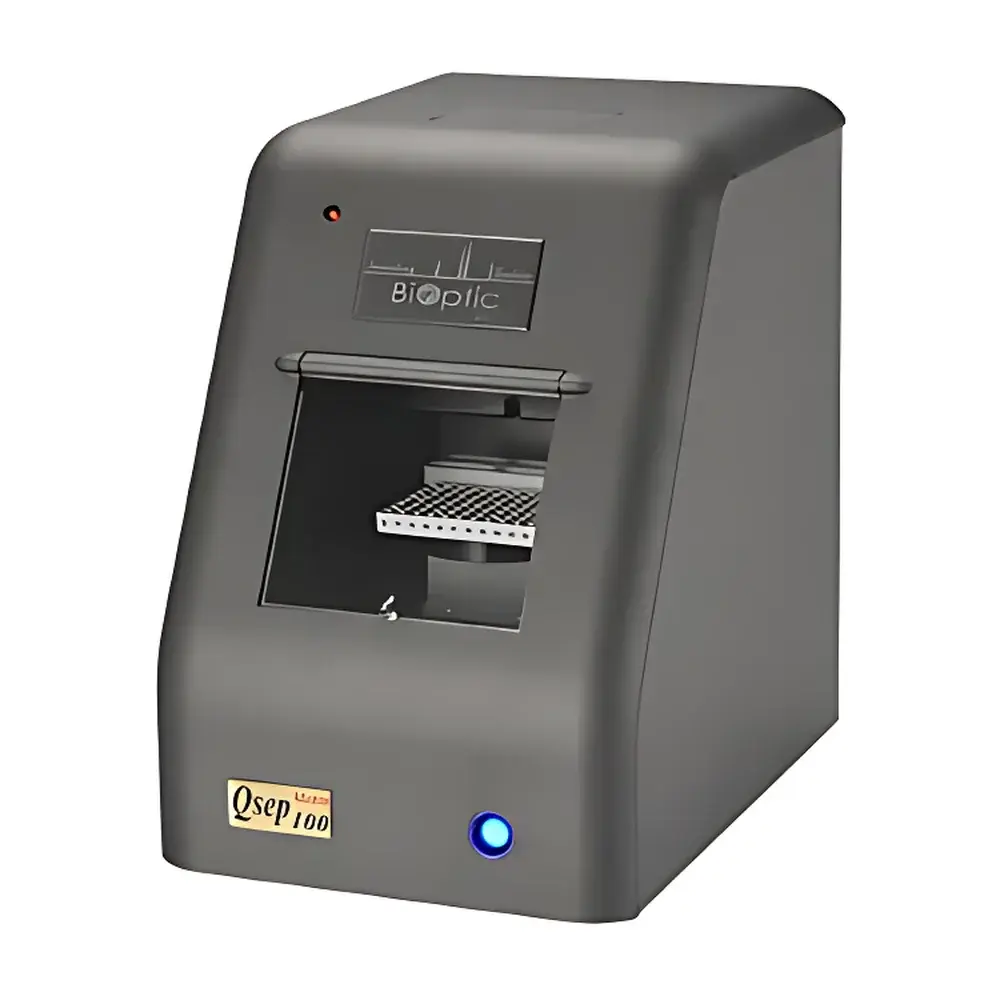
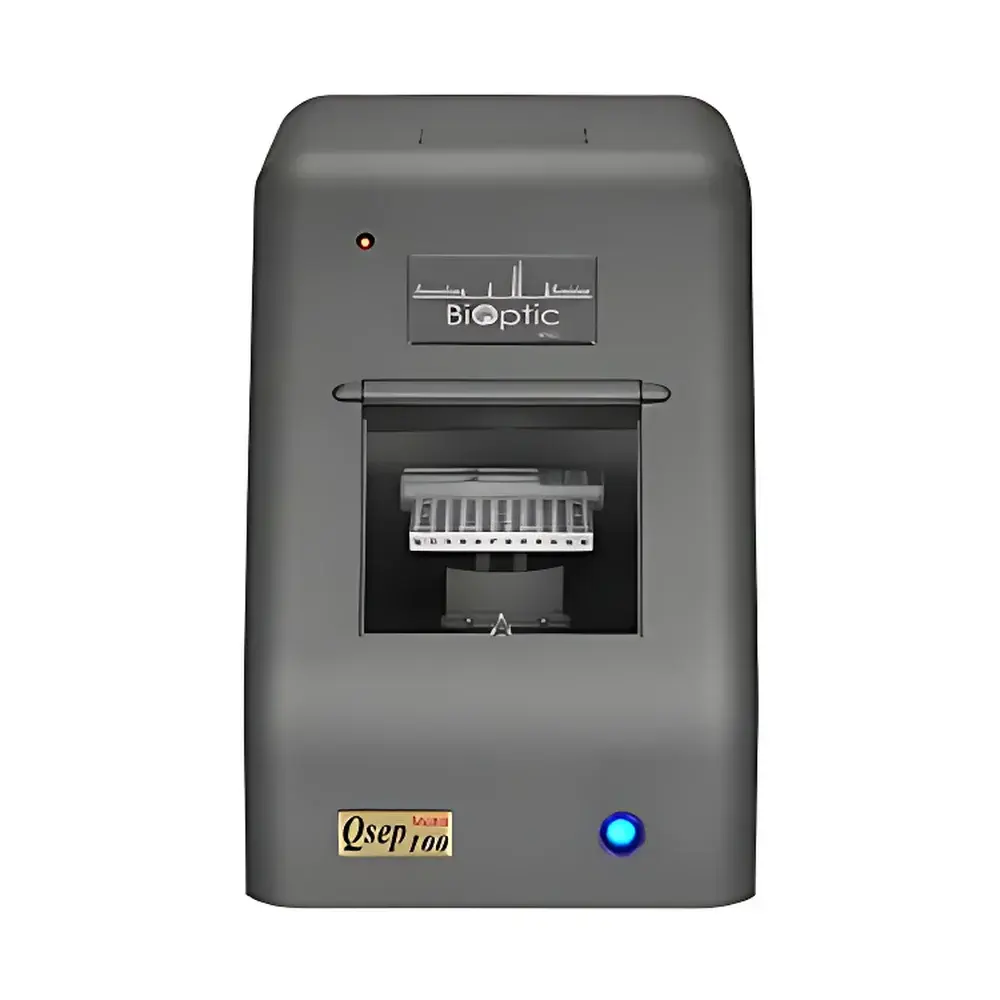
Bioptic Qsep100 Advance Automated Nucleic Acid and Protein Analysis System
| Brand | Bioptic |
|---|---|
| Origin | Jiangsu, China |
| Manufacturer Type | Authorized Distributor |
| Product Category | Domestic Instrument |
| Model | Qsep100 Advance |
| Pricing | Upon Request |
| Instrument Classification | Conventional Nucleic Acid and Protein Analyzer |
| Minimum Sample Volume | 1 µL |
Overview
The Bioptic Qsep100 Advance is an automated capillary electrophoresis (CE)-based platform engineered for high-resolution, quantitative analysis of nucleic acids (DNA and RNA) and proteins in a single integrated workflow. Unlike conventional slab-gel or spectrophotometric methods, the Qsep100 Advance employs microfluidic capillary electrophoresis with real-time UV absorbance detection at 260 nm (nucleic acids) and 280 nm (proteins), enabling simultaneous sizing, quantification, and integrity assessment with sub-nanogram sensitivity. Its core architecture integrates thermal control, automated sample loading, electrokinetic injection, and on-instrument data processing—eliminating manual gel pouring, staining, and imaging steps. Designed for routine QC in molecular biology labs, biopharma process development, and academic core facilities, the system delivers reproducible electropherograms with ladder-referenced fragment sizing accuracy ±1–3% and concentration linearity over three orders of magnitude (0.1–100 ng/µL for dsDNA).
Key Features
- Integrated dual-wavelength UV detection (260 nm and 280 nm) for concurrent nucleic acid and protein analysis without hardware reconfiguration
- Minimal sample consumption: compatible with as little as 1 µL of unpurified or purified lysate, PCR product, or purified protein solution
- Automated capillary priming, washing, and conditioning between runs—reducing carryover risk and operator dependency
- Pre-validated, ready-to-use assay kits: DNA ScreenTape, RNA ScreenTape, and Protein 230 Assay Kit (requires compatible fluorescent or UV-absorbing protein labeling reagents)
- Onboard touchscreen interface with guided workflow navigation and real-time electropherogram visualization
- Robust thermal management system maintaining capillary temperature stability within ±0.5 °C during extended run sequences
Sample Compatibility & Compliance
The Qsep100 Advance supports native and denatured samples across diverse biological matrices—including cell lysates, column-purified nucleic acids, in vitro transcription products, affinity-purified proteins, and enzymatic digests. For protein analysis, compatibility requires use of Bioptic’s certified protein labeling reagents (e.g., amine-reactive dyes compatible with CE-SDS or native CE protocols). All consumables—including ScreenTape chips and reagent kits—are manufactured under ISO 13485-certified quality systems. The instrument’s software architecture supports audit trail functionality and user access controls aligned with GLP and GMP documentation requirements. While not FDA 510(k)-cleared, the system meets ASTM D7927-17 (Standard Practice for Capillary Electrophoresis of Nucleic Acids) and ISO/IEC 17025:2017 criteria for method validation in accredited testing laboratories.
Software & Data Management
Bioptic Qsep Software v4.x provides comprehensive instrument control, data acquisition, and post-run analysis. It includes automatic band calling, molecular weight calibration using internal ladders, peak integration with baseline correction algorithms, and customizable reporting templates (PDF, CSV, Excel). Raw electropherogram files (.qsep) are stored with embedded metadata—including instrument ID, operator login, timestamp, chip lot number, and run parameters—to support traceability. Exported data comply with MIAME and MIAPE guidelines for omics data submission. The software supports network deployment in multi-user lab environments and integrates with LIMS via configurable ODBC drivers. Audit trails record all critical actions—including parameter changes, result deletions, and user logins—with immutable timestamps, satisfying 21 CFR Part 11 readiness when deployed with validated electronic signature modules.
Applications
- Routine QC of plasmid preps, PCR amplifications, and NGS library construction (fragment size distribution, adapter dimer detection, yield estimation)
- RNA integrity assessment (RIN-equivalent scoring) for qRT-PCR and single-cell sequencing workflows
- Verification of protein expression and purification—especially for His-tagged or GST-fusion proteins under non-reducing or reducing CE-SDS conditions
- Monitoring enzymatic reactions (e.g., restriction digests, DNase/RNase activity assays) with kinetic resolution up to 1-minute intervals
- Educational use in undergraduate and graduate molecular biology labs due to its walk-away automation and intuitive interface
FAQ
What sample preparation is required prior to loading on the Qsep100 Advance?
Minimal preparation is needed: nucleic acid samples require no dilution if within linear range; protein samples must be labeled using Bioptic’s validated reagents and diluted to recommended concentration ranges per kit instructions.
Can the system analyze both DNA and protein in the same run?
No—sample type is selected per run via assay kit configuration. However, the same instrument and chip platform support both modalities interchangeably without hardware modification.
Is the Qsep100 Advance compliant with regulatory data integrity standards?
Yes—when configured with appropriate administrative controls and electronic signatures, it meets ALCOA+ principles and supports 21 CFR Part 11 compliance for regulated environments.
What is the typical turnaround time from sample loading to report generation?
Average run time is 2–5 minutes per sample, with full analysis and PDF report generation completed within 30 seconds post-run.
Are consumables available globally through Bioptic authorized channels?
Yes—ScreenTape chips, reagent kits, and capillaries are distributed via Bioptic’s international network of certified distributors with documented cold-chain logistics for temperature-sensitive reagents.




