
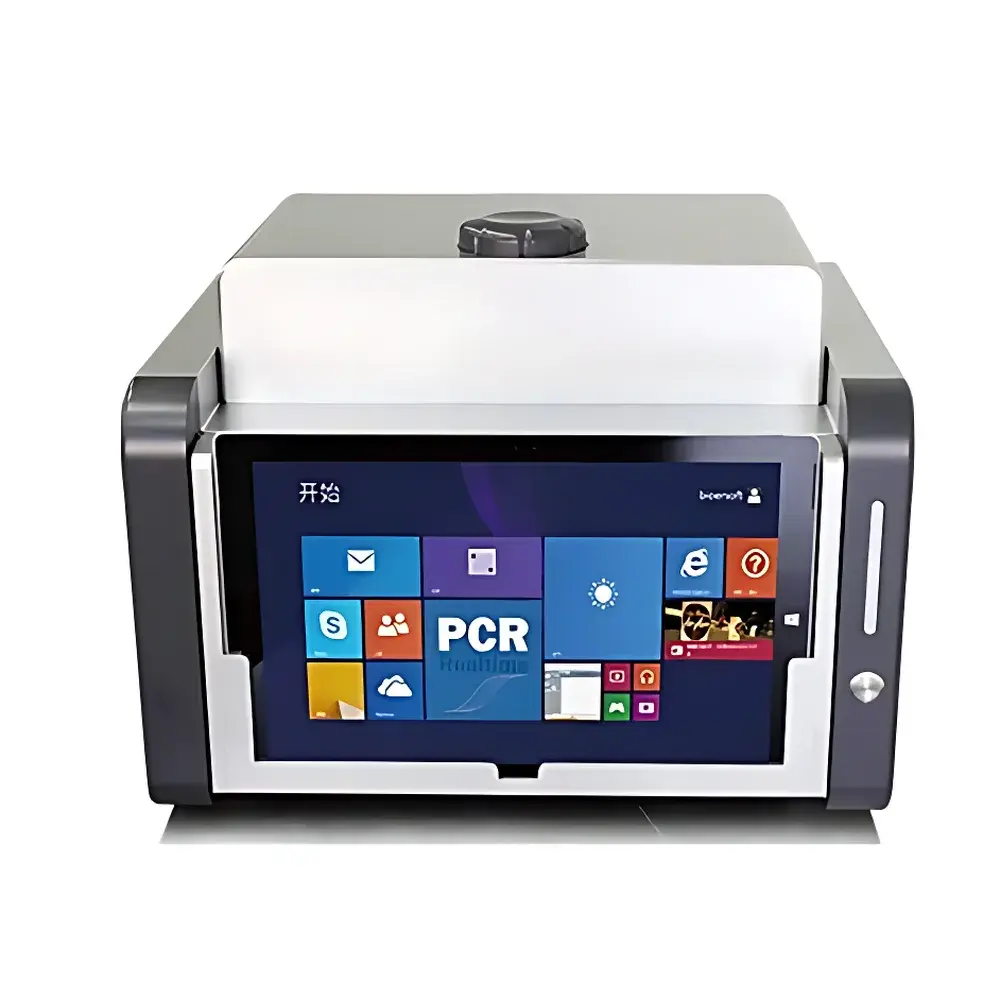
bioer LineGene K Plus Real-Time Fluorescence Quantitative PCR Detection System
| Brand | bioer |
|---|---|
| Origin | Zhejiang, China |
| Model | LineGene K Plus |
| Instrument Type | Real-Time Fluorescence Quantitative PCR System |
| Sample Capacity | 48 × 0.2 mL (compatible with individual tubes and 8-tube strips) |
| Reaction Volume | 5–100 µL |
| Detection Channels | 4 |
| Excitation Sources | High-intensity LEDs (FAM/SYBR Green I |
| Block Temperature Range | 4–105 °C (0.1 °C resolution) |
| Max Heating Rate | 5 °C/s |
| Temperature Accuracy | ≤ ±0.1 °C |
| Inter-well Uniformity | ≤ ±0.1 °C |
| Heat Lid Temperature Range | 30–110 °C (default 105 °C, auto-lift mechanism) |
| Independent Three-Zone Thermal Control | Adjustable gradient range 0.1–6 °C per zone |
| Operating System Compatibility | Windows XP / 7 / 8 / 10 |
| Interface Options | USB, RS232, Bluetooth |
| Power Input | 100–240 V AC, 50/60 Hz, 600 W |
| Dimensions | 410 × 386 × 352 mm |
| Weight | 28 kg |
Overview
The bioer LineGene K Plus Real-Time Fluorescence Quantitative PCR Detection System is an engineered platform for precise nucleic acid quantification based on the principle of real-time fluorescence monitoring during thermal cycling. It employs a solid-state LED excitation system coupled with high-sensitivity photodetectors to capture fluorescence emission kinetics across four optical channels—enabling multiplexed detection of common dyes including FAM/SYBR Green I, HEX/VIC/TET/JOE/Cy3/TAMRA, Texas Red/ROX, and Cy5/Quasar-670. The system utilizes a Peltier-based thermocycling module with patented bottom-illumination detection geometry, minimizing optical crosstalk and enhancing signal fidelity for low-abundance targets. Designed for laboratories requiring rigorous reproducibility in gene expression profiling, pathogen load assessment, genotyping, and molecular diagnostics, the LineGene K Plus conforms to foundational requirements for GLP-compliant workflows and supports audit-ready data handling when integrated with validated software protocols.
Key Features
- Patented bottom-detection optical architecture—reduces inter-channel interference and improves signal-to-noise ratio for ultra-low-volume reactions (5–100 µL).
- High-intensity, long-life LED excitation sources—eliminate lamp replacement cycles and ensure stable spectral output over extended operational lifetimes.
- Dual FerroTec Peltier heating design with lateral thermal coupling—increases heat transfer surface area, enabling rapid ramping up to 5 °C/s and precise dwell control.
- Three independently controllable thermal zones—support simultaneous gradient PCR optimization across 48 wells with adjustable differential setpoints (0.1–6 °C), facilitating robust assay development.
- Automated pressure-sensitive heat lid—self-adjusts contact force and lifts automatically during tube loading/unloading, preventing condensation and reagent evaporation.
- SOAK mode with programmable low-temperature holding (4 °C)—preserves enzyme integrity and stabilizes master mixes prior to cycling initiation.
Sample Compatibility & Compliance
The LineGene K Plus accommodates standard 0.2 mL PCR tubes and 8-tube strips without adapters, ensuring compatibility with widely adopted consumables across academic, clinical, and industrial labs. Its temperature uniformity (≤ ±0.1 °C inter-well) and accuracy (≤ ±0.1 °C) meet performance benchmarks aligned with ISO 13485–referenced instrumentation validation frameworks for in vitro diagnostic (IVD) use. While not pre-certified as an IVD device under FDA 21 CFR Part 809 or CE-IVD, the system supports method validation per CLSI EP17-A2 guidelines and provides raw fluorescence acquisition logs suitable for internal QC documentation. All firmware and software components are designed to support ALCOA+ data integrity principles—ensuring attributable, legible, contemporaneous, original, accurate, complete, consistent, enduring, and available records.
Software & Data Management
Controlled via Windows-native application (XP through Windows 10), the LineGene K Plus software suite delivers comprehensive analysis modes: qualitative detection, absolute and relative quantification, SNP genotyping, standard melt curve analysis, high-resolution melt (HRM), allelic discrimination, and isothermal amplification monitoring. Data export supports CSV, PDF, and XML formats—enabling integration with LIMS platforms and statistical packages such as R or GraphPad Prism. Built-in report templates allow customizable output for single-sample review or batch-level summary generation. Audit trail functionality logs user actions—including protocol edits, run starts/stops, and parameter modifications—with timestamps and operator IDs. Optional Bluetooth connectivity permits remote status monitoring from compatible tablets or laptops within laboratory environments.
Applications
This instrument serves core applications in translational research and regulated testing environments, including but not limited to: viral load quantification (e.g., SARS-CoV-2, HIV, HBV); tumor biomarker expression profiling (e.g., EGFR, KRAS, BRAF); pharmacogenomic variant screening (CYP2C19, TPMT); foodborne pathogen detection (Salmonella, Listeria); GMO identification; ancient DNA analysis in paleogenetics; and forensic STR profiling. Its multi-channel flexibility and HRM capability make it particularly suited for mutation scanning in hereditary disease panels and epigenetic methylation assays using methylation-specific PCR (MS-PCR) chemistries.
FAQ
Does the LineGene K Plus support FDA 21 CFR Part 11 compliance?
The system itself does not include built-in electronic signature or role-based access controls required for full Part 11 compliance; however, its data export structure and audit log format are compatible with third-party validation packages that extend Part 11 functionality in GxP environments.
Can I use third-party master mixes and probes with this instrument?
Yes—the optical configuration and thermal performance are optimized for broad compatibility with commercial SYBR Green I– and probe-based chemistries from leading vendors, provided they match the specified excitation/emission spectra.
Is gradient PCR programmable across all three zones simultaneously?
Each of the three thermal zones operates independently, allowing distinct temperature profiles—including linear gradients—to be assigned per zone, enabling parallel optimization of annealing conditions across multiple assays in one run.
What maintenance is required for the LED light sources?
LEDs require no routine replacement or alignment; their rated lifetime exceeds 50,000 hours under normal operation, and intensity calibration is performed automatically during startup.
How is data security managed during network-connected operation?
When connected via USB or RS232, the system functions as a peripheral without IP exposure; Bluetooth use is limited to local pairing and does not expose the instrument to external networks unless explicitly configured through host-side settings.
Related Products




