
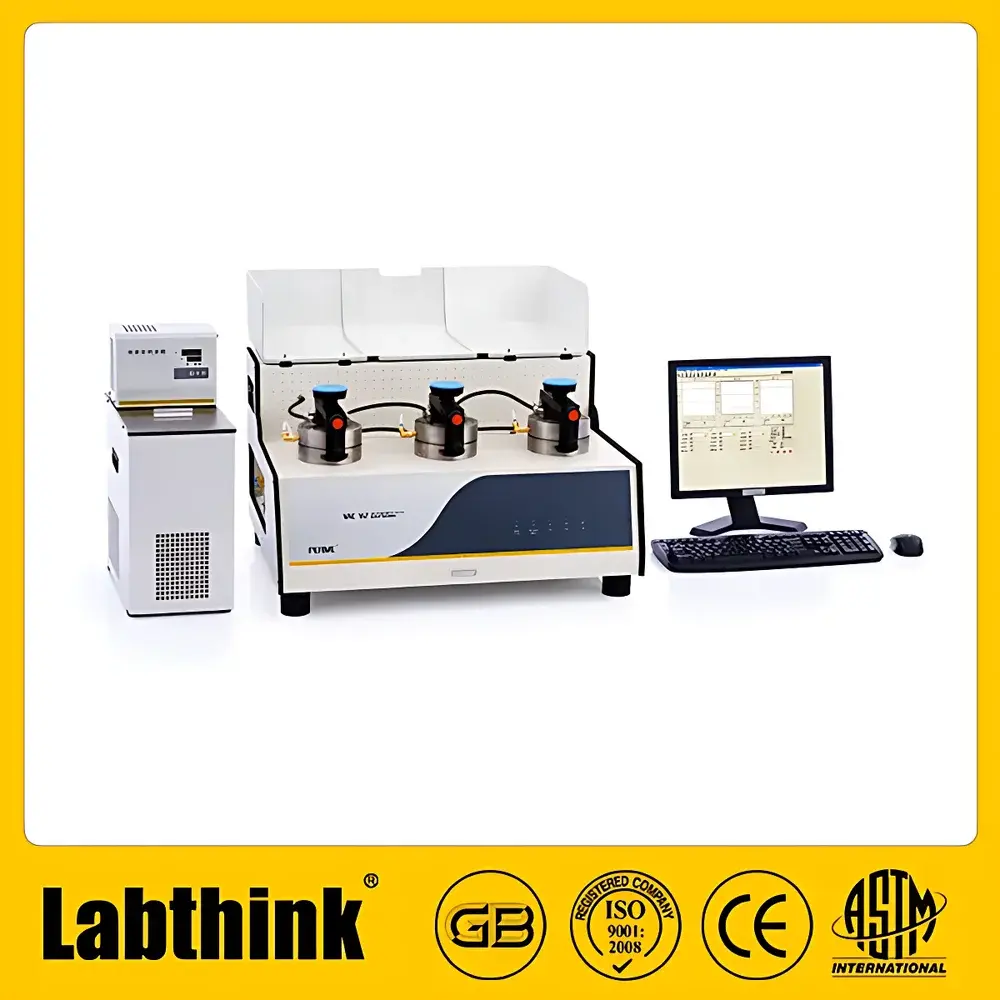
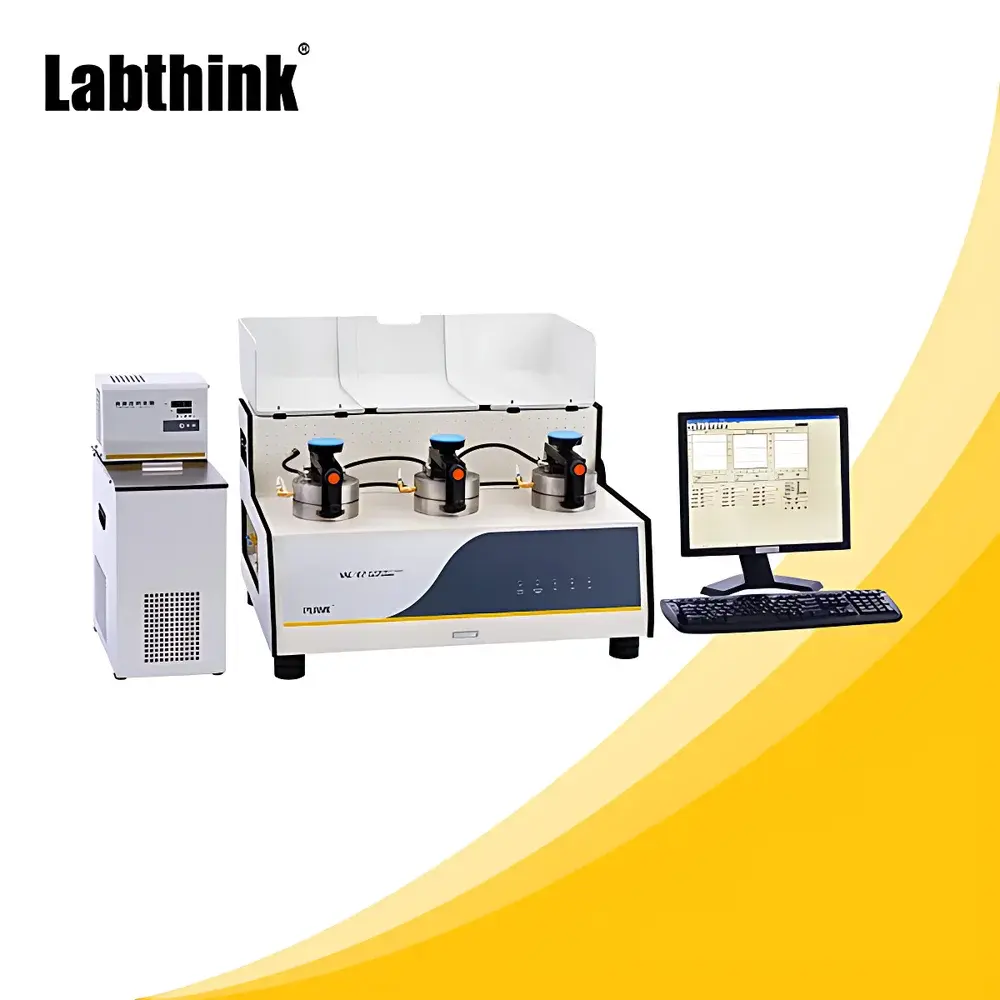
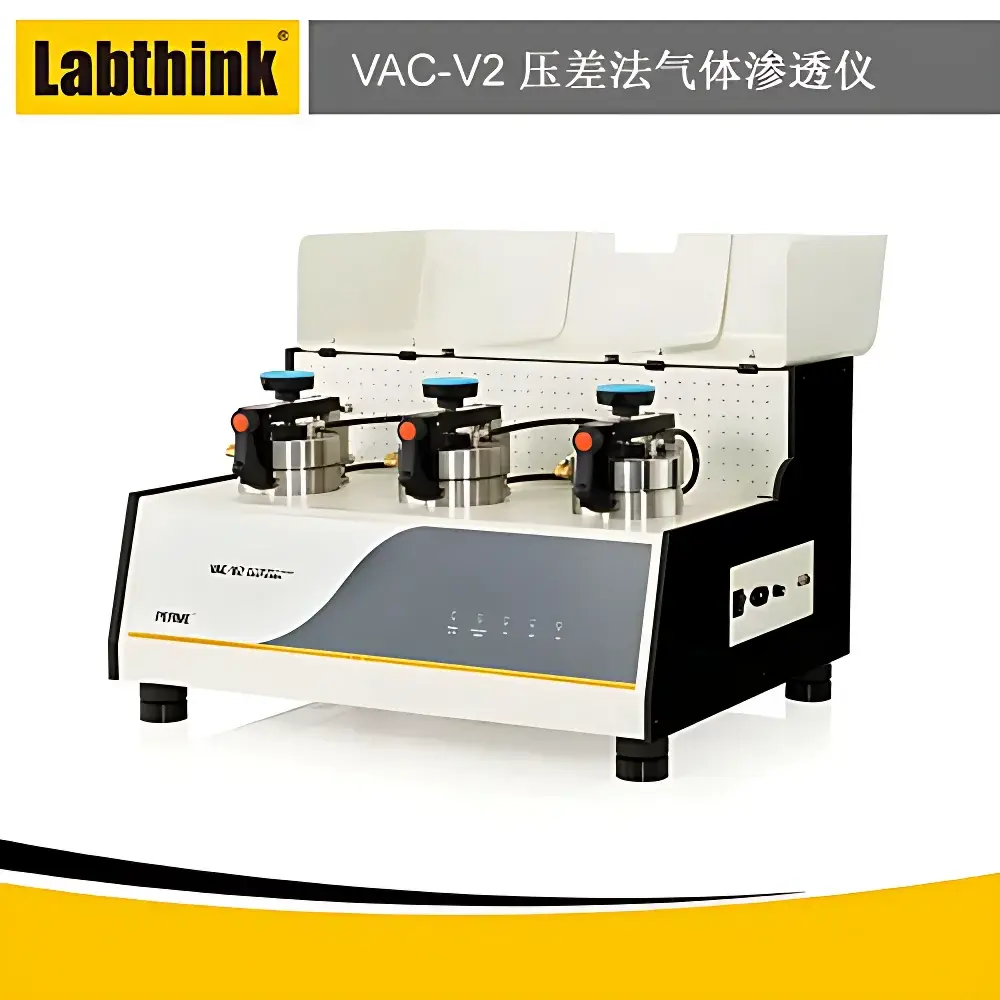
Labthink PERME博密 VAC-V2 Differential Pressure Gas Permeability Analyzer
| Brand | Labthink |
|---|---|
| Origin | Shandong, China |
| Manufacturer Type | Direct Manufacturer |
| Country of Origin | China |
| Model | PERME博密 VAC-V2 |
| Price Range | USD 14,000 – 85,000 (FOB Qingdao) |
| Test Principle | Differential Pressure (Manometric) Method |
| Standards Compliance | ISO 15105-1, ISO 2556, ASTM D1434, GB/T 1038-2000, JIS K7126-1, YBB 00082003 |
| Test Gases | O₂, N₂, CO₂, Air, He (including flammable/explosive gases with optional safety retrofit) |
| Temperature Control | 5–95 °C (±0.1 °C) |
| Humidity Control | 0%RH, 2–98.5%RH, 100%RH (external humidity generator required) |
| Vacuum Resolution | 0.1 Pa |
| Test Chamber Vacuum Level | <20 Pa |
| Sample Area | 38.48 cm² |
| Sample Diameter | Φ97 mm |
| Test Range | 0.05–50,000 cm³/m²·24h·0.1MPa (standard) |
| Independent Test Cells | 3 |
| Power Supply | 220VAC 50Hz / 120VAC 60Hz |
| Net Weight | 88 kg |
| Dimensions | 760 × 575 × 450 mm (L×W×H) |
| Interface | RS232, Lystem™ Lab Data Management System compatible |
Overview
The Labthink PERME博密 VAC-V2 is a high-precision differential pressure (manometric) gas permeability analyzer engineered for rigorous research and quality control in packaging science, materials development, and barrier performance validation. It quantifies the permeation kinetics of gases—including O₂, N₂, CO₂, air, and helium—through polymeric films, laminates, foils, and rigid sheet materials under controlled temperature and humidity conditions. Based on the fundamental principles of Fick’s laws of diffusion and Henry’s law of solubility, the instrument measures gas transmission rate (GTR), diffusion coefficient (D), solubility coefficient (S), and permeability coefficient (P = D × S) simultaneously. Its design adheres to internationally recognized test methodologies defined in ISO 15105-1 (gas transmission rate), ISO 2556 (differential pressure method), ASTM D1434 (standard test method for gas transmission rates), and Chinese national standard GB/T 1038-2000. The VAC-V2 is widely deployed in R&D laboratories evaluating high-barrier packaging for pharmaceuticals, aerospace inflatable structures (e.g., helium-filled airbags), biodegradable films, and specialty coatings—where precise, reproducible, and auditable gas transport data are critical for regulatory submission and material qualification.
Key Features
- Triple independent test chambers enable concurrent measurement of three identical or dissimilar specimens—maximizing throughput without cross-contamination or calibration drift.
- High-resolution vacuum system with 0.1 Pa resolution and sub-20 Pa base pressure ensures accurate low-flux detection, essential for ultra-high-barrier materials such as SiOₓ-coated PET or AlOₓ nanolaminates.
- Precision thermal control (5–95 °C, ±0.1 °C) supports Arrhenius-based activation energy analysis and accelerated aging simulations per ISO 11607-1 Annex B.
- Dual-mode process logic—proportional control and fuzzy logic algorithms—enhances stability during transient permeation phases, especially for highly permeable or heterogeneous samples.
- Modular gas-handling architecture permits safe operation with flammable (e.g., H₂, CH₄) and toxic gases (e.g., SO₂, Cl₂) when equipped with optional explosion-proof retrofit kits and dedicated gas exhaust manifolds.
- Expandable test range (up to ≥500,000 cm³/m²·24h·0.1MPa) accommodates both ultra-low-permeability barrier films and highly permeable elastomers or foams used in medical device packaging.
- Integrated Lystem™ laboratory data management system provides audit-trail-compliant reporting, user-level access control, and electronic signature support aligned with FDA 21 CFR Part 11 requirements.
Sample Compatibility & Compliance
The VAC-V2 accommodates flat, non-porous, and semi-crystalline specimens up to Φ97 mm, including plastic films (PET, PE, PP, PVDC), metallized laminates (Al foil, SiOₓ, AlOₓ), paperboard composites (foil-laminated cigarette packaging), rubber sheets (EPDM, butyl), fluoropolymer-coated fabrics (PTFE, FKM), and bio-based films (PLA, starch blends). It complies with GLP and GMP-aligned workflows through automated calibration traceability using certified reference membranes (e.g., NIST-traceable O₂-permeable polyester standards). All test reports include full metadata: ambient lab conditions, operator ID, instrument firmware version, calibration date, and raw pressure-time curves—ensuring full ISO/IEC 17025 traceability.
Software & Data Management
Controlled via Windows-based Labthink PermeWin™ software, the VAC-V2 delivers real-time monitoring of chamber pressure differentials, temperature/humidity profiles, and calculated kinetic parameters. Software modules support nonlinear curve fitting for time-lag analysis, Arrhenius plotting, and Weibull distribution modeling of barrier heterogeneity. Export formats include CSV, PDF, XML, and direct integration with LIMS platforms via ODBC. Audit trails record every parameter change, test start/stop event, and calibration action with timestamp and user credentials—meeting FDA 21 CFR Part 11 and EU Annex 11 requirements for computerized system validation.
Applications
- Pharmaceutical primary packaging: O₂ transmission rate (OTR) verification of blister lidding foils and cold-forming aluminum strips per USP .
- Aerospace component testing: Helium leak rate assessment of inflatable habitat membranes and balloon envelopes under simulated altitude conditions.
- Sustainable packaging R&D: Quantifying CO₂ permeability of compostable pouches for fresh produce shelf-life modeling.
- Automotive sealing systems: Measuring air permeation through EPDM gasket compounds per SAE J2236.
- Electronics encapsulation: Barrier validation of moisture-sensitive OLED display substrates using N₂ purge environments.
- Medical device packaging: Validating microbial barrier integrity of Tyvek®-based sterile barrier systems per ISO 11607-2.
FAQ
What gases can be tested on the VAC-V2?
Standard configurations support O₂, N₂, CO₂, air, and He. Custom gas train modifications enable safe operation with flammable (H₂, CH₄), corrosive (SO₂, HCl), or toxic gases (NH₃, Cl₂) upon risk assessment and engineering review.
Is humidity control built-in?
Relative humidity control (0–100% RH, ±1% RH accuracy) requires an external humidity generator module—sold separately—to maintain ISO 15105-2-compliant conditioning protocols.
Can the instrument validate compliance with FDA or EU MDR requirements?
Yes—when operated under documented SOPs, calibrated with certified standards, and paired with Lystem™’s 21 CFR Part 11-compliant audit trail, it fulfills evidentiary requirements for regulatory submissions under FDA 21 CFR 820 and EU MDR Annex I §10.4.
How is calibration performed?
Factory-certified reference membranes (e.g., polycarbonate O₂ standards) are used for daily verification; full recalibration is performed annually by Labthink-certified service engineers with NIST-traceable pressure and temperature references.
What sample preparation tools are included?
Standard configuration includes stainless-steel die-cutting tool (Φ97 mm), vacuum grease, quantitative filter paper, and imported dual-stage vacuum pump—no third-party consumables required for baseline operation.




