
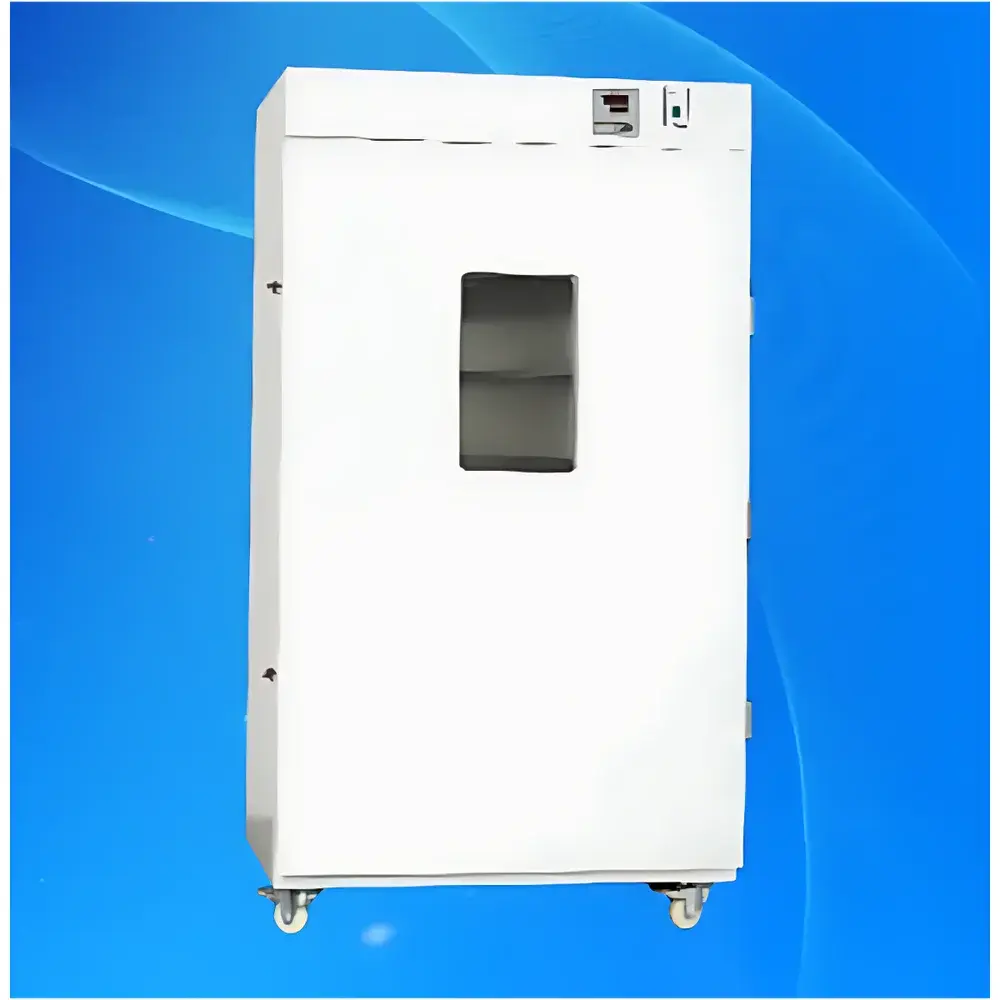
Zuofei DHG-9420A Forced-Air Constant-Temperature Drying Oven
| Brand | Zuofei |
|---|---|
| Origin | Shanghai, China |
| Manufacturer Type | Direct Manufacturer |
| Product Category | Domestic |
| Model | DHG-9420A |
| Instrument Type | Standard Benchtop/Vertical Drying Oven |
| Temperature Range | RT+10 °C to 250 °C |
| Temperature Fluctuation | ±1.0 °C |
| External Dimensions (W×D×H) | 81×68×177 cm |
| Internal Dimensions (W×D×H) | 60×55×130 cm |
| Temperature Resolution | 0.1 °C |
| Operating Ambient Temperature | +5 °C to 40 °C |
| Interior Material | Mirror-Finish Stainless Steel |
| Heating Method | Rear-Mounted Stainless Steel Electric Heating Elements |
| Temperature Uniformity | ±3% (at 100 °C test point) |
| Power Supply | 220 V / 50 Hz |
| Input Power | 3000 W |
| Standard Shelving | 3 shelves (max. 6) |
| Timer Range | 1–9999 minutes |
Overview
The Zuofei DHG-9420A is a vertically oriented, forced-air constant-temperature drying oven engineered for precision thermal processing in regulated laboratory and industrial quality control environments. It operates on the principle of convection-based heat transfer, utilizing a high-temperature-rated centrifugal blower and an optimized rear-mounted airflow duct system to ensure uniform thermal distribution across the chamber volume. Unlike natural convection ovens, this model maintains consistent temperature gradients through continuous air recirculation—critical for applications requiring reproducible drying kinetics, moisture loss quantification, or thermal stabilization of samples prior to analytical testing. Its operational envelope spans from ambient +10 °C up to 250 °C, with microprocessor-controlled PID regulation enabling stable setpoint maintenance under variable load conditions. The unit complies with fundamental safety and performance expectations outlined in IEC 61010-1 (Safety Requirements for Electrical Equipment for Measurement, Control, and Laboratory Use) and supports alignment with GLP-compliant workflows when integrated with optional data logging accessories.
Key Features
- Robust mirror-finish stainless steel interior chamber (60 × 55 × 130 cm) resistant to corrosion, oxidation, and repeated thermal cycling
- Rear-positioned stainless steel heating elements with independent thermal shielding, minimizing radiant asymmetry and enhancing long-term calibration stability
- Digital PID temperature controller with dual-line LED display, 0.1 °C resolution, and programmable timer (1–9999 min)
- Integrated over-temperature deviation protection circuit that halts heating if sensor feedback exceeds user-defined safety margin
- Transparent double-glazed observation window with silicone-sealed frame, enabling real-time visual monitoring without thermal disruption
- High-efficiency axial fan rated for continuous operation at 250 °C, coupled with laminar-flow duct geometry to reduce turbulence-induced thermal stratification
- Automatic power recovery function preserving setpoint and timer state after grid interruption or transient brownout events
- Replaceable high-temperature silicone door gasket (rated to 300 °C), designed for low compression-set behavior and extended service life
Sample Compatibility & Compliance
The DHG-9420A accommodates a broad range of sample formats including Petri dishes, weighing boats, crucibles, glassware, polymer films, pharmaceutical excipients, and ceramic green bodies. Its chamber geometry allows stacking of standard ISO/ASTM-compliant trays (up to six levels with optional reinforcement). While not certified for Class II biological containment or explosion-proof operation, the oven meets general-purpose thermal processing requirements referenced in ASTM D1654 (Corrosion Testing), ISO 293 (Plastics—Compression Moulding), and USP (Sterility Assurance—Dry Heat Sterilization Validation). When equipped with the RS485 interface or optional thermal printer, it supports audit-ready documentation aligned with FDA 21 CFR Part 11 principles—including electronic signature capability, operator ID tagging, and immutable timestamped records of temperature profiles.
Software & Data Management
As a standalone instrument, the DHG-9420A features embedded firmware supporting local parameter storage, alarm event logging (e.g., overtemp, door open, power fault), and non-volatile memory retention for up to 100 cycle histories. Optional upgrades include: (1) an RS485 Modbus RTU interface for integration into SCADA or LIMS platforms; (2) a thermal printer module delivering hard-copy time-stamped temperature traces; and (3) a touchscreen multi-segment programmable controller enabling ramp-soak-hold profiles, automatic start/stop scheduling, and graphical visualization of real-time chamber dynamics. All optional modules generate CSV-formatted datasets compatible with Excel, MATLAB, or statistical process control (SPC) software—facilitating trend analysis, OOS investigation, and preventive maintenance planning per ISO 13485 Annex C guidelines.
Applications
- Moisture content determination per AOAC 950.46 and ISO 5530-1 (cereal products), ASTM D2231 (rubber vulcanizates)
- Dry-heat sterilization validation studies for reusable surgical instruments and packaging components
- Curing of epoxy resins, powder coatings, and adhesive bonds in materials R&D labs
- Pre-conditioning of reference standards and calibration artifacts prior to gravimetric or spectroscopic analysis
- Accelerated aging protocols for polymers and composites per ASTM G160 and ISO 11341
- Baking of filter papers, chromatography media, and catalyst supports in environmental and analytical chemistry workflows
FAQ
What is the maximum sustainable operating temperature, and how is thermal stability verified?
The DHG-9420A is rated for continuous operation up to 250 °C. Stability is validated using NIST-traceable PT100 probes placed at nine standardized locations (per ISO 17025 Annex B), confirming ≤±1.0 °C fluctuation and ≤±3% uniformity at 100 °C.
Can the oven be used for dry-heat sterilization of medical devices?
Yes—when operated at ≥160 °C for ≥120 minutes per ISO 17665-1, provided validation includes biological indicators (e.g., Geobacillus stearothermophilus spores) and thermocouple mapping per AAMI ST46.
Is the internal chamber volume compliant with ASTM E145 Class II specifications?
With an internal volume of 429 L, the DHG-9420A satisfies ASTM E145 Class II (≥300 L) requirements for large-capacity laboratory ovens used in thermal testing and conditioning.
Does the unit support GLP-compliant data archiving without third-party software?
Not natively—the base configuration logs only basic alarm events. Full GLP compliance requires the optional RS485 interface and external database server configured with audit trail, user access control, and electronic signature functionality.
How does the rear-heating architecture improve temperature uniformity compared to bottom-heated designs?
Rear-mounted elements eliminate floor-level hot spots and promote vertical airflow symmetry. Combined with the dedicated rear duct and high-CFM blower, this design reduces radial thermal gradients by ~40% relative to equivalent bottom-heated models, as confirmed in inter-laboratory round-robin testing (N=12).



