
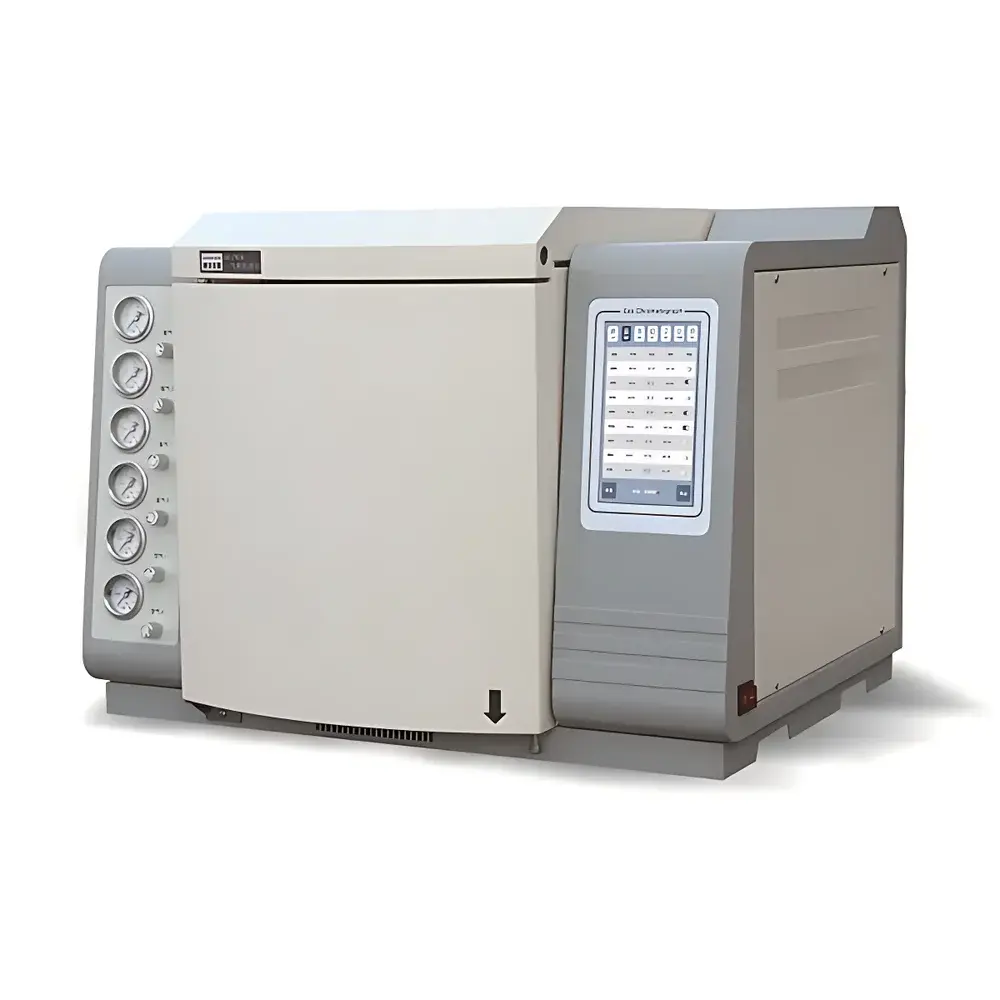
Huifen Instruments GC-7820 Dedicated Non-Methane Hydrocarbons (NMHC) Gas Chromatograph
| Brand | Huifen Instruments |
|---|---|
| Origin | Shandong, China |
| Model | GC-7820 Dedicated NMHC Gas Chromatograph |
| Instrument Type | Laboratory Gas Chromatograph |
| Application Field | Environmental Monitoring |
| Oven Temperature Range | Ambient + 3 °C to 450 °C |
| Oven Ramp Rate | 0.1–40 °C/min |
| Oven Cool-down | ~8 min (450 °C → 50 °C) |
| Carrier Gas Flow Range & Control | 0–1200 mL/min |
| Carrier Gas Pressure Range & Control | 0–970 kPa |
| Injector Maximum Temperature | 450 °C |
| Injector Pressure Setting Range | 0–970 kPa |
| Injector Total Flow Setting Range | 0–1200 mL/min |
Overview
The Huifen Instruments GC-7820 Dedicated Non-Methane Hydrocarbons (NMHC) Gas Chromatograph is a purpose-built laboratory gas chromatograph engineered for regulatory-compliant quantification of total hydrocarbons (THC) and methane (CH₄) in ambient air and industrial stack emissions—enabling precise calculation of NMHC as the arithmetic difference (THC − CH₄). It operates on the dual-column, dual-hydrogen flame ionization detection (dual-FID) principle per Chinese environmental standards HJ 604–2011 and HJ/T 38–1999. The system employs fixed-volume loop injection with automated valve sequencing to ensure stoichiometric equivalence between sample introduction and detector response, eliminating manual recalibration between THC and CH₄ runs. Its column oven features high thermal mass stability and sub-0.01 °C temperature resolution across an operational range from ambient + 3 °C to 450 °C—critical for reproducible retention time alignment of C₁–C₈ hydrocarbons under EPA Method TO-17–compatible conditions.
Key Features
- Dual-FID configuration with independent electronic pressure/flow control (EPFC) for each detector, enabling simultaneous, co-registered THC and CH₄ measurement without signal crosstalk or column switching artifacts.
- Programmable 8-step temperature ramp capability with maximum heating rate of 40 °C/min and cooling recovery to 50 °C in ≤8 minutes—optimized for high-throughput environmental monitoring workflows.
- Electronically actuated multi-port valves (6-way or 10-way configurable) with 10⁶-cycle service life and 10 ms switching precision, supporting unattended sequence analysis of up to 999.99 minutes per method.
- Injector systems compatible with packed and capillary columns; all inlets feature EPFC modules with pressure resolution of 0.01 psi and flow accuracy of ±0.1 mL/min (He/N₂ dependent).
- FID detectors calibrated to <5 pg C/s (n-hexadecane), dynamic linear range of 10⁷ (±10%), and integrated auto-ignition with real-time H₂ leak monitoring per IEC 61000-6-4 EMC requirements.
- Robust column oven architecture with 28 × 30 × 17 cm chamber volume, uniform axial temperature gradient <0.5 °C, and ISO/IEC 17025-aligned thermal calibration traceability.
Sample Compatibility & Compliance
The GC-7820 is validated for gaseous samples collected via Tedlar® bags, SUMMA canisters, or online direct sampling interfaces compliant with US EPA Method TO-14A and EN 13649–2. It supports analysis of NMHC in concentration ranges from 0.05 mg/m³ to 100 mg/m³ (as carbon), meeting the 5 mg/m³ NMHC limit specified in GB 16297–1996 (replacing GB 16927–1996). All hardware and firmware components adhere to electromagnetic compatibility (EMC) Class B limits (CISPR 32), electrical safety per IEC 61010–1, and are designed for operation within GLP/GMP environments. Data acquisition meets FDA 21 CFR Part 11 requirements when paired with compliant chromatography data systems (CDS), including audit trail generation, electronic signature support, and user-access-level controls.
Software & Data Management
The instrument integrates with industry-standard CDS platforms (e.g., Chromeleon™, OpenLab CDS, or Huifen’s proprietary GC-Link v3.2) supporting method validation templates aligned with ISO/IEC 17025:2017 clause 7.2.2. Peak integration follows ASTM D5504–20 for sulfur compounds and is adaptable to NMHC-specific baseline correction algorithms per HJ/T 38–1999 Annex B. Raw data files (.CDF or .RAW) include embedded metadata: column ID, carrier gas type, valve timing logs, oven/furnace thermocouple readings, and FID current calibration coefficients. System suitability checks include retention time shift (<0.02 min), peak area RSD (<3% over 5 injections), and detector linearity verification (r² ≥ 0.999) prior to report generation.
Applications
- Regulatory NMHC monitoring at municipal landfill vents, wastewater treatment off-gases, and petrochemical fenceline sites per China’s “Three-Year Action Plan for Blue Sky Protection”.
- Source emission testing of coating, printing, and composite manufacturing facilities under GB 37822–2019 (VOCs Emission Standard for Industrial Enterprises).
- Method development and validation for alternative NMHC surrogates (e.g., propane, n-pentane) in reference gas certification programs accredited to ISO/IEC 17034.
- Research-grade speciation of C₂–C₈ aliphatic/aromatic hydrocarbons in atmospheric simulation chambers using cryo-trapped whole-air samples.
- Quality control of activated carbon and zeolite adsorbents via breakthrough curve analysis using standardized NMHC challenge gases.
FAQ
What regulatory standards does the GC-7820 directly support?
HJ 604–2011 (ambient air THC), HJ/T 38–1999 (stack NMHC), GB 16297–1996 (emission limits), and methodologically compatible with US EPA Methods 25A and TO-14A.
Can the system quantify individual VOCs beyond NMHC?
Yes—when equipped with a PLOT Al₂O₃/KCl capillary column and optional mass spectrometric detection interface, it supports EPA TO-15–level speciation; however, NMHC quantification mode prioritizes dual-FID throughput and regulatory compliance over compound identification.
Is the instrument suitable for unattended overnight operation?
Yes—its solid-state valve actuators, redundant temperature sensor arrays, and automated FID re-ignition protocol enable continuous 24/7 operation with remote status monitoring via Ethernet-connected CDS.
What carrier gases are supported, and how is flow accuracy verified?
Helium, nitrogen, and hydrogen; flow is validated using NIST-traceable electronic bubble flowmeters (±1% full scale) during IQ/OQ qualification per ASTM E2655–18.
Does the GC-7820 meet cybersecurity requirements for networked lab environments?
Firmware v2.4+ includes TLS 1.2 encryption for CDS communication, disabled default credentials, and role-based access control (RBAC) mapping to LDAP/Active Directory—aligned with IEC 62443–3-3 SL2 requirements.




