
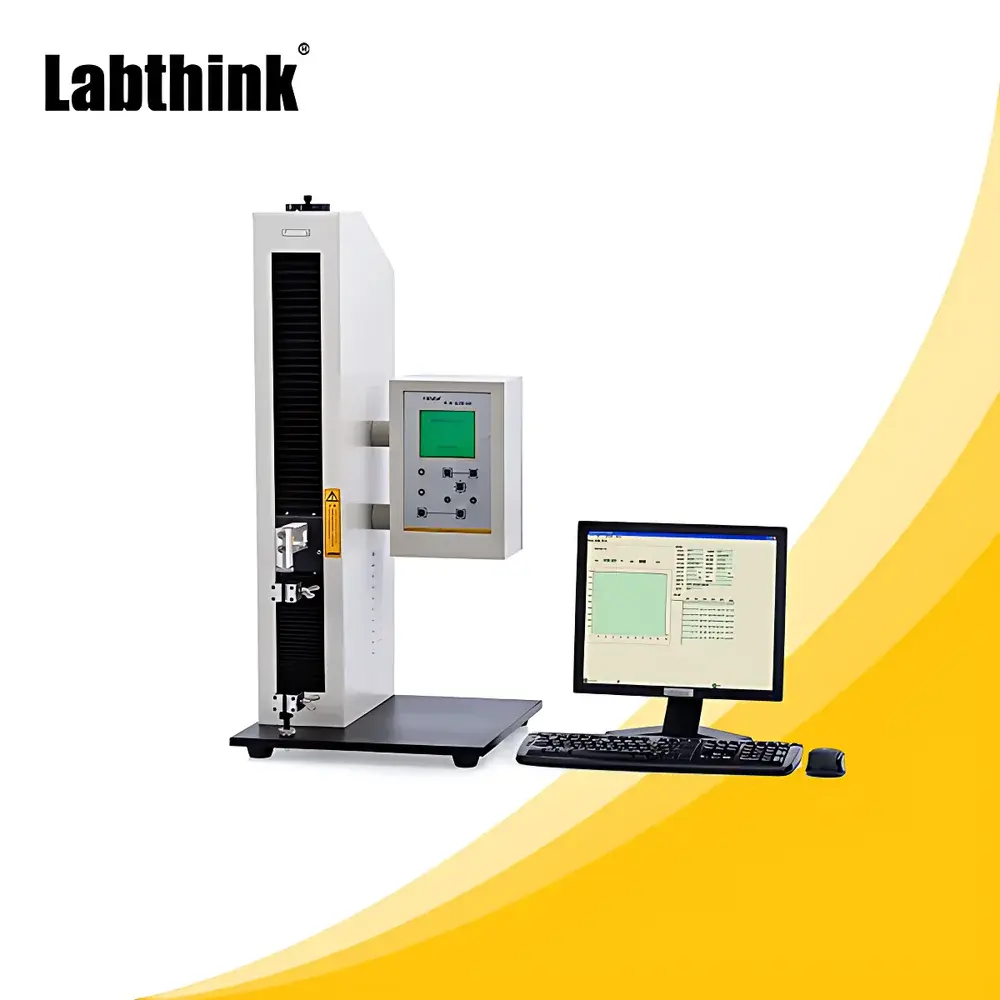
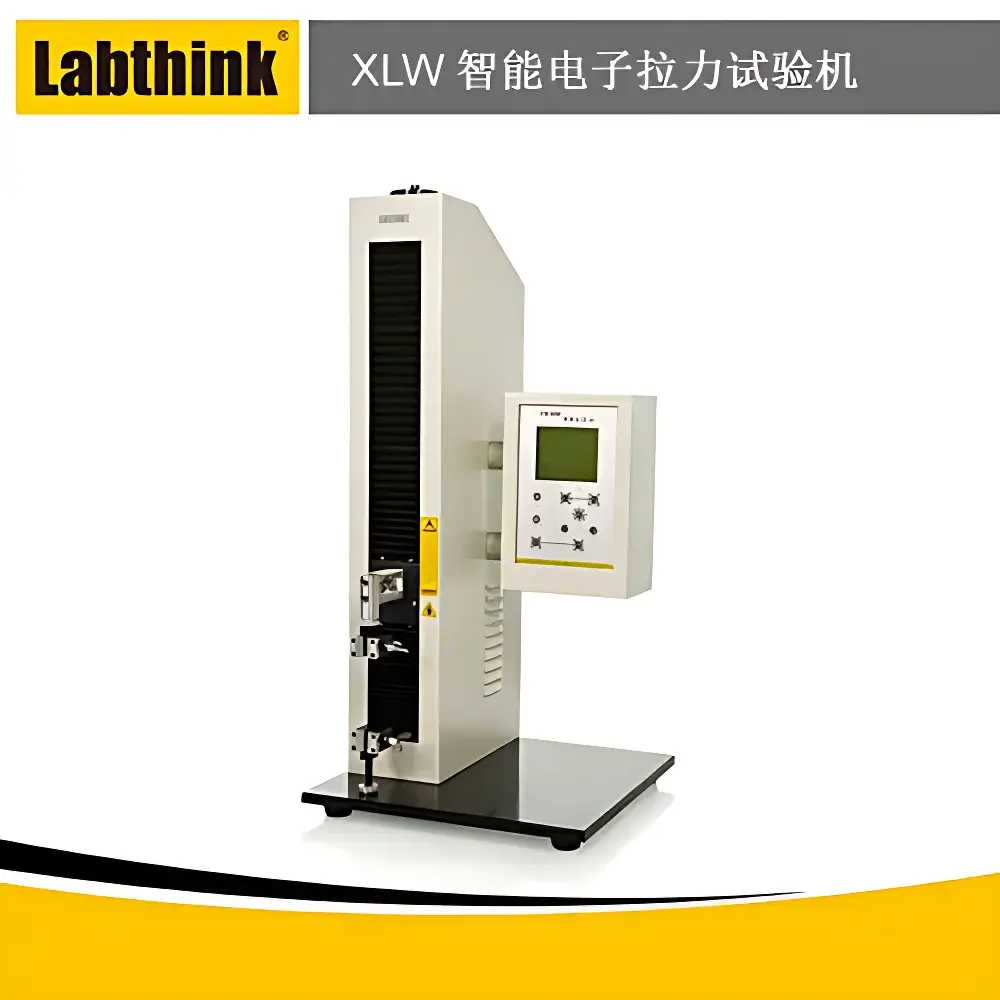
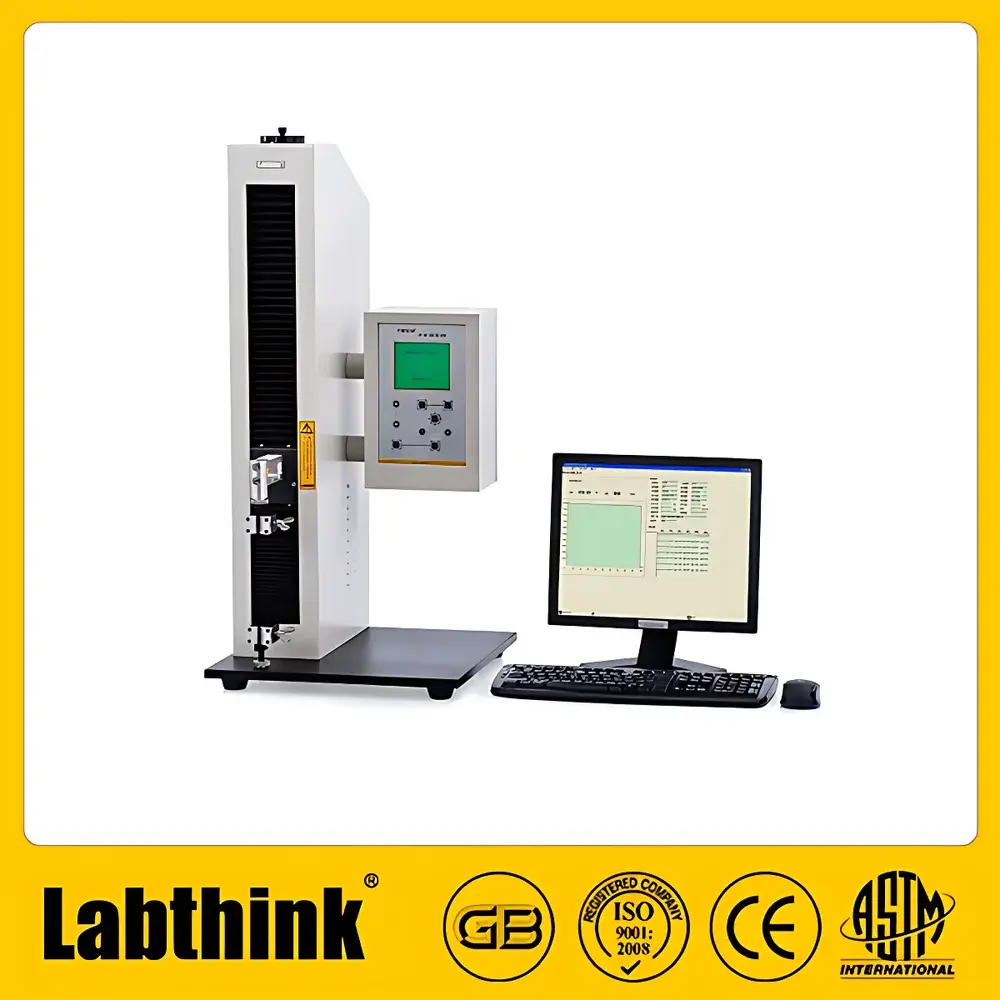
Labthink XLW Series Electronic Tensile Testing Machine
| Brand | Labthink |
|---|---|
| Model | XLW |
| Type | Electronic Tensile Testing Machine |
| Max Test Load | 1 kN |
| Force Accuracy Class | Class 1 |
| Test Stroke | 600 mm |
| Standard Gauge Width | 30 mm |
| Optional Gauge Width | 50 mm |
| Test Speed Range | 50–500 mm/min (adjustable in discrete steps: 50, 100, 150, 200, 250, 300, 500 mm/min) |
| Dimensions (L×W×H) | 450 × 450 × 980 mm |
| Origin | Shandong, China |
| Manufacturer | Labthink Co., Ltd. |
Overview
The Labthink XLW Series Electronic Tensile Testing Machine is a precision-engineered instrument designed for standardized mechanical property evaluation of thin, flexible materials under uniaxial tensile loading. Based on the fundamental principles of Hooke’s Law and stress–strain continuum mechanics, it delivers repeatable force-displacement data essential for quality control, material development, and regulatory compliance in packaging, medical device, polymer, and paper industries. The system operates in accordance with internationally recognized test methodologies—including ASTM D882 (Standard Test Method for Tensile Properties of Thin Plastic Sheeting), ISO 527-3 (Plastics — Determination of Tensile Properties — Part 3: Test Conditions for Films and Sheets), and GB/T 13022–1991 (Plastics — Film and Sheet — Determination of Tensile Properties)—ensuring data traceability and cross-laboratory comparability. Its rigid dual-column frame, high-resolution load cell, and synchronized motorized crosshead enable stable, low-noise acquisition across the full 1 kN capacity range, supporting both static and dynamic mechanical characterization.
Key Features
- Class 1 force accuracy per ISO 7500-1 and GB/T 16491, verified via third-party calibration certificates traceable to national metrology institutes.
- Programmable crosshead speed from 50 to 500 mm/min in seven discrete increments, optimized for consistent strain rate control in compliance with GB/T 1040.3 and ASTM D882 Annex A1.
- 600 mm effective travel stroke accommodates elongation testing of highly ductile films (e.g., LDPE, TPU, or hydrogel-based substrates) without premature end-of-travel interruption.
- Modular夹具 system featuring standard 30 mm wide pneumatic or mechanical grips; optional 50 mm width and specialized fixtures (e.g., floating roller clamps, peel-adhesion jigs, puncture probes) support multi-standard testing protocols.
- Robust cast-iron base and reinforced aluminum alloy columns minimize vibration-induced signal noise during high-speed or low-force measurements.
- Integrated overload protection and emergency stop circuitry conforming to IEC 61000-6-2 electromagnetic compatibility requirements and CE machinery directive 2006/42/EC.
Sample Compatibility & Compliance
The XLW platform is validated for use with polymeric films (BOPP, PET, PE, PVDC), laminated structures (aluminum foil/paper/plastic composites), pressure-sensitive adhesives (PSAs), medical tapes, nonwovens, elastomeric membranes, and fiber-reinforced papers. It supports full-spectrum mechanical assessments including tensile strength at yield and break, elongation at break, modulus (secant and tangent), peel adhesion (180° and 90°), tear resistance (Elmendorf, trouser, and pant-leg methods), puncture force, heat seal strength, and delamination force. All test routines comply with GLP documentation standards and are compatible with FDA 21 CFR Part 11–enabled software configurations when paired with optional audit trail modules.
Software & Data Management
The included PC-based testing software provides real-time force–displacement curve visualization, automatic peak detection, statistical reporting (mean, SD, CV%), and export to CSV, PDF, or XML formats. Raw data files retain full metadata—operator ID, timestamp, environmental conditions (if interfaced with optional温湿度 sensor), calibration history, and test parameter logs—enabling full audit readiness. Software architecture supports user-defined test templates aligned with specific internal SOPs or external standards (e.g., USP for package integrity validation). Optional integration with LIMS platforms via OPC UA or TCP/IP ensures seamless data flow into enterprise quality management systems.
Applications
- Quality assurance of pharmaceutical blister lidding films and pouch seals per USP and ISO 11607-2.
- Characterization of lithium-ion battery separator tensile stability under thermal aging per IEC 62660-1.
- Evaluation of biodegradable packaging film performance across humidity gradients (ASTM D618 conditioning).
- Validation of medical device backing layer cohesion in transdermal patches (ISO 10993-10 cytotoxicity correlation).
- R&D screening of nanocomposite film reinforcement efficiency using modulus–filler concentration regression models.
- Supplier qualification testing against automotive OEM specifications (e.g., GMW14872, Ford FLTM BO 137-01).
FAQ
What standards does the XLW series directly support out-of-the-box?
The system is preconfigured with test methods for GB/T 13022–1991, GB/T 1040.3–2006, ASTM D882, ISO 527-3, and ISO 1184. Custom method creation is enabled via editable parameter sets.
Can the XLW perform peel and tear tests without hardware modification?
Yes—peel fixtures (180°/90°) and Elmendorf-type tear blades are available as plug-and-play accessories; no recalibration is required when switching between tensile and peel modes.
Is force calibration traceable to international standards?
Each unit ships with a factory calibration certificate traceable to CNAS-accredited laboratories (ISO/IEC 17025), and field recalibration kits meet ISO 7500-1 Class 1 verification criteria.
Does the software support multi-user access with role-based permissions?
Yes—administrator, technician, and reviewer roles can be assigned with configurable permissions for test execution, data export, and report approval, satisfying ALCOA+ data integrity principles.
What maintenance intervals are recommended for long-term accuracy?
Load cell and encoder verification every 6 months; full mechanical inspection (guide rails, belt tension, grip alignment) annually; documented in the provided maintenance logbook and supported by Labthink’s global service network.



