
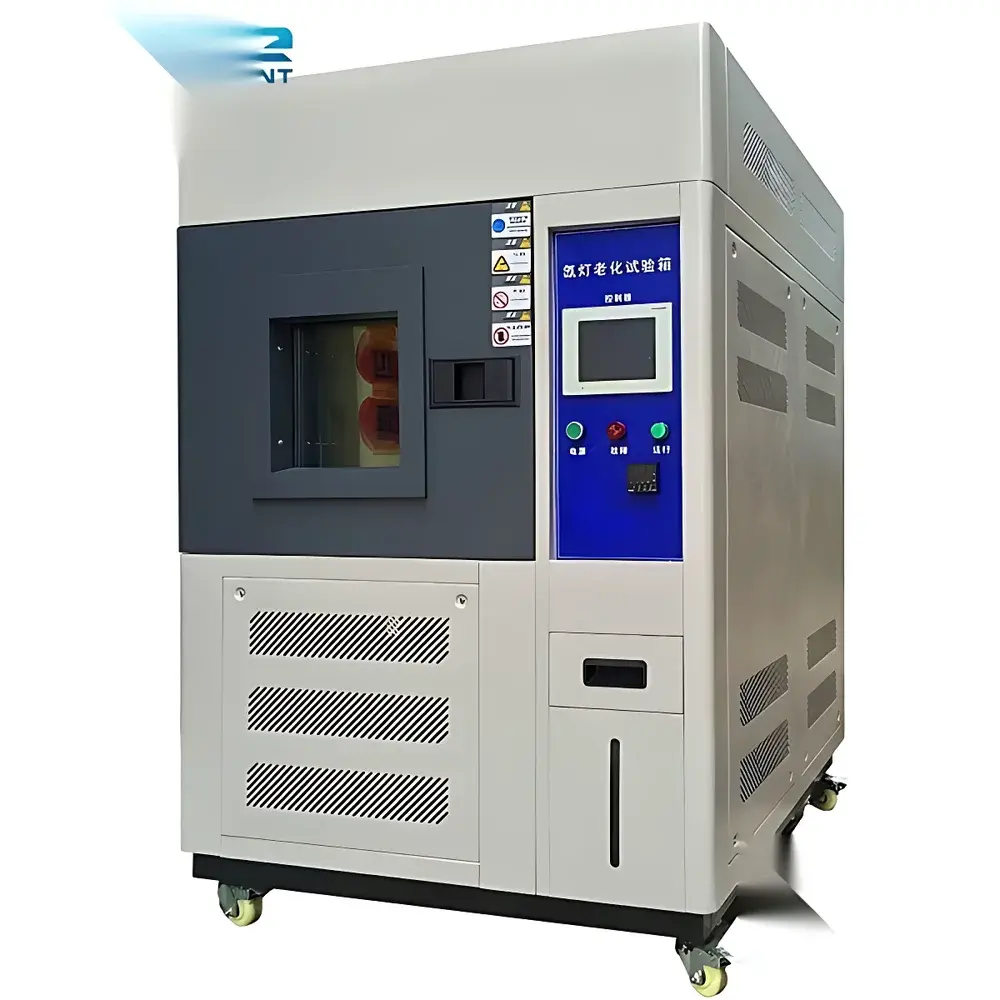
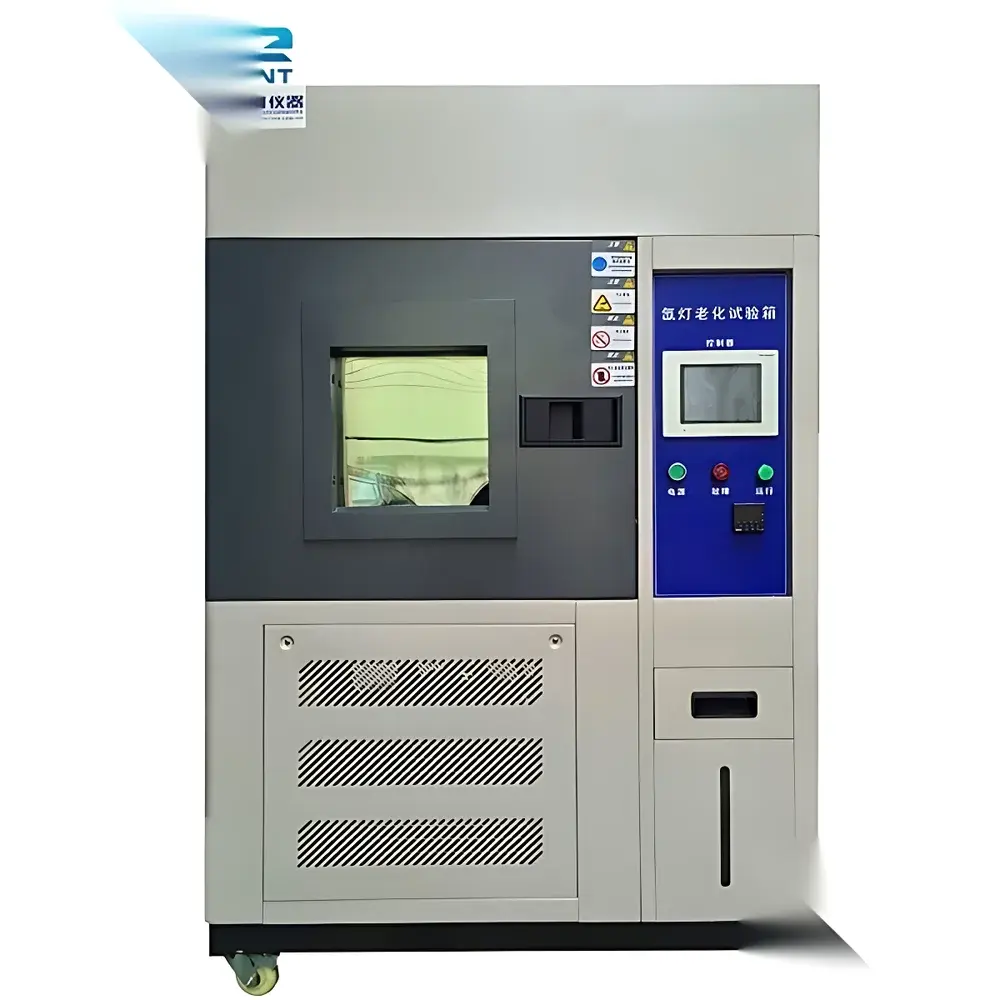
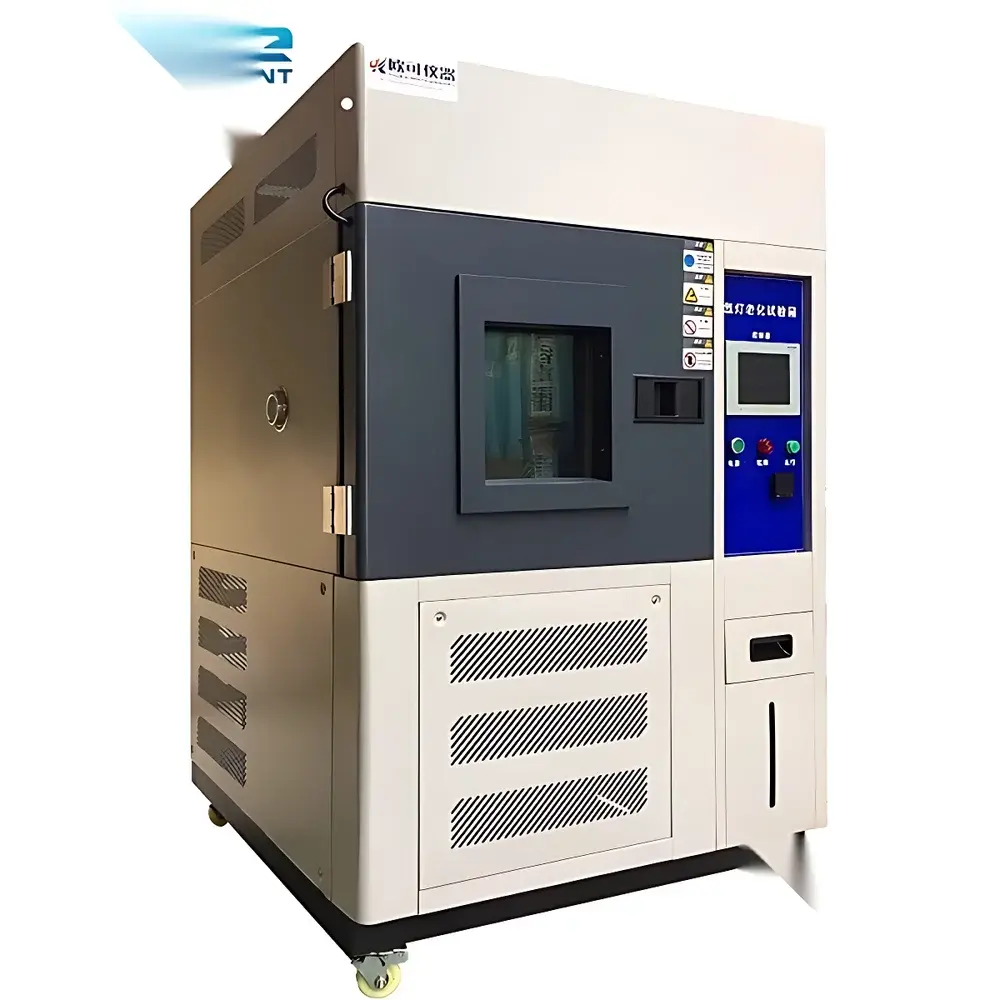
OKEO Xenon Arc Weathering Test Chamber for Windows and Doors
| Brand | OKEO |
|---|---|
| Type | Xenon Arc Weathering Test Chamber |
| Cooling Method | Water-Cooled / Air-Cooled / Benchtop Configurations Available |
| Light Source | 1× Water-Cooled Xenon Lamp or 3× Air-Cooled Xenon Lamps |
| Temperature Range | Ambient to +80 °C (Black Panel) |
| Humidity Control | 10–95% RH (optional) |
| Irradiance Control | 0.35–0.65 W/m² @ 340 nm (adjustable) |
| Rain Simulation | Programmable Spray Cycle (deionized water) |
| Compliance | ASTM G155, ISO 4892-2, SAE J2527, GB/T 16422.2 |
| Power Supply | 380 VAC, 3-phase, 50/60 Hz |
| Dimensions (Typical Water-Cooled) | W1200 × D1100 × H1900 mm |
| Weight (Typical) | ~450 kg |
| Refrigerant | R404A (CFC-free) |
| Compressor | Tecumseh/Taikang Hermetic Scroll Type |
| Noise Level | <60 dB(A) at 1 m |
| Data Logging | Real-time irradiance, temperature, humidity, spray status |
| Software | OKEO-WeaTest v3.x (multi-language, audit trail, CFR 21 Part 11 compliant export) |
Overview
The OKEO Xenon Arc Weathering Test Chamber for Windows and Doors is an engineered environmental simulation system designed to replicate the full spectrum of outdoor weathering stressors—including solar radiation (UV, visible, and near-IR), thermal cycling, relative humidity, condensation, and periodic water spray—under controlled laboratory conditions. Based on the principles of xenon arc irradiation, the chamber employs either a single high-intensity water-cooled xenon lamp or an array of three air-cooled lamps to deliver spectral energy closely matching natural sunlight (CIE No. 85:1989 reference). This enables accelerated evaluation of photodegradation, color fading, gloss loss, cracking, chalking, and adhesion failure in architectural fenestration components—particularly silicone-sealed windows, PVC-U profiles, aluminum composite panels, gaskets, and coated glazing systems. Unlike UV fluorescent or QUV-based testers, xenon arc technology provides superior fidelity in spectral match and thermal load distribution, making it the internationally preferred method for qualification testing per automotive OEM specifications (e.g., Ford CETP, GMW14124) and building product standards (EN 1279-5, ISO 11341).
Key Features
- Modular optical architecture supporting both water-cooled and air-cooled xenon lamp configurations—enabling selection based on test throughput, spectral stability requirements, and infrastructure constraints (e.g., absence of chilled water supply)
- Integrated black panel thermometer (BPT) and white panel thermometer (WPT) with PID-controlled feedback loop for precise radiant temperature regulation (±0.5 °C)
- Programmable rain simulation system using deionized water, with adjustable spray duration, frequency, and pressure (0.1–0.4 MPa); optional distilled water recovery circuit for >65% water reuse
- Double-wall insulated stainless steel chamber with electrostatically applied epoxy coating; inner chamber constructed from SUS316L to resist chlorine-induced corrosion during wet cycles
- Tecumseh/Taikang hermetic scroll compressor paired with R404A refrigerant—meeting EU F-Gas Regulation (EC) No. 517/2014 and offering <60 dB(A) acoustic emission at operational load
- Energy-optimized control logic reducing standby power consumption by ≥30% versus legacy designs; automatic tap-water filtration module eliminates need for external DI water supply
- Full IEC 61000-4 EMC compliance; CE-marked per Machinery Directive 2006/42/EC and Low Voltage Directive 2014/35/EU
Sample Compatibility & Compliance
The chamber accommodates standard fenestration specimens up to 600 mm × 600 mm × 50 mm (W×D×H) on its rotating sample rack (water-cooled configuration) or flat horizontal tray (air-cooled configuration). Non-standard geometries—including curved sashes, multi-point locking assemblies, and fully assembled window units—are supported via custom fixture design. All configurations meet the irradiance uniformity requirement (±15% across test area) specified in ASTM G155 Annex A1. The system is validated for conformance to ISO 4892-2:2013 (Method A), SAE J2527:2021, and GB/T 16422.2–2014. Optional GLP-compliant operation includes electronic signature-enabled user access control, automated calibration log generation, and 21 CFR Part 11–ready data export with embedded metadata (test ID, operator, timestamp, parameter set, instrument ID).
Software & Data Management
OKEO-WeaTest v3.x is a native Windows application developed in-house using .NET Framework 4.8 and SQLite3 backend. It supports real-time monitoring of irradiance (340 nm and 420 nm channels), chamber air temperature, black panel temperature, relative humidity, and spray status—with configurable alarm thresholds and SMS/email alert integration. Test programs are stored as XML templates with version history; all runtime data is time-stamped with microsecond precision and archived in encrypted binary format. Audit trail functionality records every user action—including parameter edits, start/stop events, and manual overrides—with immutable timestamps and operator ID linkage. Multi-language UI (English, German, French, Spanish, Chinese, Japanese) is enabled at installation; language packs may be updated without firmware revision.
Applications
This chamber is routinely deployed in R&D laboratories and QC departments for: accelerated weathering validation of silicone structural sealants per ASTM C1184 and EN ISO 11600; UV resistance assessment of powder-coated aluminum frames under cyclic wet/dry exposure; durability testing of low-emissivity (low-E) coatings on insulating glass units; regulatory submission testing for CE marking of curtain wall systems (EN 13830); and comparative benchmarking of alternative gasket materials (EPDM, TPE, thermoplastic vulcanizates) under simulated coastal salt-fog + UV conditions. Its programmability also supports non-standard protocols—such as extended dark cycles with elevated humidity to simulate dew formation on vertical surfaces—or hybrid stress sequences combining thermal shock (-20 °C to +70 °C in ≤15 min) with simultaneous UV exposure.
FAQ
What is the typical lead time for a custom-configured chamber?
Standard water-cooled models ship within 8–10 weeks from order confirmation; air-cooled and benchtop variants require 6–8 weeks. Non-standard dimensions, extended temperature ranges, or integrated electrical biasing fixtures extend lead time by 3–5 weeks.
Can the chamber operate continuously for 1,000-hour test cycles?
Yes—continuous unattended operation is supported via redundant safety interlocks, automatic lamp hour tracking, and predictive maintenance alerts triggered at 80% of rated lamp life (typically 1,500 hours for water-cooled, 1,200 hours for air-cooled lamps).
Is third-party calibration certification available?
OKEO provides NIST-traceable irradiance calibration certificates (per ISO/IEC 17025) upon request; field verification services are offered globally through authorized metrology partners.
How is humidity controlled without condensation on optical components?
A dedicated humidity management subsystem uses modulated steam injection combined with precisely timed chamber purge cycles to maintain RH setpoints while preventing lens fogging or quartz filter deposition.
Does the system support remote diagnostics and firmware updates?
Yes—via secure TLS 1.2–encrypted Ethernet connection; remote access requires prior customer authorization and is logged with full traceability.



