
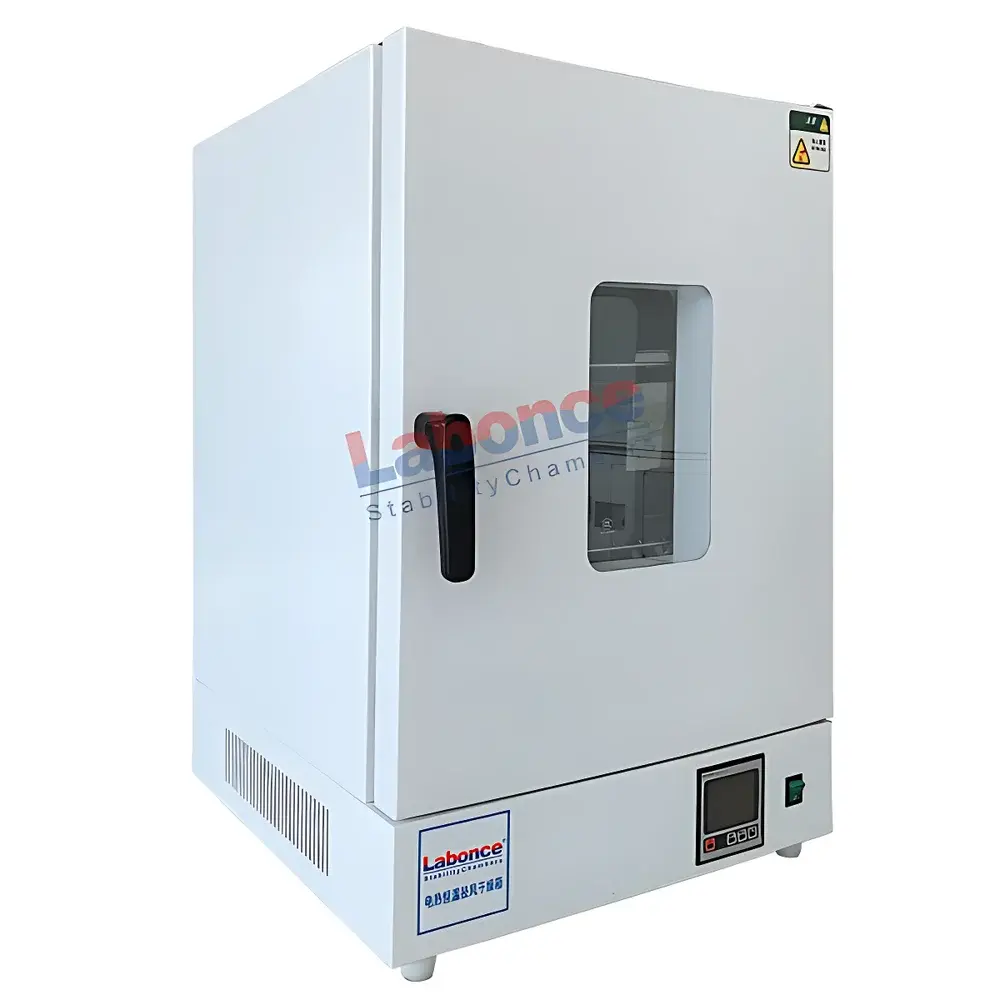
Labonce Labonce-245JMH Precision Forced-Air Drying Oven (300°C)
| Brand | Labonce |
|---|---|
| Model | Labonce-245JMH |
| Temperature Range | RT+20°C to 300°C |
| Chamber Volume | 240 L |
| Internal Dimensions (W×D×H) | 550×550×750 mm |
| External Dimensions (W×D×H) | 750×750×1150 mm |
| Power Supply | AC 220V±10% 50Hz or AC 380V±10% 50Hz |
| Rated Power | 2.5 kW |
| Temperature Uniformity | ±3.0°C (at ≤200°C) |
| Temperature Fluctuation | ±1.0°C |
| Standard Shelving | 2 adjustable stainless steel shelves (max. 7 configurable) |
| Construction | Exterior – powder-coated steel |
| Control System | Digital PID temperature controller |
| Safety | Independent over-temperature protection circuit |
| Compliance | Designed per IEC 61010-1 for laboratory electrical safety |
Overview
The Labonce Labonce-245JMH Precision Forced-Air Drying Oven is an industrial-grade, convection-heated thermal processing system engineered for reproducible, uniform heat treatment of samples in research laboratories, quality control environments, and manufacturing validation workflows. Operating across a calibrated temperature range from ambient +20°C up to 300°C, the oven employs a forced-air circulation architecture—driven by a rear-mounted centrifugal blower and optimized multi-directional airflow ducting—to achieve high spatial temperature homogeneity within its 240-liter stainless steel chamber. This design conforms to fundamental thermodynamic requirements for convective drying, thermal aging, moisture removal, and pre-conditioning of electronic components, polymers, pharmaceutical excipients, and ceramic precursors. Its structural integrity, thermal stability, and operational repeatability support routine use in ISO/IEC 17025-accredited labs and GMP-aligned production support areas where traceable, documented thermal exposure is required.
Key Features
- Forced-air convection system with rear-mounted blower and engineered air duct network ensures consistent airflow distribution, minimizing thermal stratification and delivering ≤±3.0°C temperature uniformity (measured per ASTM E2207 at ≤200°C)
- Chamber constructed from corrosion-resistant 304 stainless steel (interior) and electrophoretically coated carbon steel (exterior), providing long-term durability under repeated thermal cycling and chemical exposure
- Digital PID temperature controller with real-time display, programmable ramp-soak profiles, and manual setpoint adjustment—enabling precise thermal protocol execution without external software dependency
- Dual-stage thermal protection: primary control loop integrated with an independent mechanical over-temperature cut-off switch (adjustable up to 320°C), safeguarding both sample integrity and equipment longevity
- Ergonomic chamber access via double-layer insulated door with silicone gasket seal, reducing heat loss and maintaining stable internal conditions during intermittent loading/unloading
- Modular shelving system: two standard 304 stainless steel trays included; up to seven trays可 configured (tray spacing adjustable) to accommodate varied sample geometries and mass loading requirements
Sample Compatibility & Compliance
The Labonce-245JMH accommodates a broad spectrum of non-volatile, non-explosive, and non-hygroscopic materials—including metal alloys, polymer pellets, filter media, glassware, PCB substrates, and inert reference standards—under controlled dry-heat conditions. It is not intended for flammable solvents, biological tissues requiring humidity control, or vacuum-sensitive specimens. The unit complies with IEC 61010-1:2010 for safety requirements of electrical equipment for measurement, control, and laboratory use. While not certified to UL or CSA standards out-of-the-box, its construction and circuit protection meet baseline criteria for integration into CE-marked laboratory systems. For regulated environments, users may configure audit trails via optional RS485/Modbus RTU interface (available upon request) to support 21 CFR Part 11–aligned data integrity practices when paired with validated third-party SCADA platforms.
Software & Data Management
The Labonce-245JMH operates as a standalone instrument with embedded firmware-based control logic. No proprietary software is bundled; however, the digital controller supports analog output (0–10 V or 4–20 mA) and Modbus RTU communication (RS485 port, optional) for integration into centralized lab management systems (LIMS) or PLC-controlled thermal validation sequences. Real-time temperature logging requires external data acquisition hardware; internal memory retains only current setpoint and actual chamber temperature. For GLP/GMP applications, users are advised to implement external calibrated thermocouple mapping (e.g., using Fluke 1524 or similar) prior to qualification, and to document calibration intervals per ISO/IEC 17025 Clause 6.4. Firmware updates are distributed via secure FTP upon registration and are subject to version-controlled release notes.
Applications
- Thermal aging studies of elastomers, adhesives, and encapsulants per ASTM D573 and ISO 188
- Drying and conditioning of analytical reference standards prior to gravimetric analysis (USP & EP general chapter <1251>)
- Pre-baking of printed circuit boards and semiconductor packaging substrates to eliminate moisture-induced popcorning
- Moisture content determination in pharmaceutical granules and excipients following USP <921> loss-on-drying methodology
- Heat treatment of calibration weights, volumetric glassware, and metrology fixtures to stabilize dimensional properties
- Accelerated stability testing of packaging materials under elevated temperature protocols (ICH Q1A)
FAQ
What is the maximum recommended continuous operating temperature?
The Labonce-245JMH is rated for continuous operation up to 300°C; however, sustained use above 280°C is discouraged to preserve heater element lifespan and gasket integrity.
Can this oven be used for sterilization?
No—this model lacks HEPA filtration, steam generation, pressure control, or validation-grade documentation required for sterilization processes per ISO 17665 or EN 285.
Is the chamber volume verified per ISO 12781-1?
Chamber volume is calculated geometrically from nominal internal dimensions; volumetric verification per ISO 12781-1 is not performed at factory but can be conducted on-site using calibrated displacement methods.
Does it support NIST-traceable calibration?
The unit ships with a factory calibration certificate referencing NIST-traceable reference standards; full IQ/OQ/PQ documentation packages are available separately for regulated users.
What maintenance is required for long-term reliability?
Biannual inspection of blower motor bearings, cleaning of air intake filters, and verification of door seal compression are recommended; heater resistance checks should be performed annually.



