
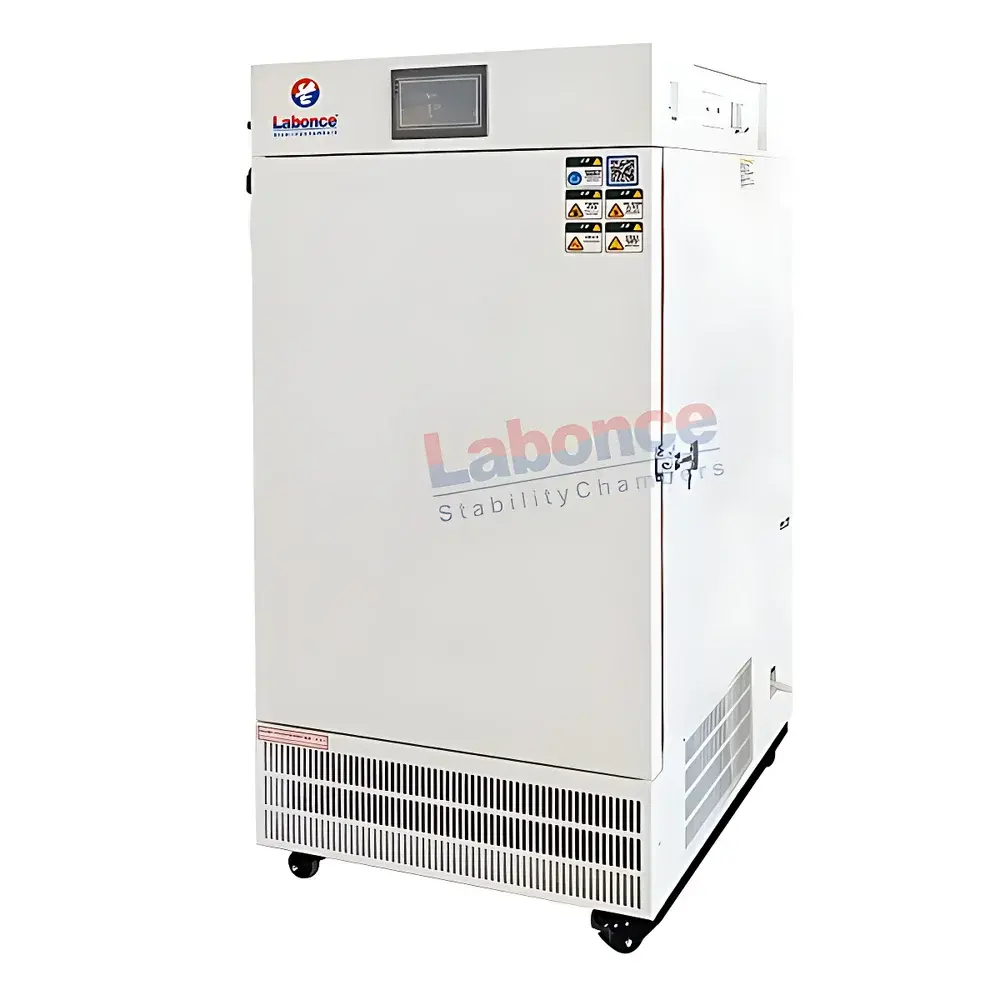
Labonce Labonce-250GS-FC Pharmaceutical Stability Testing Chamber (Single-Door Configuration)
| Brand | Labonce |
|---|---|
| Origin | Beijing, China |
| Manufacturer Type | Direct Manufacturer |
| Product Category | Domestic |
| Model | Labonce-250GS-FC |
| Pricing | Available Upon Request |
| Temperature Range | 10–65 °C |
| Humidity Range | 15–95 %RH |
| Internal Volume | 250 L |
| Internal Dimensions (W×D×H) | 600×500×830 mm |
| External Dimensions (W×D×H) | 780×880×1650 mm |
| Power Consumption | 1.8 kW |
| Standard Shelves | 3 (adjustable), up to 7 configurable |
| Temperature Uniformity | ±1.0 °C |
| Temperature Fluctuation | ±0.5 °C |
| Humidity Uniformity | ±3 %RH |
| Humidity Fluctuation | ±2 %RH |
| Ambient Operating Temperature | +5 to +35 °C |
| Power Supply | 220 V, 50/60 Hz |
| Compressor | Imported Hermetic Inverter Compressor |
| Humidity Sensor | Imported Capacitive RH Sensor |
| Controller | 7-inch Full-Color Programmable Touchscreen |
| User Access Control | Three-Tier Role-Based Authentication |
| Audit Trail | Time-stamped, tamper-evident operation and alarm logs exportable via USB in read-only format |
| Data Output | Built-in thermal line printer + internal electronic storage with timestamped records |
| Safety Systems | Independent overtemperature protection, compressor overheat/overpressure cutoff, dry-run prevention, water shortage detection, anti-dry-burn safeguards |
| Alarm Modes | Local audible alarm + remote SMS alert for temperature/humidity deviation and power failure |
| Door Design | Dual-door system — outer insulated solid door + inner tempered glass observation door (minimizes internal environmental disturbance during visual inspection) |
| Insulation | High-density polyurethane foam (≥120 mm thickness, closed-cell structure) |
| Interior Material | Mirror-finish AISI 304 stainless steel |
| Exterior Finish | Powder-coated cold-rolled steel |
| Compliance References | ICH Q1A(R2), Q5C, Q5D |
Overview
The Labonce Labonce-250GS-FC Pharmaceutical Stability Testing Chamber is an engineered environmental simulation platform designed specifically for long-term, real-time stability studies required under ICH Q1 guidelines and regulatory submissions to the NMPA, FDA, EMA, and PMDA. It operates on a dual-control principle—precisely regulating both temperature (10–65 °C) and relative humidity (15–95 %RH) within a thermally isolated 250 L chamber volume—enabling controlled stress testing of drug substances and products across defined climatic zones (Zone IVa, IVb, III). Its core architecture integrates an imported hermetic inverter compressor, enabling continuous modulation of refrigerant flow to maintain setpoint stability without cycling, thereby minimizing thermal shock and ensuring high reproducibility across repeated test cycles. The chamber’s structural integrity supports uninterrupted operation for durations exceeding 12 months—essential for accelerated and long-term stability protocols mandated by pharmacopeial monographs and quality agreements.
Key Features
- High-efficiency inverter refrigeration system delivering ≥50% reduction in energy and water consumption versus fixed-speed alternatives, validated per ISO 50001-aligned internal benchmarks.
- Triple-tier user access control with role-based permissions (Administrator, Supervisor, Operator), enforced via encrypted username/password authentication and session timeout.
- Comprehensive audit trail compliant with FDA 21 CFR Part 11 requirements: all parameter changes, manual interventions, alarm events, and calibration actions are time-stamped, uniquely identified, and stored with immutable metadata.
- 7-inch full-color programmable touchscreen controller supporting multi-segment ramp-soak profiles, real-time display of inverter output ratio, and intuitive graphical trend visualization.
- Dual-door configuration: outer door constructed with reinforced insulation and vapor barrier; inner door fabricated from low-emissivity tempered glass—enabling non-intrusive sample observation while limiting internal RH/temperature perturbation to <±0.3 °C and <±0.8 %RH during brief openings.
- High-density polyurethane foam insulation (≥120 mm, closed-cell, CFC-free) applied via high-pressure foaming process ensures thermal resistance (R-value > 4.2 m²·K/W) and dimensional stability over 15+ years of service life.
- AISI 304 mirror-finish stainless steel interior eliminates particle shedding, facilitates cleaning validation (per USP ), and resists corrosion from aggressive humidity regimes or solvent vapors.
Sample Compatibility & Compliance
The Labonce-250GS-FC accommodates standard pharmaceutical packaging formats—including blister cards, HDPE bottles, aluminum tubes, and secondary cartons—on three adjustable, perforated stainless steel shelves (load capacity: 15 kg/shelf). Its uniformity performance meets or exceeds ICH Q1A(R2) acceptance criteria: temperature deviation ≤±1.0 °C and fluctuation ≤±0.5 °C across all designated sensor locations (at least nine points per ICH Q5C Annex 2); humidity deviation ≤±3 %RH and fluctuation ≤±2 %RH. All control algorithms and data handling routines are developed and verified under a documented GxP-compliant software lifecycle (aligned with ICH Q9/Q10), supporting GLP and GMP environments. Validation documentation packages—including IQ/OQ/PQ templates, traceable calibration certificates (NIST-traceable sensors), and risk assessments per ISO 14971—are provided upon request.
Software & Data Management
Embedded firmware implements deterministic real-time control logic with millisecond-level sampling resolution. Data logging occurs at user-defined intervals (1–60 minutes), storing temperature, humidity, compressor status, door-open events, and alarm states in non-volatile memory with cyclic overwrite protection. Export functionality supports USB mass storage devices: audit logs and measurement records are written in .CSV format with SHA-256 hash integrity verification and write-protection attributes—ensuring compliance with ALCOA+ principles (Attributable, Legible, Contemporaneous, Original, Accurate, Complete, Consistent, Enduring, Available). Optional integration with Labonce CloudLink™ enables secure TLS 1.3–encrypted remote monitoring, automated report generation (PDF/Excel), and centralized fleet management across multiple chambers.
Applications
- ICH Q1-compliant real-time and accelerated stability studies for API and finished dosage forms (tablets, capsules, injectables, topicals).
- Photostability testing when integrated with optional ICH Q1B-compliant light cabinets (not included).
- Excipient compatibility screening under elevated humidity conditions (e.g., hygroscopicity assessment per USP ).
- Storage condition qualification for warehouse mapping and cold chain validation support.
- Method suitability verification for dissolution, assay, and impurity profiling under stressed environmental conditions.
- Regulatory submission dossier preparation (CTD Module 3.2.P.8) requiring documented chamber performance history and control traceability.
FAQ
Does the Labonce-250GS-FC comply with FDA 21 CFR Part 11 for electronic records and signatures?
Yes—the system enforces electronic signature equivalence through role-based login, mandatory audit trail capture, and exportable logs with cryptographic integrity checks.
Can the chamber be qualified per GMP requirements?
Yes—full IQ/OQ/PQ documentation kits, including protocol templates, acceptance criteria, and execution worksheets, are available and pre-aligned with Annex 15 and ASTM E2500 standards.
What is the expected calibration interval for the humidity sensor?
The capacitive RH sensor is factory-calibrated and requires no routine recalibration for 24 months under normal operating conditions; annual verification against NIST-traceable reference standards is recommended.
Is remote monitoring supported out-of-the-box?
Local Ethernet connectivity is standard; cloud-based remote access requires optional Labonce CloudLink™ license and IT infrastructure alignment with organizational cybersecurity policies.
How is temperature and humidity uniformity verified during PQ?
Uniformity mapping follows ICH Q5C Annex 2: nine calibrated PT100 and capacitive RH probes are positioned across the working volume per defined grid, with data logged continuously over 24 hours at worst-case setpoints (40 °C/75 %RH and 25 °C/60 %RH).




