
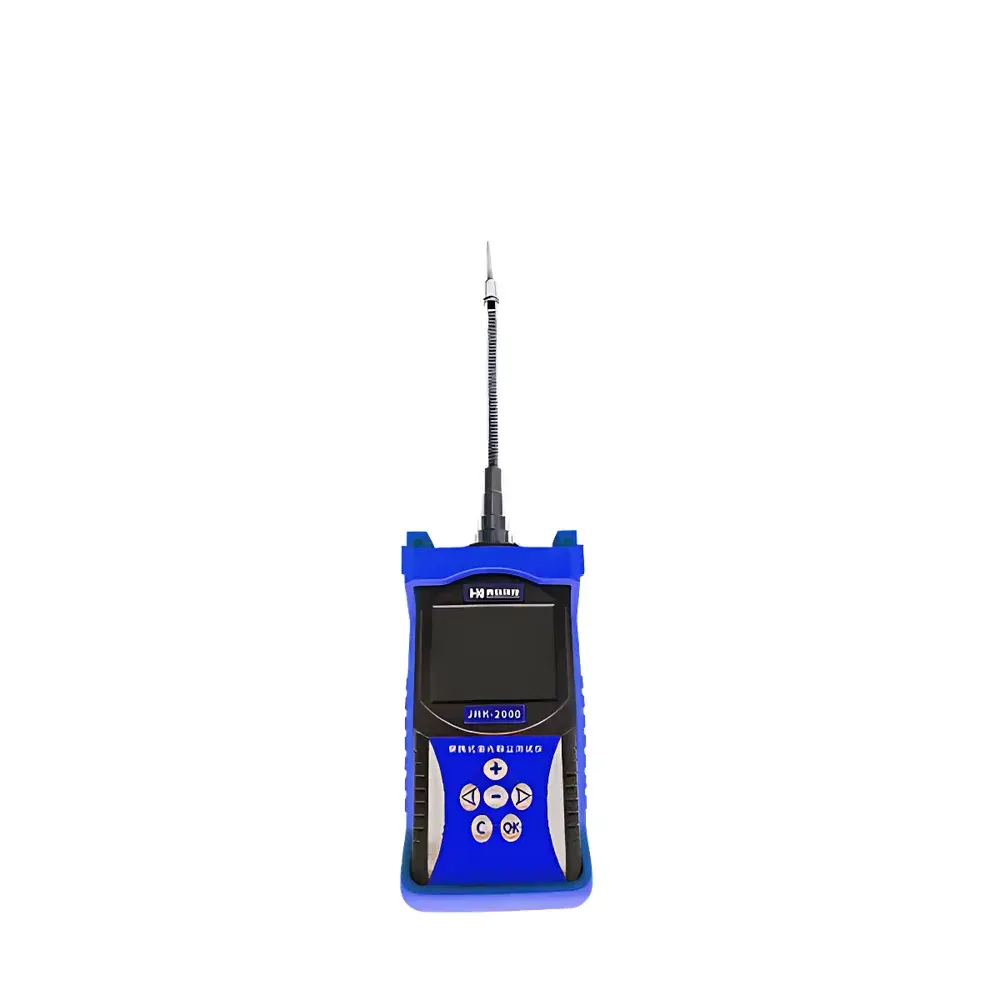
HUANKONG JHK-2000 Portable Laser Scattering Dust Monitor
| Brand | HUANKONG |
|---|---|
| Origin | Shandong, China |
| Manufacturer Type | OEM/ODM Producer |
| Country of Origin | China |
| Model | JHK-2000 |
| Measurement Principle | Laser Light Scattering |
| Safety Rating | Explosion-Proof (Ex ib IIB T4 Gb) |
| Measurement Range | 0–1999.9 µg/m³ |
| Resolution | 0.1 µg/m³ |
| Accuracy | ±15% (relative to gravimetric reference under ISO 7708:1995 conditions) |
| Display | Backlit LCD, 3.5-inch, 320×240 pixels |
| Power Supply | Rechargeable Li-ion battery (7.4 V, 4400 mAh), >24 h continuous operation |
| Environmental Operating Range | 0–40 °C, 10–90% RH (non-condensing) |
| Data Output | USB-C and optional Bluetooth 5.0 module for wireless data transmission |
| Compliance | JJG 846–1993, WS/T 206–2001, LD 98–1996 |
Overview
The HUANKONG JHK-2000 Portable Laser Scattering Dust Monitor is an industrial-grade particulate matter (PM) analyzer engineered for real-time, on-site quantification of respirable airborne dust concentrations. It operates on the principle of Mie scattering theory, where a collimated 650 nm laser diode illuminates suspended particles in a precisely conditioned airflow path; the intensity and angular distribution of scattered light are detected by a high-gain photodiode array and converted into mass concentration values (µg/m³) via factory-calibrated algorithms traceable to NIST-traceable PM reference aerosols. Designed specifically for occupational hygiene, indoor air quality (IAQ) assessment, and environmental compliance monitoring, the JHK-2000 delivers simultaneous dual-channel measurement of PM2.5 and PM10 fractions—aligned with the aerodynamic diameter cut-points defined in ISO 7708:1995 and WHO Air Quality Guidelines. Its explosion-proof housing (certified to Ex ib IIB T4 Gb per GB 3836.4–2021) enables safe deployment in hazardous locations including coal handling facilities, grain silos, and chemical processing zones where combustible dust accumulation poses ignition risk.
Key Features
- Real-time dual-fraction PM2.5/PM10 concentration output with 1-second sampling interval and 10-second rolling average display
- High-contrast 3.5-inch backlit LCD (320×240 resolution) optimized for readability under direct sunlight or low-illumination industrial settings
- Integrated temperature and relative humidity sensors (±0.5 °C, ±3% RH) for automatic environmental compensation of optical signal drift
- Ruggedized IP54-rated enclosure with ergonomic grip and shock-absorbing silicone bumper for field durability
- Onboard data logging capacity: up to 100,000 timestamped records (PM2.5, PM10, T, RH, battery level) stored internally with microSD card expansion support
- USB-C interface for firmware updates, configuration export, and raw data retrieval compatible with Windows/macOS/Linux platforms
Sample Compatibility & Compliance
The JHK-2000 is validated for use with ambient air, recirculated HVAC duct streams, and confined-space atmospheres containing non-hygroscopic and moderately hygroscopic aerosols (e.g., coal dust, cement powder, wood flour, and metal grinding particulates). It excludes application in highly viscous, oily, or corrosive aerosol environments without optional inlet filtration. Regulatory alignment includes adherence to Chinese national metrological verification规程 JJG 846–1993, occupational health standard WS/T 206–2001 for inhalable particulate matter, and industrial safety method LD 98–1996. While not certified to EU CE or US EPA EQVM requirements, its optical calibration methodology conforms to ISO 12103-1:2016 (A2 test dust) and supports traceability to gravimetric reference methods per ISO 10175-2:2022 for workplace exposure assessment.
Software & Data Management
The instrument ships with HUANKONG DustView™ PC software (v3.2+), enabling configuration of alarm thresholds (user-definable high/low limits per PM fraction), report generation (PDF/CSV), and time-series visualization with overlay of meteorological parameters. All data exports include embedded metadata: instrument ID, calibration date, operator ID, GPS coordinates (when paired with external GNSS module), and audit trail logs compliant with GLP documentation practices. Bluetooth 5.0 connectivity permits wireless synchronization with Android/iOS mobile applications for field technicians, supporting configurable push notifications and cloud upload to secure SFTP servers—facilitating integration into enterprise EHS management systems requiring ISO 45001-aligned record retention.
Applications
- Occupational exposure monitoring in mining, construction, foundry, and pharmaceutical manufacturing
- Indoor air quality audits for schools, hospitals, office buildings, and public transport cabins
- Post-abatement verification following asbestos or lead dust remediation projects
- Real-time feedback during local exhaust ventilation (LEV) system commissioning and performance testing
- Field validation of fixed-site ambient air monitoring networks (as a mobile reference unit)
- Research-grade particulate characterization in university environmental engineering laboratories
FAQ
What particle size distributions does the JHK-2000 resolve?
It reports mass concentrations for two standardized aerodynamic cut-points: PM10 (≤10 µm) and PM2.5 (≤2.5 µm), derived from optical scattering response calibrated against polydisperse aerosol standards.
Is the instrument suitable for outdoor long-term unattended operation?
No—it is designed for portable, operator-assisted surveys. Continuous outdoor deployment requires climate-controlled enclosures, power conditioning, and periodic optical window cleaning to maintain accuracy.
How often does the optical chamber require maintenance?
The laser and detector assembly is sealed and maintenance-free for 12 months under normal use; however, the inlet filter must be inspected and replaced every 50 hours of cumulative sampling in high-dust environments.
Can measurement data be integrated into SCADA or BMS platforms?
Yes—via Modbus RTU over RS-485 (optional adapter) or HTTP API endpoints enabled through the Bluetooth/Wi-Fi gateway module (sold separately).
Does the device meet FDA 21 CFR Part 11 requirements for electronic records?
The onboard audit trail meets ALCOA+ principles; full Part 11 compliance requires deployment within a validated IT infrastructure with electronic signatures, role-based access control, and periodic backup verification—implemented at the enterprise software layer, not at the instrument firmware level.







