
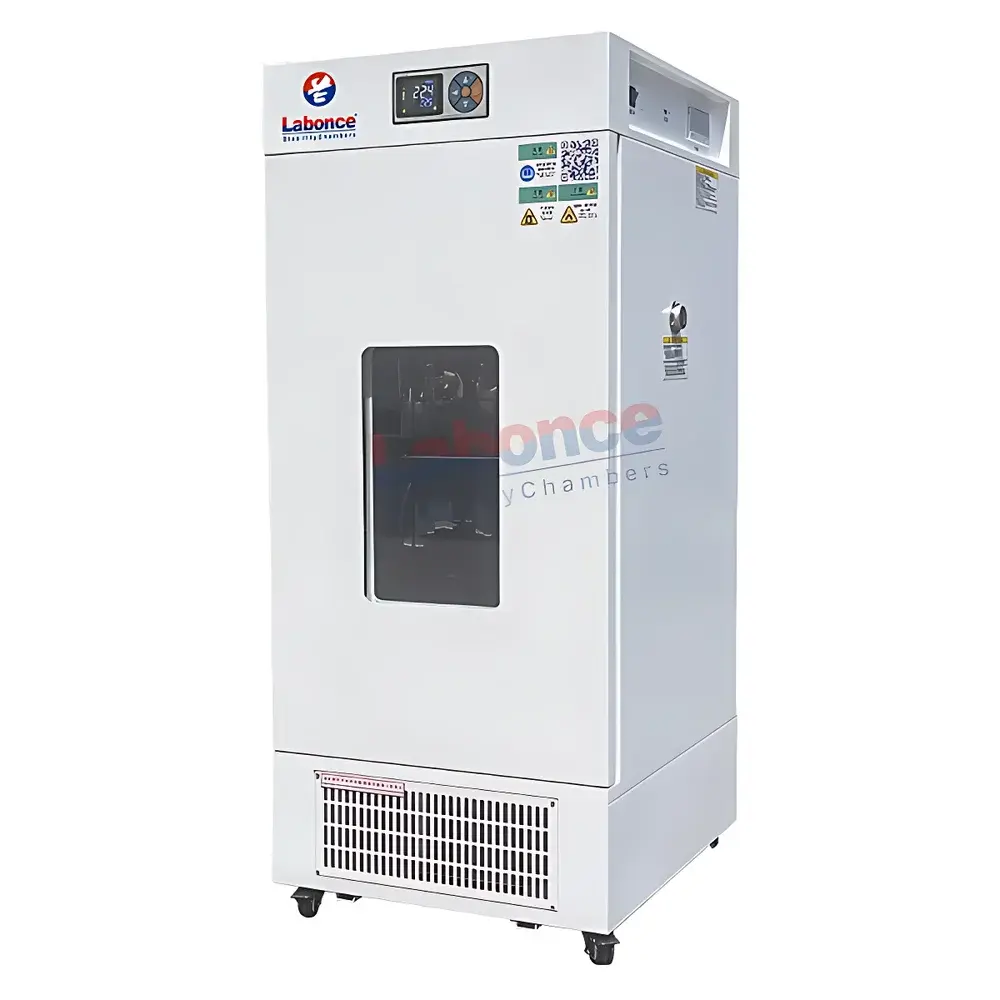
Labonce Labonce-150MI Mold Incubator
| Brand | Labonce |
|---|---|
| Model | Labonce-150MI |
| Temperature Range | 0–60°C |
| Chamber Volume | 150 L |
| Internal Dimensions (W×D×H) | 520×460×600 mm |
| External Dimensions (W×D×H) | 640×700×1250 mm |
| Power Consumption | 0.5 kW |
| Standard Shelving | 3 stainless steel shelves (max. 6 configurable) |
| Temperature Uniformity | ≤2.0°C at 37°C |
| Temperature Fluctuation | ±0.5°C (high-temp range), ±1.0°C (low-temp range) |
| Construction | Exterior – powder-coated steel |
| Cooling System | Imported hermetic industrial compressor |
| Control Interface | LCD controller with adjustable air velocity setting |
| Data Logging | Built-in electronic memory + thermal line printer (optional USB data export) |
| Safety | Independent over-temperature protection, compressor overheat/overpressure cut-off, audible alarm |
| Optional Accessories | UV germicidal lamp, interior lighting, testing port, casters, SMS alert module, MIT touchscreen controller (with 3-tier user permissions and 21 CFR Part 11-compliant audit trail) |
Overview
The Labonce Labonce-150MI Mold Incubator is a precision-engineered, forced-air thermostatic chamber designed specifically for the controlled cultivation of filamentous fungi, yeasts, and other humidity-sensitive microorganisms in compliance with standard microbiological testing protocols. It operates on a robust convection-based thermal regulation principle, utilizing an optimized air circulation system to ensure minimal thermal stratification across the entire working volume. Unlike general-purpose incubators, the Labonce-150MI integrates structural and operational features essential for mold growth studies—such as sustained low-temperature stability, non-reactive stainless-steel interiors, and contamination-minimized airflow pathways—making it suitable for BOD determination, pharmaceutical environmental monitoring, mycological research, and regulatory-compliant water quality analysis per ISO 6222, APHA 9215B, and USP /.
Key Features
- Advanced air distribution architecture ensures temperature uniformity ≤2.0°C at 37°C and ≤3.0°C across the full 0–60°C operating range—critical for reproducible sporulation and hyphal development assays.
- Chamber interior constructed entirely from electropolished AISI 304 stainless steel with seamless welds and rounded corners, eliminating crevices where spores or biofilms may accumulate; exterior finished with corrosion-resistant epoxy powder coating.
- High-efficiency, low-noise hermetic compressor system enables stable cooling performance even under ambient conditions up to 35°C, supporting uninterrupted long-term incubation cycles required for slow-growing molds.
- LCD-based microprocessor controller with real-time display of setpoint, actual temperature, elapsed time, and fan speed—fan velocity is continuously adjustable to balance heat transfer rate and sample desiccation risk.
- Dual-layer safety architecture: primary PID-controlled thermal regulation supplemented by independent mechanical over-temperature cutoff and compressor thermal overload protection, with local audible alarm activation.
- Integrated infrastructure includes 1× Ø50 mm pass-through port for sensor cables or gas lines, UV-C germicidal lamp (254 nm), LED interior illumination, and locking casters for lab mobility and positional stability.
Sample Compatibility & Compliance
The Labonce-150MI accommodates standard microbiological formats including Petri dishes (up to 150 mm diameter), multi-well plates, slant tubes, and liquid culture flasks—without compromising airflow integrity. Its 150 L chamber volume and three factory-installed 304 stainless steel shelves (expandable to six) support scalable experimental workflows. The unit conforms to IEC 61010-1 for electrical safety and meets structural requirements for GLP-compliant laboratories. When equipped with the optional MIT touchscreen controller, it supports FDA 21 CFR Part 11-compliant electronic records, including user authentication, immutable audit trails, and role-based access control (administrator/operator/auditor tiers).
Software & Data Management
Data integrity is maintained via dual-channel logging: internal flash memory retains timestamped temperature readings at user-defined intervals (1–60 min), while the integrated thermal line printer provides immediate hard-copy output for QC sign-off. All stored datasets are exportable via USB 2.0 interface in CSV format for traceability and statistical process analysis. The MIT controller upgrade introduces Ethernet connectivity, remote monitoring via secure HTTPS, automated report generation (PDF/Excel), and event-driven notifications—including SMS alerts triggered by deviation thresholds or door-open events.
Applications
- Regulatory mycological testing per ISO 7954 (mold enumeration in air), ISO 16000-17 (indoor air mold analysis), and EU GMP Annex 1 environmental monitoring requirements.
- Biochemical Oxygen Demand (BOD5) incubation at 20°C per ISO 5815-1 and ASTM D5210, where consistent thermal stability directly impacts oxygen consumption kinetics.
- Antifungal susceptibility testing (AFST) using agar dilution or broth microdilution methods requiring precise 25–30°C incubation windows.
- Stability studies of biologics and excipients under accelerated mold-challenge conditions per ICH Q5C guidelines.
- Environmental isolate propagation for taxonomic identification, whole-genome sequencing library prep, and reference strain maintenance.
FAQ
What is the minimum and maximum operating temperature range?
The Labonce-150MI maintains temperatures from 0°C to 60°C with programmable ramping and soaking profiles.
Does the incubator support humidity control?
No—the Labonce-150MI is a dry-heat mold incubator. For combined temperature/humidity applications, consider the Labonce-250MIS or Labonce-500MIS series.
Can the unit be validated for IQ/OQ/PQ protocols?
Yes—its stable thermal profile, documented sensor calibration points, and optional MIT controller with electronic audit trail facilitate full qualification per ASTM E2500 and Annex 15.
Is the stainless-steel interior certified for autoclave compatibility?
The AISI 304 chamber is resistant to standard laboratory disinfectants (e.g., 70% ethanol, 1% sodium hypochlorite) but is not rated for repeated autoclaving; cleaning is performed via wipe-down with validated sporicidal agents.
What power supply configuration is required?
A dedicated single-phase AC220V ±10%, 50 Hz circuit with proper grounding and ≥16 A circuit breaker is recommended for reliable operation.




