
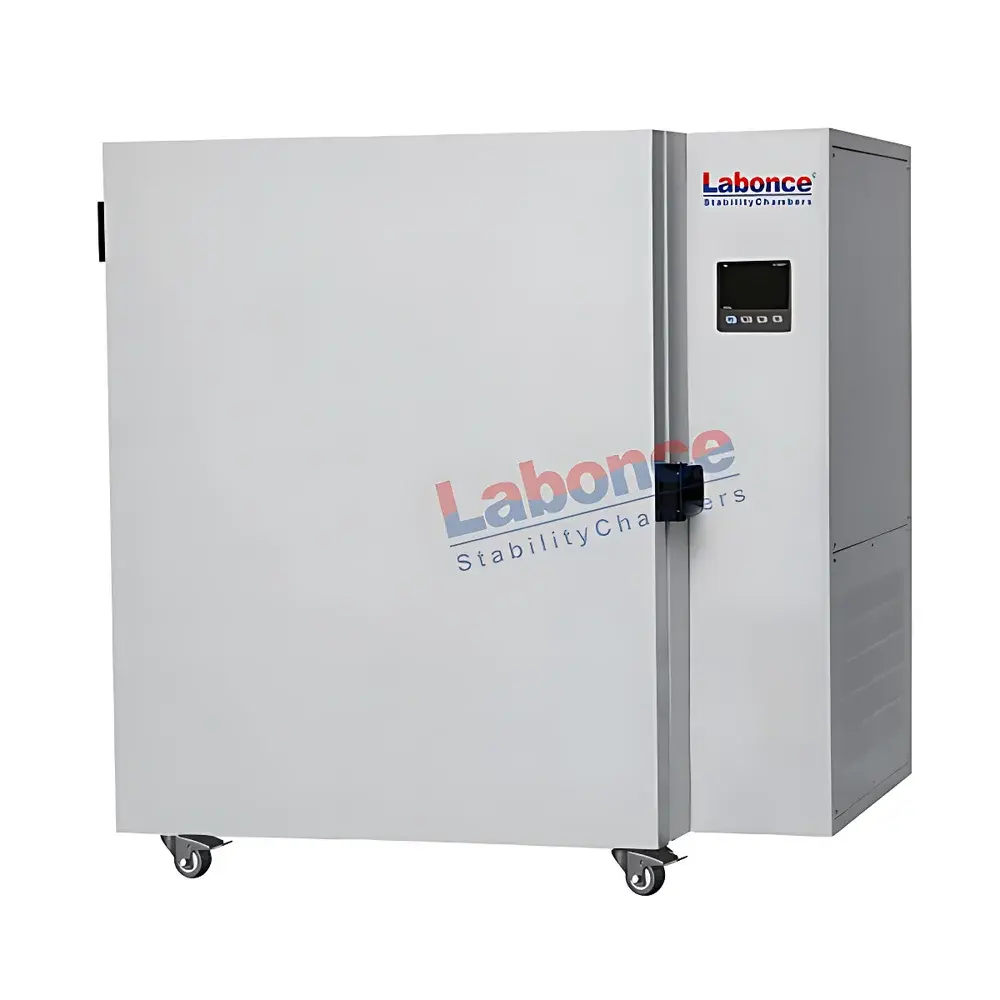
Labonce Labonce-250GW-T High-Temperature Constant-Temperature Test Chamber (200 °C)
| Brand | Labonce |
|---|---|
| Origin | Beijing, China |
| Manufacturer Type | Direct Manufacturer |
| Region of Origin | Domestic (China) |
| Model | Labonce-250GW-T |
| Temperature Range | RT+15 °C to 200 °C |
| Internal Volume | 250 L |
| Internal Dimensions (W×D×H) | 600×600×700 mm |
| External Dimensions (W×D×H) | 1250×850×1000 mm |
| Power Consumption | 2.5 kW |
| Standard Shelving | 2 adjustable stainless steel shelves |
| Temperature Uniformity | ≤ ±2.0 °C (≤200 °C) |
| Temperature Fluctuation | ≤ ±0.5 °C (≤200 °C) |
| Controller | Programmable color touchscreen controller with three-tier user permission management and audit trail capability |
| Compliance | GB/T 11158–2008 |
Overview
The Labonce Labonce-250GW-T High-Temperature Constant-Temperature Test Chamber is an engineered environmental simulation system designed for precise, repeatable thermal exposure testing of electrical, electronic, and material specimens under sustained elevated temperature conditions up to 200 °C. It operates on the principle of forced-air convection with a dynamically balanced airflow architecture to ensure uniform thermal distribution across the test volume—critical for compliance-driven qualification protocols in R&D, quality assurance, and reliability engineering. Unlike general-purpose ovens, this chamber integrates metrologically traceable temperature control, independent overtemperature protection, and structural design validated against GB/T 11158–2008, the Chinese national standard for high-temperature test chamber performance evaluation. Its application scope spans pre-conditioning per IEC 60068-2-2 (Test B), aging studies per ASTM D3045, and thermal stress screening for solder joint integrity, polymer degradation kinetics, and component derating validation.
Key Features
- Forced-air circulation system with optimized duct geometry and tangential blower placement—ensures temperature uniformity ≤ ±2.0 °C within the working volume at 200 °C.
- Programmable 7-inch full-color TFT touchscreen controller supporting multi-segment ramp-soak profiles, real-time data logging, and configurable alarm thresholds.
- Three-level hierarchical access control (Operator / Engineer / Administrator) with encrypted login, session timeout, and full audit trail compliant with GLP/GMP documentation requirements.
- Dual-wall construction: exterior cold-rolled steel with epoxy-polyester powder coating; interior 304 stainless steel chamber liner resistant to oxidation and thermal cycling fatigue.
- Independent mechanical overtemperature cut-off circuit—hardwired, non-software-dependent safety layer meeting IEC 61000-6-2 immunity and EN 60335-1 functional safety expectations.
- Thermal insulation using high-density ceramic fiber board (≥100 mm thickness) minimizing external surface temperature rise and energy consumption.
Sample Compatibility & Compliance
The Labonce-250GW-T accommodates samples up to 600 mm wide × 600 mm deep × 700 mm high, with two standard load-bearing stainless steel shelves (adjustable in 25 mm increments). Its thermal performance has been verified per GB/T 11158–2008, including measurement of temperature fluctuation (≤ ±0.5 °C at ≤200 °C), spatial uniformity, and recovery time after door opening. While not certified to ISO/IEC 17025, its controller’s audit trail functionality supports internal calibration verification and regulatory readiness for FDA 21 CFR Part 11–aligned workflows when paired with validated SOPs. The chamber is routinely deployed in laboratories conducting thermal aging per UL 746B, PCB thermal shock pre-screening, and automotive component endurance testing aligned with AEC-Q200 Annex C.
Software & Data Management
The embedded controller records temperature setpoints, actual chamber readings, alarm events, and user actions at user-defined intervals (1–600 seconds). Data export is supported via USB flash drive in CSV format—compatible with Excel, MATLAB, and LIMS platforms. No cloud connectivity or remote monitoring is provided; all data reside locally to meet ITAR-sensitive or air-gapped facility requirements. Audit trail entries include timestamp, operator ID, parameter change type (e.g., “Setpoint modified”, “Alarm acknowledged”), and pre-change/post-change values—enabling full reconstructability during internal audits or regulatory inspections.
Applications
- Accelerated thermal aging of elastomers, adhesives, and thermoplastics per ASTM D573 and ISO 188.
- Pre-bake conditioning of PCB assemblies prior to conformal coating or reflow soldering.
- Stability testing of active pharmaceutical ingredients (APIs) and excipients under ICH Q1A(R2) long-term and accelerated storage conditions.
- Thermal endurance evaluation of insulating materials used in motors, transformers, and power electronics.
- Validation of thermal cutoff switch response times and bimetallic actuator repeatability.
- Environmental stress screening (ESS) for military-grade components under MIL-STD-810 Method 501.7.
FAQ
What is the maximum operating temperature and corresponding accuracy specification?
The Labonce-250GW-T is rated for continuous operation up to 200 °C. At temperatures ≤200 °C, temperature deviation is ≤ ±2.0 °C and fluctuation is ≤ ±0.5 °C, as measured per GB/T 11158–2008 Clause 5.3.
Does the chamber support humidity control?
No—this is a dry-heat-only chamber. Humidity control is not implemented; models with combined temperature/humidity capability are designated separately (e.g., Labonce-GWH series).
Is third-party calibration certification available?
Labonce provides factory calibration reports traceable to CNAS-accredited standards. On-site NIST-traceable calibration by external providers is supported via accessible PT100 sensor ports and documented procedures.
Can the controller be integrated into a central lab monitoring network?
The unit does not feature Ethernet, RS-485, or Modbus interfaces. Integration requires external data loggers connected to the analog output terminals (0–10 V or 4–20 mA), configured per user-defined signal mapping.
What maintenance is required for long-term reliability?
Recommended quarterly inspection includes cleaning of air intake filters, verification of door gasket compression, and visual check of heating element terminal connections. Ceramic fiber insulation requires no periodic replacement under normal use conditions.



