
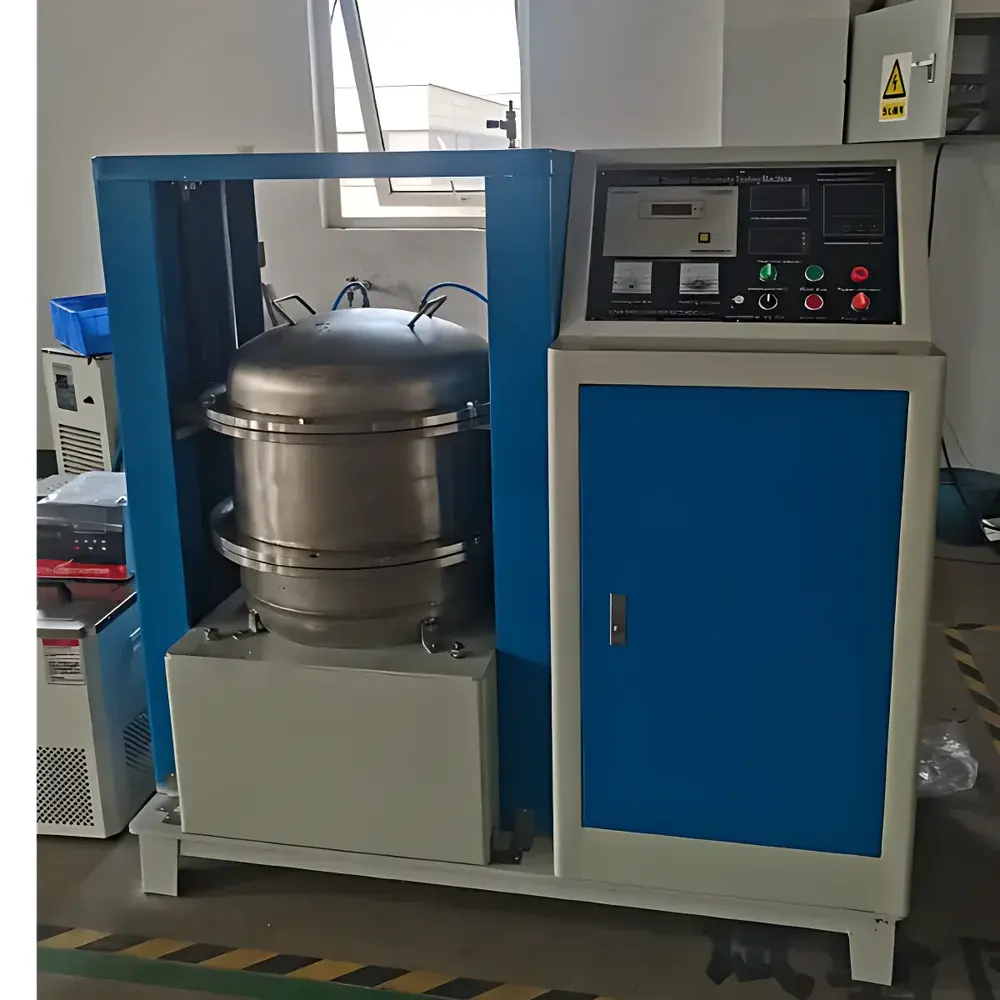
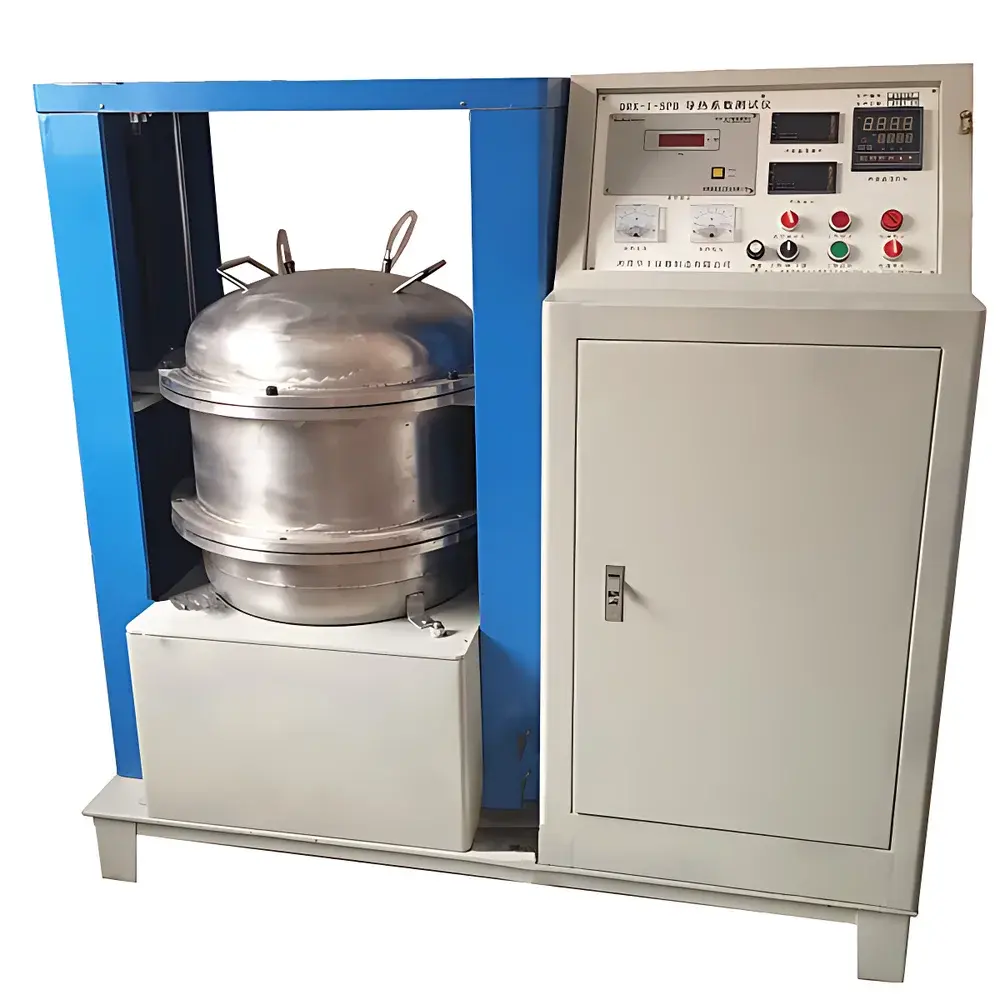
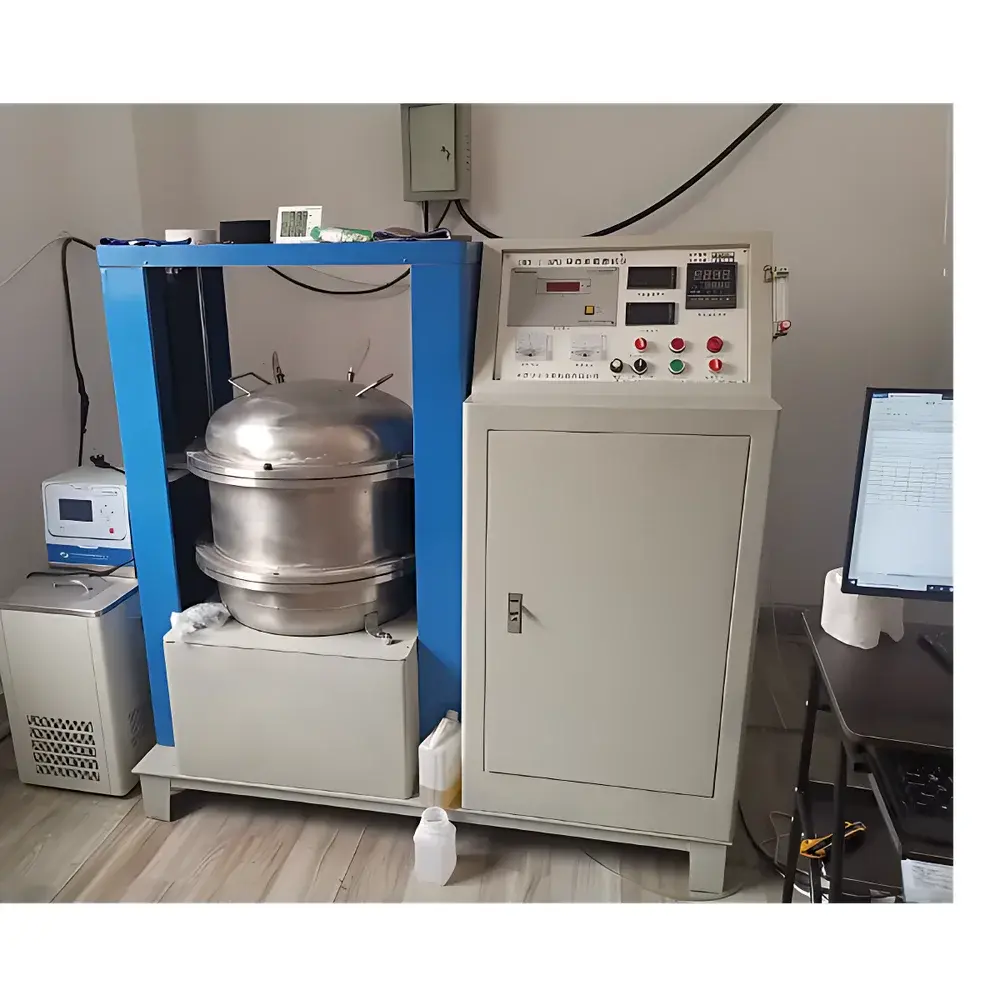
ZHENHUAFENXI DRX-II-SPB 1600 High-Temperature Thermal Conductivity Analyzer (Heat Flow Method)
| Brand | ZHENHUAFENXI |
|---|---|
| Origin | Hunan, China |
| Model | DRX-II-SPB 1600 |
| Measurement Principle | Heat Flow Method |
| Temperature Range | 600–1600 °C |
| Thermal Conductivity Range | 0.001–5 W/(m·K) |
| Accuracy | ≤3% |
| Repeatability | ≤3% |
| Sample Form | Solid |
| Sample Dimensions | φ119 × (35–45) mm |
| Test Atmosphere | Inert gas or vacuum (≤1000 Pa) |
| Heating Element | Molybdenum rod |
| Cooling System | Water-cooled furnace housing |
| Pressure Control Range | 0–0.1 MPa |
| Sensor | Imported U.S. heat flux sensor |
| Software | Fully automated analysis software with digital point monitoring |
| Physical Dimensions (L×W×H) | 1300 × 800 × 1450 mm |
| Power Supply | 220 V, 50 Hz |
Overview
The ZHENHUAFENXI DRX-II-SPB 1600 High-Temperature Thermal Conductivity Analyzer is an engineered solution for precise thermal conductivity characterization of refractory and insulating solids under extreme thermal conditions. Designed explicitly for the heat flow method (ASTM C1113, ISO 8301), this instrument operates across a continuous temperature range from 600 °C to 1600 °C—enabling reliable quantification of low-to-moderate thermal conductivity materials in controlled inert or vacuum environments. Its core architecture integrates a molybdenum heating element, water-cooled furnace housing, and a calibrated U.S.-sourced heat flux sensor to ensure stable thermal gradients and high signal fidelity. The system complies with key national standards including GB/T 17911.8–2002 (Refractory Ceramic Fiber Products) and YB/T 4130–2005 (Refractories – Determination of Thermal Conductivity by Heat Flow Method), and supports traceable, GLP-aligned testing protocols through full digital acquisition and timestamped state-point logging.
Key Features
- Stable high-temperature operation up to 1600 °C using dual-zone molybdenum rod heating with active water cooling to maintain structural integrity and thermal uniformity
- Precision heat flux measurement via imported thermopile-based sensor with linear response over the full 0.001–5 W/(m·K) range
- Controlled test atmosphere: programmable inert gas purging (N₂, Ar) or high-vacuum operation (≤1000 Pa) to suppress convection and oxidation effects
- Adjustable axial sample pressure (0–0.1 MPa) to standardize interfacial contact resistance—critical for heterogeneous or fibrous specimens
- Automated data acquisition and real-time visualization of temperature profiles, heat flux, and calculated conductivity values at user-defined intervals
- Modular hardware design supporting integration with external PLCs or LIMS via RS-485/Modbus RTU; compatible with FDA 21 CFR Part 11-compliant audit trail add-ons
Sample Compatibility & Compliance
The DRX-II-SPB 1600 is optimized for disk-shaped solid specimens measuring φ119 mm in diameter and 35–45 mm in thickness—ideal for ceramic fiber felts, graphite-based insulation, carbon-carbon composites, silicon carbide refractories, and porous oxide insulators. Its geometry and thermal boundary configuration minimize edge losses and radial heat leakage, satisfying the one-dimensional steady-state conduction assumptions required by ISO 8301 and ASTM C1113. All calibration and validation procedures follow documented SOPs aligned with ISO/IEC 17025 requirements for testing laboratories. Optional NIST-traceable reference material kits (e.g., certified alumina or fused quartz standards) are available for periodic system verification.
Software & Data Management
The embedded Windows-based analysis software provides full control over ramp rates, soak times, pressure setpoints, and atmosphere switching sequences. Each test generates a structured .CSV and .PDF report containing raw thermocouple voltages, normalized heat flux readings, calculated thermal conductivity versus temperature curves, uncertainty estimates (per GUM guidelines), and operator metadata. Audit logs record all parameter changes, user logins, and instrument status transitions—enabling compliance with GLP, GMP, and internal QA review processes. Data export supports direct import into MATLAB, Python (via Pandas), or statistical platforms such as JMP for advanced regression modeling of thermal behavior across temperature domains.
Applications
- Quality assurance of high-temperature insulation used in aerospace thermal protection systems (TPS) and industrial kiln linings
- R&D evaluation of next-generation refractory composites for metallurgical ladles and glass melting furnaces
- Thermal property benchmarking of carbon-fiber-reinforced ceramics (CFCCs) under simulated service conditions
- Validation of computational models (e.g., finite element thermal simulations) requiring experimentally derived k(T) functions
- Regulatory submissions requiring ISO 8301-compliant thermal data for building material fire safety certification
FAQ
What sample preparation protocols are recommended for optimal accuracy?
Standardized machining to ±0.1 mm flatness and parallelism is required; surfaces must be free of oxidation scale or machining residue. Pre-conditioning at 1000 °C in inert atmosphere for 2 hours is advised for carbon-containing materials.
Can the system operate unattended overnight during long-duration thermal soak tests?
Yes—the controller maintains setpoint stability within ±2 °C over 24+ hours and triggers automatic shutdown on overtemperature or coolant flow failure.
Is third-party calibration support available outside mainland China?
ZHENHUAFENXI partners with accredited metrology labs in Germany (DAkkS), Japan (JCSS), and the U.S. (A2LA) for on-site or return-to-facility calibration services.
How is thermal contact resistance mitigated between sample and hot/cold plates?
The integrated pressure actuation system applies uniform axial load while graphite foil or BN-based interface films may be applied per ASTM C1113 Annex A recommendations.
Does the software support multi-sample batch processing with auto-report generation?
Yes—up to 12 sequential runs can be queued; reports are timestamped, digitally signed, and archived in configurable network storage paths.



