
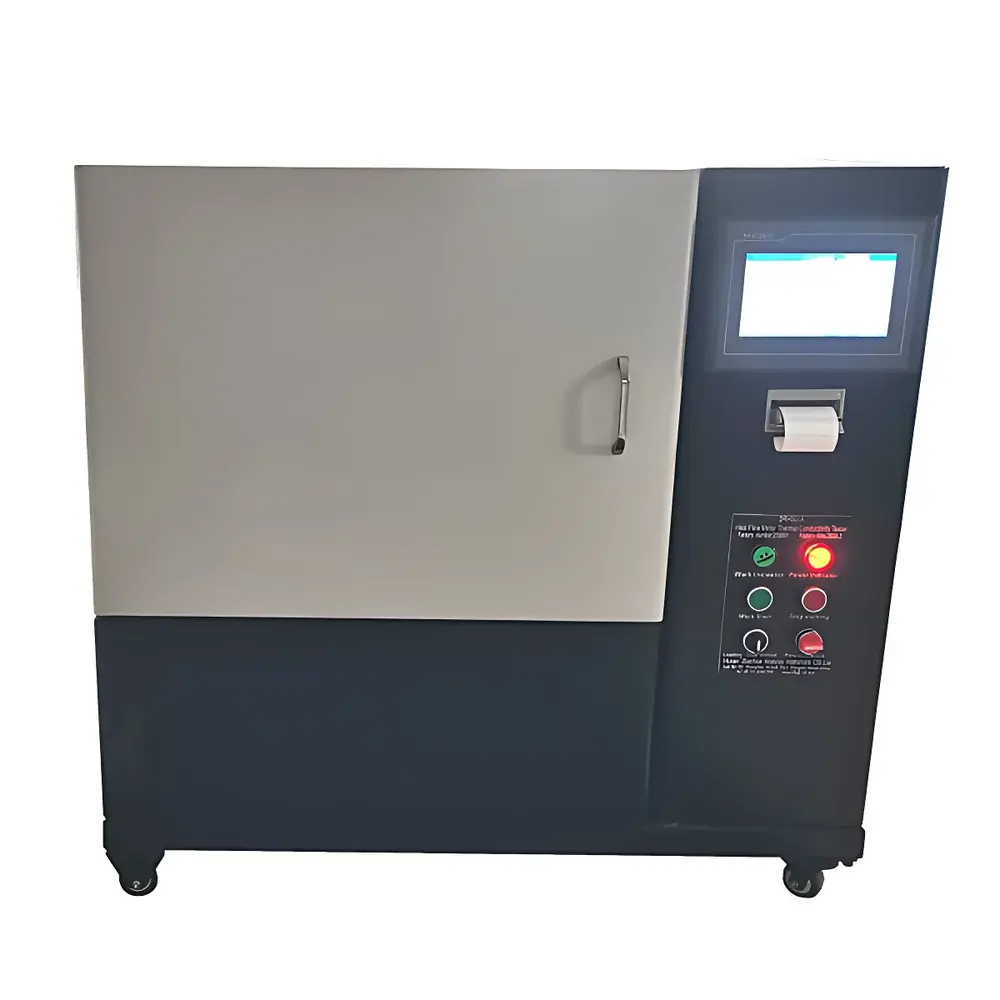
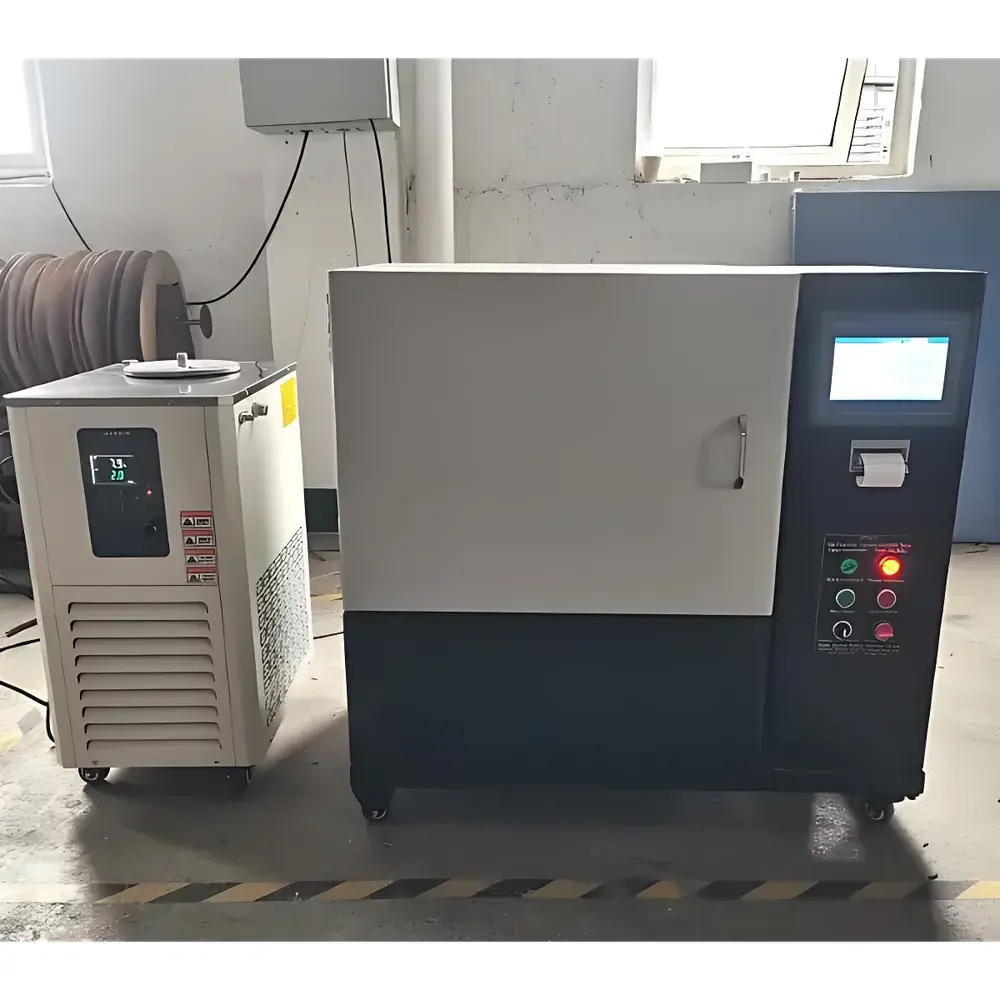
ZHENHUAFENXI DRH-300C Guarded Hot Plate Thermal Conductivity Analyzer
| Brand | ZHENHUAFENXI |
|---|---|
| Origin | Hunan, China |
| Model | DRH-300C |
| Measurement Principle | Guarded Hot Plate Method (ASTM C177 / ISO 8302) |
| Thermal Conductivity Range | 0.001–2.7 W/m·K |
| Accuracy | ±3% |
| Repeatability | ±1% |
| Temperature Control Range | −20 °C to 70 °C |
| Sample Thickness | 15–100 mm (auto-measured, 0.1 mm resolution) |
| Sample Size | 300 mm × 300 mm |
| Compliance | ASTM C518, ISO 8301, GB/T 10295, EN 1946-3:1999 |
| Cooling Options | Forced air, external water bath, or Peltier-based electronic cooling |
| Software | PC-based automated data acquisition, real-time thermal resistance calculation, report generation, and GLP-compliant audit trail (optional) |
Overview
The ZHENHUAFENXI DRH-300C Guarded Hot Plate Thermal Conductivity Analyzer is a precision instrument engineered for the steady-state measurement of thermal conductivity and thermal resistance of low-to-moderate conductivity solid materials. It operates on the guarded hot plate principle—defined in ASTM C177 and ISO 8302—as a primary reference method for insulating materials. In this configuration, a centrally heated test plate is surrounded by a temperature-controlled guard ring to eliminate lateral heat loss, ensuring one-dimensional vertical heat flow through the sample. Two calibrated heat flux sensors—symmetrically mounted on both sides of the sample—enable differential heat flux measurement, significantly improving accuracy and reducing sensitivity to sensor drift or calibration offset. The system maintains precise thermal gradients across the sample under ambient pressure, with independently controlled hot and cold plates achieving temperature stability within ±0.1 °C. Designed for industrial quality control, R&D laboratories, and third-party certification testing, the DRH-300C delivers traceable, reproducible results compliant with international standards including ASTM C518, ISO 8301, GB/T 10295, and EN 1946-3:1999.
Key Features
- Guarded hot plate architecture with dual symmetrical heat flux sensors (23.26 W/m²·mV sensitivity, factory-calibrated; optional NIST-traceable imported sensors available)
- Automated sample thickness measurement via motorized displacement transducer (range: 15–100 mm; resolution: 0.1 mm; repeatability: ±0.01 mm)
- Independent PID-controlled hot plate (up to 99.99 °C) and cold plate (−20 °C to 15.0 °C), both equipped with 0.01 °C resolution digital thermometry (Class 0.1 accuracy)
- Configurable cooling options: forced-air convection, external recirculating water bath, or solid-state Peltier modules—selected based on required low-temperature performance and lab infrastructure
- Motor-driven sample positioning system supporting both soft compressible insulation (zero-contact auto-approach) and rigid foams (100 N pre-load capability)
- Integrated sample geometry support: standardized 300 mm × 300 mm square aperture; optional cylindrical sample holders (Ø90 mm) for soils, powders, or granular media
- Full automation via Windows-based software—including programmable temperature ramping, real-time thermal resistance monitoring, and automatic endpoint detection (typical QC cycle time < 5 minutes)
Sample Compatibility & Compliance
The DRH-300C is validated for homogeneous, isotropic, non-phase-changing solids with thermal conductivities between 0.001 and 2.7 W/m·K. Common applications include rigid and flexible polymeric foams (PU, XPS, EPS), mineral wool, aerogels, ceramic fiber boards, fired clay bricks, concrete composites, and compacted soils. Powdered or granular samples are accommodated using optional confinement fixtures that maintain uniform density and interfacial contact. All measurements adhere to the boundary condition requirements of ASTM C518 (flat-surface contact, no air gaps) and ISO 8301 (steady-state validation criteria). The instrument’s mechanical symmetry, thermal shielding design, and dual-flux sensor topology meet the geometric and metrological specifications outlined in EN 1946-3:1999 for building material certification. Calibration traceability is supported via certified reference standards (e.g., SRM 1450c Fibrous Glass Board), sold separately.
Software & Data Management
The DRH-300C is operated through a dedicated Windows application providing full IEC 62304-compliant instrument control, data logging, and reporting functionality. The software implements automated sequence execution—including thermal equilibration verification, dynamic endpoint detection based on d(Rth)/dt thresholds, and statistical outlier rejection per ASTM E691. Raw sensor outputs (voltage, temperature, displacement) are logged at 1 Hz with embedded timestamps and hardware-level metadata (sensor IDs, firmware versions, calibration dates). Reports conform to GLP requirements: electronic signatures, revision-controlled templates, and immutable audit trails compliant with FDA 21 CFR Part 11 (when configured with user authentication and role-based access). Data export supports CSV, PDF, and XML formats; raw datasets retain full traceability to individual calibration certificates and environmental logs (ambient temperature/humidity). Optional embedded touchscreen controller (industrial-grade ARM platform) enables standalone operation without external PC.
Applications
- Quality assurance of commercial insulation products (R-value certification per ASTM C518)
- Thermal property mapping during formulation development of novel aerogel composites
- Validation of thermal performance claims for green building materials (LEED, BREEAM documentation)
- Research into temperature-dependent conductivity behavior of phase-stable PCM-impregnated matrices
- Third-party verification of thermal resistance for fire-rated assemblies (UL 1715, EN 13501-1)
- In-field calibration transfer using reference boards in accredited metrology labs
FAQ
What standards does the DRH-300C comply with?
ASTM C177, ASTM C518, ISO 8301, ISO 8302, GB/T 10295, and EN 1946-3:1999.
Can it measure powders or loose-fill materials?
Yes—using optional cylindrical sample holders (Ø90 mm) with controlled compaction and interfacial pressure management.
Is the system suitable for GMP/GLP-regulated environments?
Yes—when deployed with audit-trail-enabled software, electronic signatures, and documented calibration history.
What is the minimum measurable thermal conductivity?
0.001 W/m·K, achievable with high-aspect-ratio samples and extended stabilization periods under low-ΔT conditions.
Does the instrument require external chiller or water supply?
Only if selecting the external water bath cooling option; forced-air and Peltier variants operate autonomously.
How is thickness uncertainty managed during testing?
Via motorized displacement transducer with 0.1 mm resolution and active feedback compensation for thermal expansion effects.



