
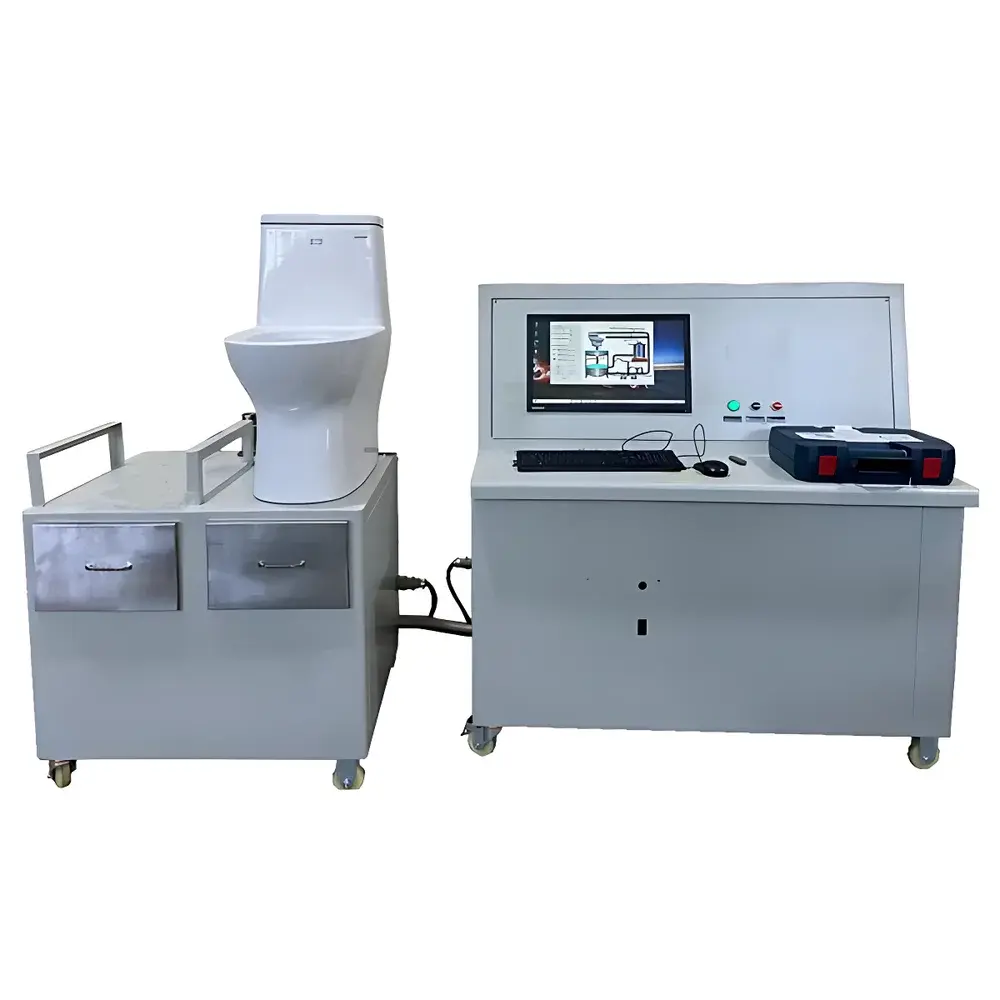
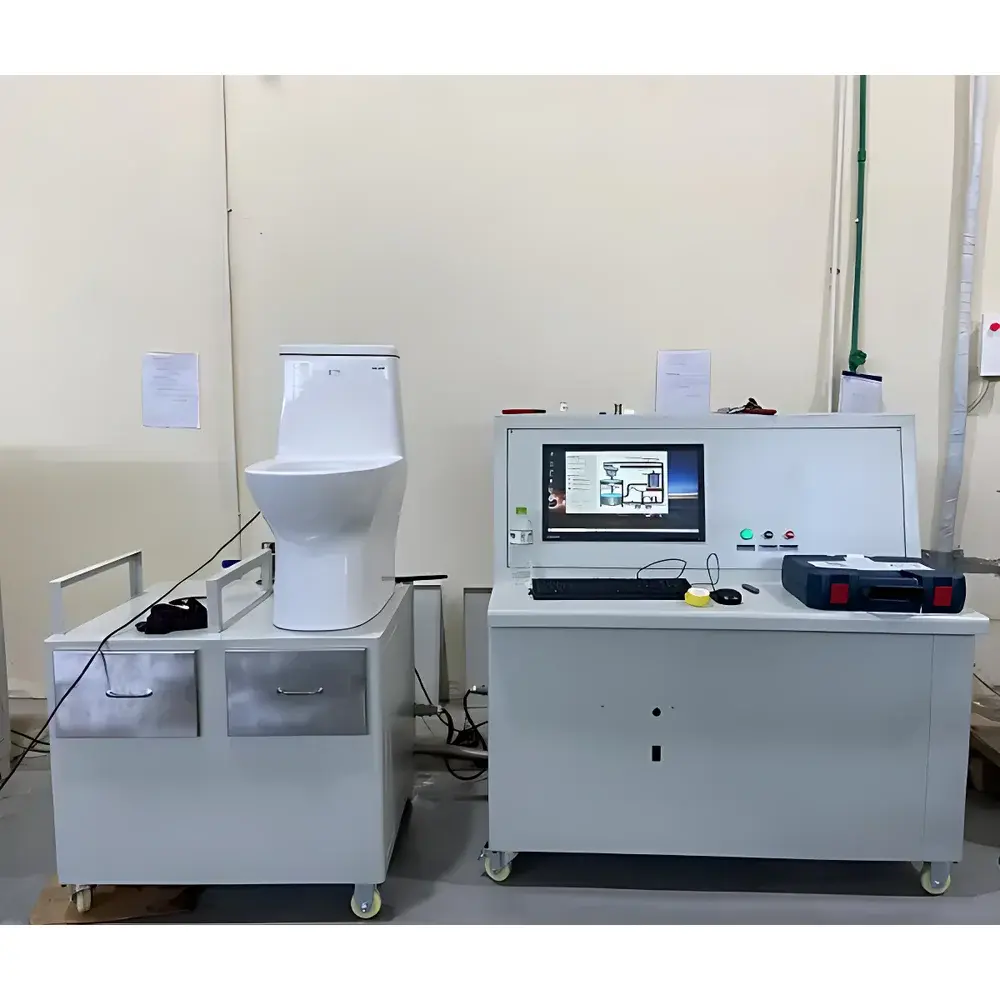
ZHENHUAFENXI TCS-II Toilet Flush Performance Tester
| Brand | ZHENHUAFENXI |
|---|---|
| Model | TCS-II |
| Power Supply | AC 220 V, 50 Hz |
| Test Pressure Range | 0.05–1.0 MPa |
| Flow Rate Range | 0–100 L/min (Accuracy Class 0.2) |
| Time Setting Range | 0–99999 s |
| Outlet Diameters | Φ20 mm, Φ40 mm |
| Maximum Flush Volume | 13 L |
| Maximum Flush Duration | 60 s |
| Sampling Interval | ≤70 ms |
| Liquid Level Resolution | 0.1 mm |
| Compliance | GB/T 26750–2011, GB 6952–2015, JC/T 931–2003, EN 997:2003, AS 1172.1–2005, AS 1172.2–1999, ATS 5200.016–2005, ATS 5200.017–2005, ASME A112.19.6 |
Overview
The ZHENHUAFENXI TCS-II Toilet Flush Performance Tester is a precision-engineered physical property testing instrument designed for standardized evaluation of flush performance in sanitary ceramic fixtures—including siphonic and washdown toilets, pressure-assisted flush valves, and tank-type flushing systems. It operates on the principle of controlled hydraulic delivery using a frequency-converter-driven constant-pressure water supply system, enabling repeatable, traceable, and metrologically sound measurement of dynamic flush parameters. The system captures time-resolved flow rate, pressure, volume, and velocity profiles during actual flush cycles—critical for verifying compliance with international regulatory and performance standards governing water efficiency, cleaning efficacy, and mechanical reliability.
Key Features
- Integrated variable-frequency constant-pressure water supply unit ensures stable test conditions across the full operational range (0.05–1.0 MPa), minimizing pressure drift and enhancing measurement reproducibility.
- High-resolution electromagnetic flowmeter (Class 0.2 accuracy) with dual outlet configurations (Φ20 mm and Φ40 mm) supports both standard and high-capacity fixture testing.
- Real-time data acquisition at ≤70 ms sampling intervals enables precise reconstruction of instantaneous flush velocity and volumetric discharge curves—including raw waveform capture and least-squares fitted trend analysis.
- Dual-mode operation (automatic sequence control + manual override) accommodates routine QC verification and R&D-level parametric studies, including adjustable flush duration (up to 60 s) and programmable cycle counts.
- On-screen HMI interface displays live process schematics, real-time analog values (pressure, flow, level), discrete status indicators (valve actuation, sensor faults), and user-selectable test protocols.
- Embedded alarm logic triggers visual and audible alerts for abnormal pressure spikes, flow stagnation, timeout events, or hardware communication loss—supporting GLP-aligned operational integrity.
- Level sensing subsystem provides ±0.1 mm resolution liquid height tracking in auxiliary reservoirs or test tanks, essential for correlating water surface dynamics with flush initiation timing.
Sample Compatibility & Compliance
The TCS-II is validated for use with all common sanitary ceramic configurations covered under GB 6952–2015 (Sanitary Ceramics), GB/T 26750–2011 (Pressure-Assisted Flush Devices), and JC/T 931–2003 (Mechanical Flush Valves). Its hydraulic architecture meets dimensional and functional requirements specified in EN 997:2003 (European toilet standard), AS 1172.1–2005 / AS 1172.2–1999 (Australian cistern and valve specifications), ATS 5200.016–2005 / ATS 5200.017–2005 (Australian plumbing product testing), and ASME A112.19.6 (U.S. performance criteria for flush valves). The system supports standardized test media—including polypropylene (PP) balls, polyethylene (PE) granules, synthetic sausage casings, and paper wads—with dedicated retrieval ports and counter interfaces to satisfy ISO/IEC 17025-compliant test documentation workflows.
Software & Data Management
Data logging is performed via embedded industrial controller firmware compliant with IEC 61131-3 architecture. All acquired waveforms (instantaneous flow rate, cumulative volume, pressure transients) are timestamped and stored in CSV-compatible binary format. Software modules support overlay plotting of up to 16 consecutive flush cycles, statistical aggregation (mean, SD, CV%), and export of curve-fit coefficients (e.g., polynomial order, R²). Audit trails record operator ID, test start/stop timestamps, parameter set revisions, and calibration event logs—fully compatible with FDA 21 CFR Part 11 electronic record requirements when deployed with optional PKI-enabled authentication.
Applications
- Verification of flush volume consistency per WC pan classification (e.g., ≤6 L dual-flush, ≤4.8 L single-flush per ASME A112.19.6).
- Performance benchmarking of pressure-assisted flush mechanisms against GB/T 26750–2011 activation thresholds and discharge stability criteria.
- Developmental testing of low-flow valve designs under variable inlet pressures (0.1–0.6 MPa typical).
- Third-party certification testing for WaterSense, WELS, or CE marking submissions requiring traceable hydraulic performance evidence.
- Root-cause analysis of incomplete bowl evacuation using synchronized video + flow curve correlation (via optional external trigger interface).
FAQ
What standards does the TCS-II directly support out-of-the-box?
The system is factory-configured to execute test sequences aligned with GB/T 26750–2011, GB 6952–2015, JC/T 931–2003, EN 997:2003, and ASME A112.19.6 Annex B procedures.
Can the system be used for non-ceramic fixtures such as stainless steel or plastic toilets?
Yes—provided the fixture’s mounting interface and outlet geometry conform to standard test rig dimensions and the flush actuation mechanism is mechanically or pneumatically interfaced.
Is calibration documentation provided with shipment?
Each unit ships with a NIST-traceable calibration certificate for the flowmeter and pressure transducer, valid for 12 months from date of manufacture.
Does the software support multi-language UI or localized report templates?
The base firmware supports English and Simplified Chinese UI; custom report templates (PDF/Excel) can be configured per regional regulatory formatting requirements upon request.
What maintenance intervals are recommended for long-term operational stability?
Quarterly verification of flowmeter zero point and pressure sensor linearity is advised; annual recalibration of all primary sensors is recommended for ISO/IEC 17025-accredited laboratories.



