
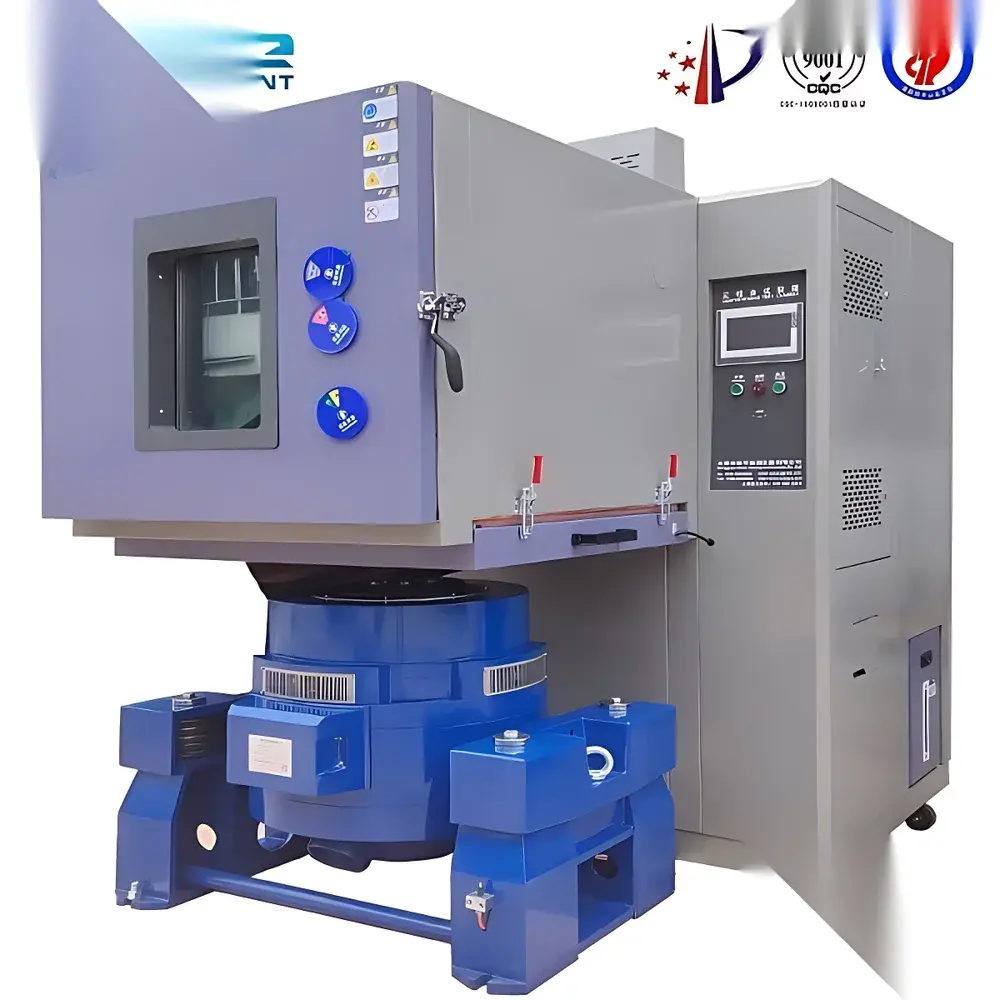
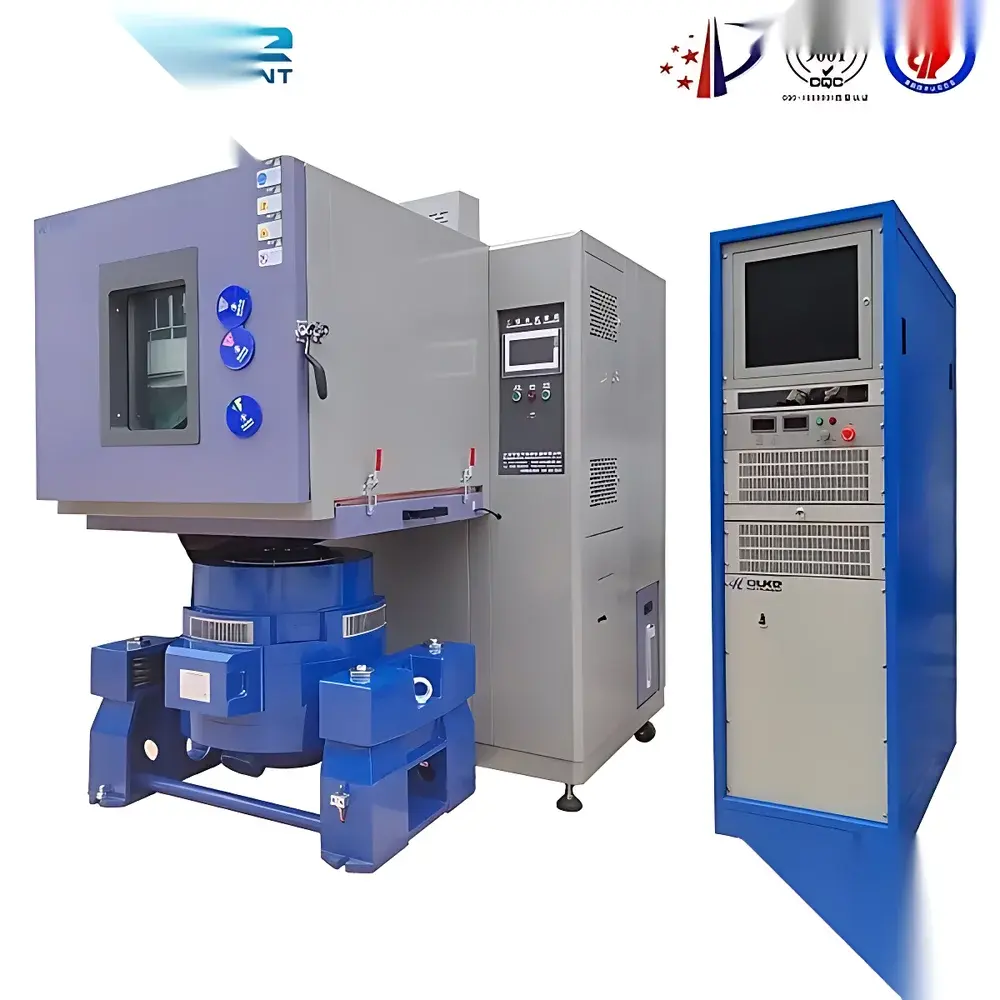
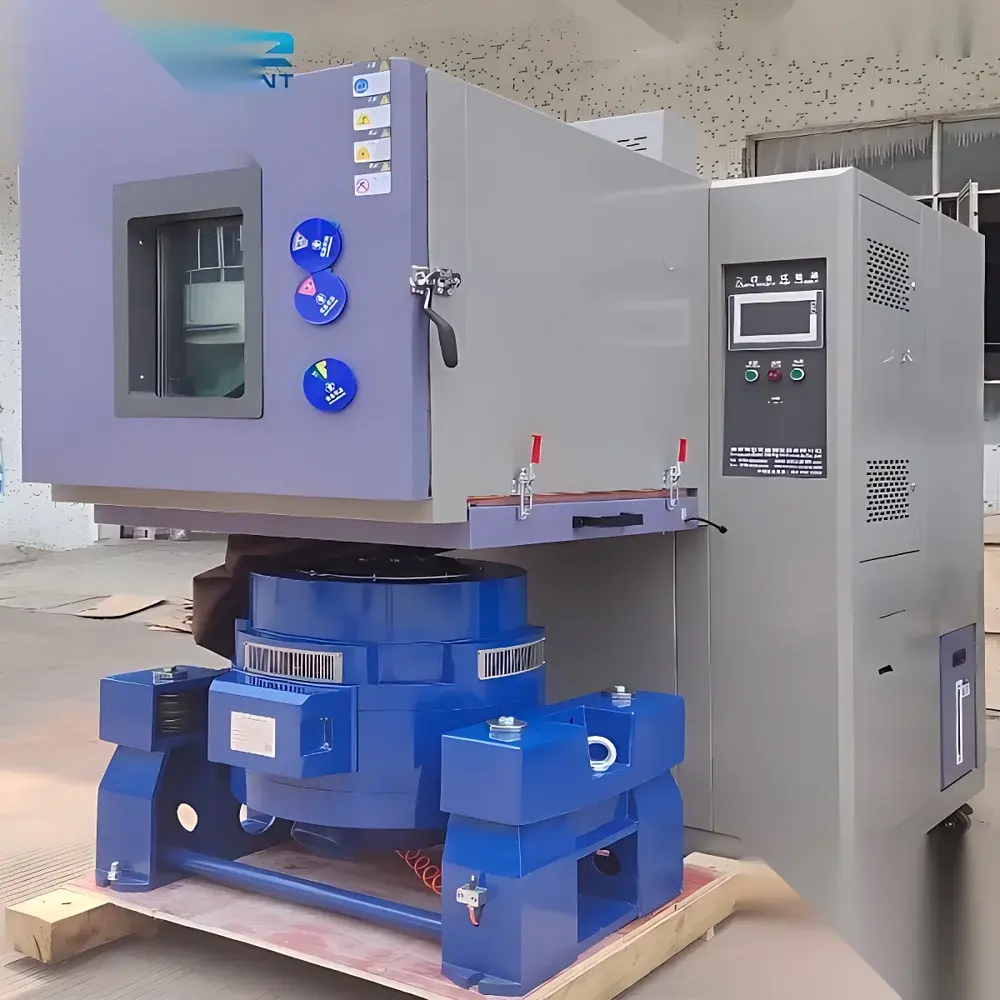
Combined Environmental Test Chamber – OK-ZTH-225 Series (Temperature, Humidity & Vibration)
| Key | Temperature Range: −60 °C to +150 °C |
|---|---|
| Temperature Uniformity | ≤ ±2 °C |
| Temperature Fluctuation | ±0.5 °C |
| Temperature Deviation | ≤ ±2 °C |
| Ramp Rate | 0.7–1.0 °C/min |
| Time Setting Range | 0–9999 h |
| Refrigeration System | Two-stage cascade mechanical compression |
| Refrigerant | HFC-R404A / HFC-R23 |
| Cooling Method | Water-cooled |
| Control Interface | Color touchscreen + PLC (OYO or TIME) |
| Construction | A3 steel exterior with powder coating |
| Viewing Window | Multi-layer tempered glass with conductive film |
| Cable Port | Ø50 mm (left side) |
| Humidification | Built-in water tank with booster pump |
| Air Circulation | Forced convection via extended-shaft stainless steel centrifugal blower (bottom inlet / top outlet) |
| Sealing | Dual-layer high-tensile high-temp silicone gasket |
| Vibration Integration | Optional electrodynamic or servo-hydraulic shaker system (user-specified) |
Overview
The OK-ZTH-225 Series Combined Environmental Test Chamber is an integrated reliability validation platform engineered for simultaneous or sequential application of temperature, humidity, and mechanical vibration stressors. It operates on the principle of accelerated environmental simulation—exposing test specimens to rigorously controlled, reproducible multi-stress conditions representative of real-world deployment environments. This triaxial capability supports qualification testing per international standards including MIL-STD-810H, IEC 60068-2-6 (vibration), IEC 60068-2-14 (thermal shock), IEC 60068-2-30 (damp heat cyclic), and ISO 16750-4 (road vehicles). Designed for engineering labs, automotive Tier-1 suppliers, aerospace component manufacturers, and electronics reliability teams, the chamber enables failure mode identification under synergistic stress coupling—where thermal expansion mismatches, condensation-induced corrosion, and resonant fatigue interact nonlinearly.
Key Features
- Triple-stress integration architecture: Independent yet synchronized control of thermal, hygrothermal, and vibrational domains—enabling programmable profiles such as “vibrate while ramping from −40 °C to +85 °C” or “hold at 85 °C/85% RH for 96 h with 5–500 Hz random vibration.”
- High-fidelity thermal performance: Achieves −60 °C to +150 °C operating range using a two-stage cascade refrigeration system with environmentally compliant HFC-R404A (low-temp stage) and HFC-R23 (ultra-low-temp stage), supported by brazed-plate stainless steel condensers and finned air-cooled evaporators.
- Robust chamber construction: Exterior housing of powder-coated A3 carbon steel ensures structural integrity and ESD-safe grounding; interior chamber fabricated from electropolished SUS 304 stainless steel with mirror finish minimizes contamination and facilitates cleaning per ISO 14644 cleanroom protocols.
- Optimized airflow dynamics: Single-loop forced convection system employs an extended-shaft, corrosion-resistant centrifugal blower mounted at the chamber base, delivering uniform laminar flow (bottom-in/top-out) with minimal turbulence—critical for minimizing thermal gradients during steady-state and transient operation.
- Human-centric interface: 10.4″ full-color resistive touchscreen running embedded PLC-based logic (OYO 8226 or TIME TPC-1061E firmware), supporting multi-segment profile programming, real-time data logging, alarm history, and USB export of CSV-formatted test records.
- Modular vibration integration: Standardized mounting interface accommodates user-selected shaker systems—electrodynamic (up to 100 g peak, 2–3000 Hz) or servo-hydraulic (broadband low-frequency capability)—with sealed base plate and dynamic load compensation algorithms to maintain thermal stability during excitation.
Sample Compatibility & Compliance
The OK-ZTH-225 accommodates samples up to 225 L volume (W×D×H: 600 × 500 × 750 mm internal dimensions), with customizable payload support structures and optional inert gas purging (N₂ or dry air) for oxidation-sensitive materials. Its design complies with safety and electromagnetic compatibility requirements per EN 61000-6-2 (immunity) and EN 61000-6-4 (emission), and meets electrical safety standards IEC 61010-1. The chamber supports GLP/GMP-aligned validation documentation packages—including IQ/OQ protocols, sensor calibration certificates (traceable to NIST), and uncertainty budgets for temperature/humidity sensors—and is compatible with FDA 21 CFR Part 11-compliant electronic record systems when paired with validated data acquisition software.
Software & Data Management
Native controller firmware provides full-cycle test automation: profile creation (ramp/soak/vibration step sequencing), real-time parameter visualization (temperature, humidity, acceleration PSD), and event-triggered actions (e.g., pause on over-temperature, initiate data dump on alarm). Logged data includes timestamped sensor values (Pt100 RTDs, capacitive humidity sensors, IEPE accelerometers), setpoint trajectories, and system status flags (compressor duty cycle, heater output %, chiller flow rate). Export formats include .CSV and .PDF reports with configurable headers, pass/fail annotations, and signature fields for audit trails. Optional Ethernet/IP or Modbus TCP connectivity enables integration into centralized MES or LIMS platforms for automated result ingestion and cross-test correlation analysis.
Applications
- Automotive electronics: ECUs, ADAS sensors, battery management systems subjected to thermal cycling + road-simulated vibration per ISO 16750-4 Annex D.
- Aerospace avionics: Flight-critical modules undergoing DO-160G Section 24 (temperature), Section 25 (humidity), and Section 8 (vibration) combined stress screening.
- Medical device packaging: Sterile barrier validation under accelerated aging conditions (e.g., 40 °C/75% RH for 6 months equivalent) while monitoring seal integrity under micro-vibration.
- Consumer electronics: Smartphone PCBs and flex cables tested for solder joint fatigue under thermal gradient + random vibration spectra mimicking drop-and-transport scenarios.
- Materials science: Polymer composite curing behavior analysis under simultaneous thermal ramp and mechanical constraint—quantifying residual stress development via in-situ strain gauge telemetry.
FAQ
What vibration shaker types are compatible with the OK-ZTH-225?
Electrodynamic shakers (e.g., LDS V875, TIRA TV 50120) and servo-hydraulic shakers (e.g., MTS 370 series) can be integrated via standardized flange interface and dynamic isolation mounts.
Is humidification available across the full temperature range?
Humidification is active between +10 °C and +85 °C; below +10 °C, dehumidification via refrigerant coil condensation is employed to maintain low RH levels.
Can the chamber operate unattended for extended durations?
Yes—equipped with dual independent safety cutouts (mechanical thermostat + digital overtemp limiter), door interlock, refrigerant pressure monitoring, and remote alarm relay outputs for integration with facility SCADA systems.
What calibration documentation is provided upon delivery?
Factory calibration certificate for temperature (±0.3 °C accuracy), humidity (±2% RH), and vibration (±5% amplitude linearity), all traceable to national metrology institutes (NMI) with uncertainty statements.
Is water cooling mandatory, or is air-cooling an option?
Water cooling is required for stable operation below −20 °C and during high-rate ramping; air-cooled variants are available for milder temperature ranges (−20 °C to +100 °C) with reduced ramp performance.



