
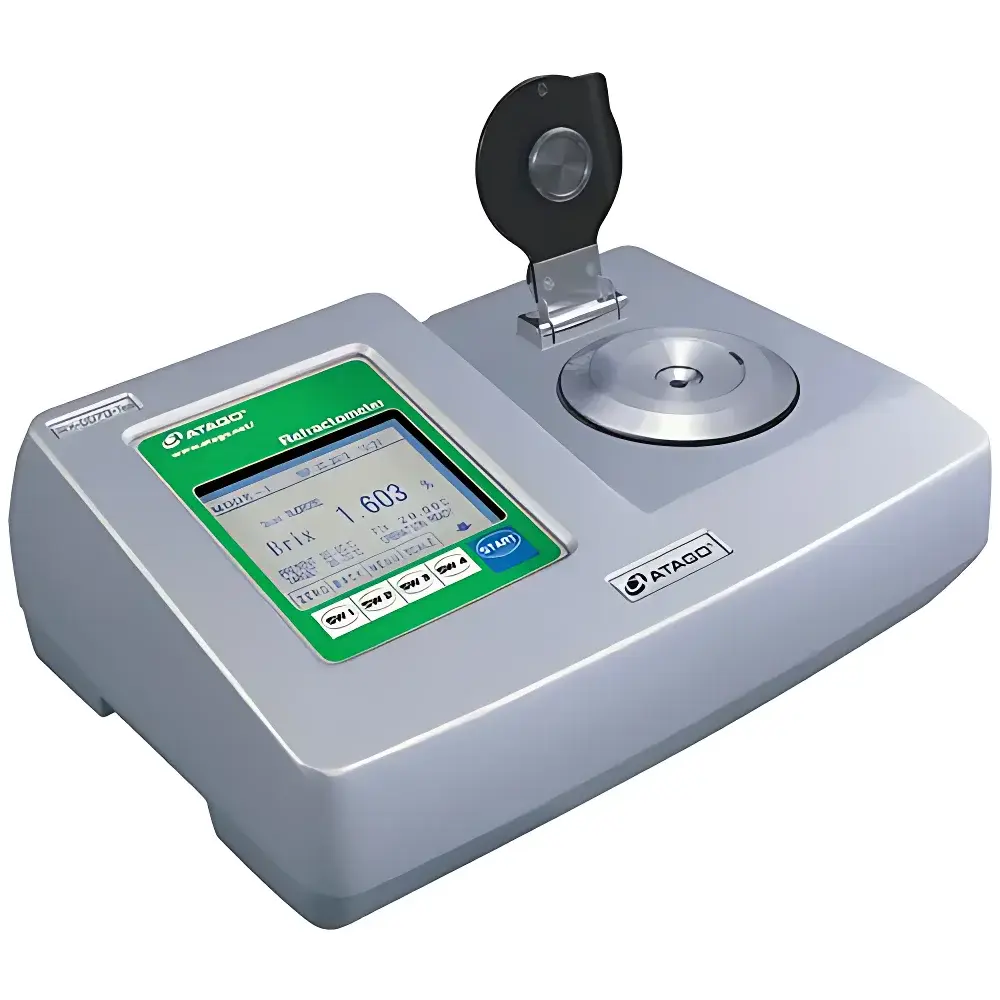
ATAGO RX-DD7α-tea Desktop Automatic Digital Refractometer
| Brand | ATAGO |
|---|---|
| Origin | Japan |
| Model | RX-DD7α-tea |
| Product Type | Benchtop Refractometer |
| Temperature Control | Peltier-based thermostatic control |
| Display | Digital LCD |
| Measurement Range | 0.000–5.000% (w/w, sucrose-equivalent scale for tea & low-sugar beverages) |
| Accuracy | ±0.005% |
| Resolution | 0.001% |
| Connectivity | RS-232/USB interface for PC and printer |
| Compliance | FDA 21 CFR Part 11 compliant data logging software included |
| Calibration | One-touch zero calibration with distilled water |
| Housing | Rugged die-cast metal chassis |
| User Interface | Two-button operation (START / ZERO) |
Overview
The ATAGO RX-DD7α-tea is a high-precision benchtop digital refractometer engineered specifically for the quantitative analysis of low-concentration aqueous solutions in tea processing, ready-to-drink (RTD) beverages, herbal infusions, and other low-brix formulations. It operates on the principle of critical angle measurement of total internal reflection at the prism-sample interface, converting refractive index shifts into concentration values expressed as mass percent (w/w) on a sucrose-equivalent scale optimized for tea extracts and diluted sugar solutions. Unlike general-purpose refractometers, the RX-DD7α-tea employs a proprietary optical calibration curve aligned with the DD-7 reference standard—ensuring traceable, inter-laboratory comparable results under controlled thermal conditions (30 °C ambient reference). Its integrated Peltier thermoelectric module maintains sample temperature stability within ±0.1 °C across the measurement cycle, eliminating dependence on external water baths and enabling reproducible readings independent of ambient fluctuations.
Key Features
- Precise low-range quantification: Optimized 0.000–5.000% measurement range with ±0.005% accuracy and 0.001% resolution—ideal for subtle concentration differentials in green tea, oolong, black tea, and low-sugar functional beverages.
- Integrated Peltier temperature control: Maintains prism surface at user-defined setpoints (typically 20–30 °C), ensuring compliance with ISO 2173 and AOAC 932.12 methodology requirements for temperature-sensitive refractive index determination.
- Two-button operational workflow: START and ZERO keys enable full measurement and calibration sequences with minimal operator intervention—reducing training time and minimizing procedural variability.
- Rugged industrial design: Die-cast aluminum housing provides mechanical stability and thermal inertia, while the chemically resistant sapphire-coated prism ensures long-term optical integrity against acidic or tannin-rich samples.
- FDA 21 CFR Part 11–compliant software suite: Includes audit-trail enabled data recording, electronic signature support, user access levels, and encrypted result storage—meeting GLP/GMP documentation standards for regulated QC environments.
Sample Compatibility & Compliance
The RX-DD7α-tea is validated for aqueous solutions containing natural polyphenols, caffeine, organic acids, and low-level sweeteners (e.g., stevia, erythritol, sucralose) commonly found in cold-brewed teas and lightly sweetened RTDs. It excludes viscous, turbid, or highly colored suspensions requiring filtration or dilution prior to analysis. The instrument complies with ISO 2173:2003 (fruit juice and related products), AOAC Official Method 932.12 (refractometric solids determination), and JIS K 0061 (Japanese Industrial Standard for refractometers). Its calibration protocol adheres to NIST-traceable reference standards (certified sucrose solutions), and routine verification follows internal SOPs aligned with ISO/IEC 17025 clause 7.7 (uncertainty of measurement).
Software & Data Management
The bundled PC software supports real-time data streaming, batch export to CSV/Excel, statistical process control (SPC) charting, and customizable report generation. All measurements are timestamped, annotated with operator ID, temperature setpoint, and calibration status. Audit logs record every parameter change, data export event, and user login—retained for ≥18 months per default configuration. Data encryption (AES-256) and role-based permissions (administrator, analyst, reviewer) ensure integrity during regulatory inspections. USB and RS-232 interfaces allow seamless integration with LIMS platforms and automated QA reporting systems.
Applications
- Concentration monitoring of tea extract concentrates during evaporation and blending stages.
- Batch release testing of low-sugar RTD beverages to verify formulation consistency against target brix specifications.
- In-process control of osmotic pressure adjustment in cold-infused herbal preparations.
- Raw material acceptance testing for green leaf extracts and standardized botanical infusions.
- Stability studies tracking solute migration or degradation in shelf-life trials.
FAQ
What is the difference between the RX-DD7α-tea and the standard RX-DD7?
The RX-DD7α-tea uses the identical optical engine and temperature control architecture as the DD-7 but features a factory-installed, application-specific calibration curve optimized for tea and low-sugar beverage matrices—ensuring direct equivalence to DD-7 reference measurements without manual scaling.
Does the instrument require external cooling or heating equipment?
No. The built-in Peltier module provides active temperature regulation across 15–40 °C; no chiller, water bath, or auxiliary thermostat is needed.
Can I create custom calibration curves for non-sucrose solutes?
Yes. The instrument supports up to five user-defined scales via PC software, allowing correlation to HPLC-validated concentration data for compounds such as catechins or theobromine.
How often should calibration be performed?
Zero calibration with distilled water is recommended before each measurement session; full two-point calibration (zero + standard) is advised daily or per shift in regulated production environments.
Is the prism surface resistant to tannin staining?
Yes—the sapphire-coated prism resists chemical etching and staining from polyphenolic compounds; cleaning with ethanol or mild detergent followed by lint-free wiping restores baseline performance.




