
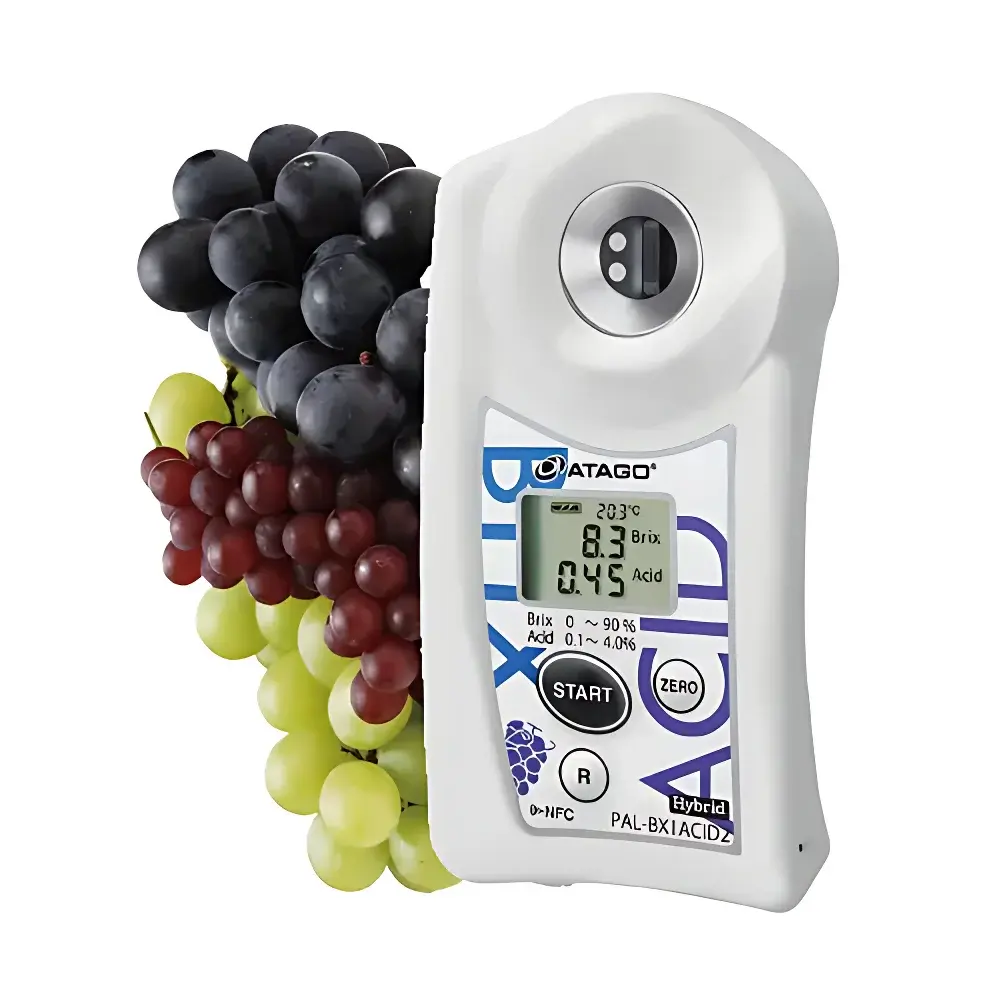
ATAGO PAL-BX/ACID 2 Portable Grape Brix and Titratable Acidity Meter
| Brand | ATAGO |
|---|---|
| Origin | Japan |
| Model | PAL-BX/ACID 2 |
| Measurement Principle | Refractometric Brix + pH-based Titration-Equivalent Acid Quantification (as Tartaric Acid) |
| Brix Range | 0.0–90.0% |
| Acid Range | 0.10–4.00% (expressed as tartaric acid) |
| Brix Accuracy | ±0.2% |
| Acid Accuracy | ±0.10% (0.10–1.00%), ±10% relative (1.01–4.00%) |
| Temperature Compensation | 10–40°C |
| Resolution | Brix 0.1%, Acid 0.01% (≤9.99%), 0.1% (≥10.0%) |
| IP Rating | IP65 |
| Dimensions | 5.5 × 3.1 × 10.9 cm |
| Weight | 100 g (instrument only) |
| Power | 2 × AAA alkaline batteries |
Overview
The ATAGO PAL-BX/ACID 2 is a handheld, dual-parameter optical instrument engineered for rapid, field-deployable assessment of soluble solids content (Brix) and titratable acidity in fresh grape juice and grape-derived products. Unlike conventional benchtop methods requiring laboratory infrastructure, this device integrates refractometry for Brix measurement with a calibrated electrochemical response algorithm to estimate total titratable acidity—expressed equivalently as tartaric acid concentration—based on sample pH and conductivity signatures under standardized dilution conditions. Its design adheres to empirical correlations validated against AOAC Official Method 942.15 and ISO 2173:2003 for fruit juice analysis, enabling consistent, operator-independent results without reagents or titration hardware. The instrument computes the acid-sugar ratio (Brix ÷ % tartaric acid) at the press of the “R” key, supporting objective evaluation of ripeness, varietal typicity, and harvest timing in viticulture and winemaking QA/QC workflows.
Key Features
- Simultaneous Brix and titratable acidity measurement in a single handheld unit—no external probes or calibration fluids required.
- Offset curve correction function enables alignment of acidity readings with reference titration data or alternate analytical units (e.g., malic or citric acid equivalents), ensuring method comparability across laboratories.
- Automatic temperature compensation (10–40°C) using integrated thermistor, minimizing thermal drift in field or cellar environments.
- Rugged, IP65-rated enclosure resists dust ingress and incidental water exposure during outdoor vineyard use or wet processing areas.
- Optimized sample protocol: Brix measured directly from undiluted juice; acidity determined after precise 1:50 (w/w) dilution with distilled water—eliminating filtration, centrifugation, or chemical neutralization steps.
- High-resolution LCD display with dedicated Brix, acidity, and acid-sugar ratio readouts—including dynamic decimal placement (0.00, 00.0, or 000 format) to maintain significant-figure integrity across concentration ranges.
Sample Compatibility & Compliance
The PAL-BX/ACID 2 is validated for use with intact juice expressed from Vitis vinifera cultivars including Kyoho (Black Corinth) and Concord-type grapes, as well as clarified must, crushed berry homogenates, and commercial grape concentrates. It is not intended for highly turbid, pectin-rich, or fermented samples exhibiting CO₂ evolution or ethanol >2% v/v. While not a primary compliance instrument for regulatory submissions, its output supports GLP-aligned internal quality control per ISO/IEC 17025:2017 Clause 7.2.2 (method validation) when used with documented offset corrections and routine verification using NIST-traceable sucrose and potassium hydrogen tartrate standards. Data output meets minimum requirements for audit trails under FDA 21 CFR Part 11 when paired with ATAGO’s optional data logging accessories.
Software & Data Management
The PAL-BX/ACID 2 operates as a standalone field instrument with no embedded firmware updates or cloud connectivity. All measurements are displayed in real time with no onboard storage. For traceable recordkeeping, users may manually transcribe values into LIMS or Excel templates compliant with ISO 15197:2013 data integrity principles. When used with ATAGO’s optional RS-232 interface cable and LogMaster software (v3.2+), raw Brix, acidity, and acid-sugar ratio values—including timestamp and ambient temperature—can be exported as CSV files. Exported datasets include instrument ID, measurement mode flag, and offset correction status to support retrospective method verification.
Applications
- Vineyard harvest decision support: Correlating Brix-acid ratio trends with phenolic maturity indices to define optimal picking windows.
- Winery incoming fruit inspection: Screening lot uniformity prior to crushing; identifying overripe or underripe clusters requiring segregation.
- Cultivar comparison trials: Quantifying sensory-relevant balance parameters across rootstock/scion combinations under controlled irrigation regimes.
- Post-harvest storage monitoring: Tracking acid degradation kinetics in cold-stored table grapes to predict shelf-life endpoints.
- Educational demonstrations: Teaching enology students core concepts of fruit metabolic balance without requiring wet chemistry labs.
FAQ
Does the PAL-BX/ACID 2 measure actual titratable acidity via titration?
No—it estimates tartaric acid concentration using a proprietary algorithm calibrated against AOAC-standard titration data. It requires 1:50 (w/w) dilution with distilled water but performs no chemical reaction.
Can I use it for non-grape fruits like apples or citrus?
It is factory-calibrated exclusively for grape matrixes. Acid response deviations exceed ±15% for non-Vitis samples due to differing organic acid profiles (e.g., malic dominance in apples, citric in oranges).
What does the “OFFSET” function correct for?
It applies a linear shift to acidity readings to reconcile instrument output with lab-based titration results or alternative reporting units (e.g., converting tartaric-equivalent to malic-equivalent values).
Is battery life affected by frequent temperature compensation cycles?
No—temperature sensing draws negligible current. Typical battery life exceeds 10,000 measurements on two AAA alkaline cells under ambient conditions (20–25°C).
How often should I verify calibration?
Daily verification with 10.00% sucrose standard and 0.50% potassium hydrogen tartrate solution is recommended before critical sampling sessions, per ATAGO Technical Bulletin TB-ACID-2023.





