
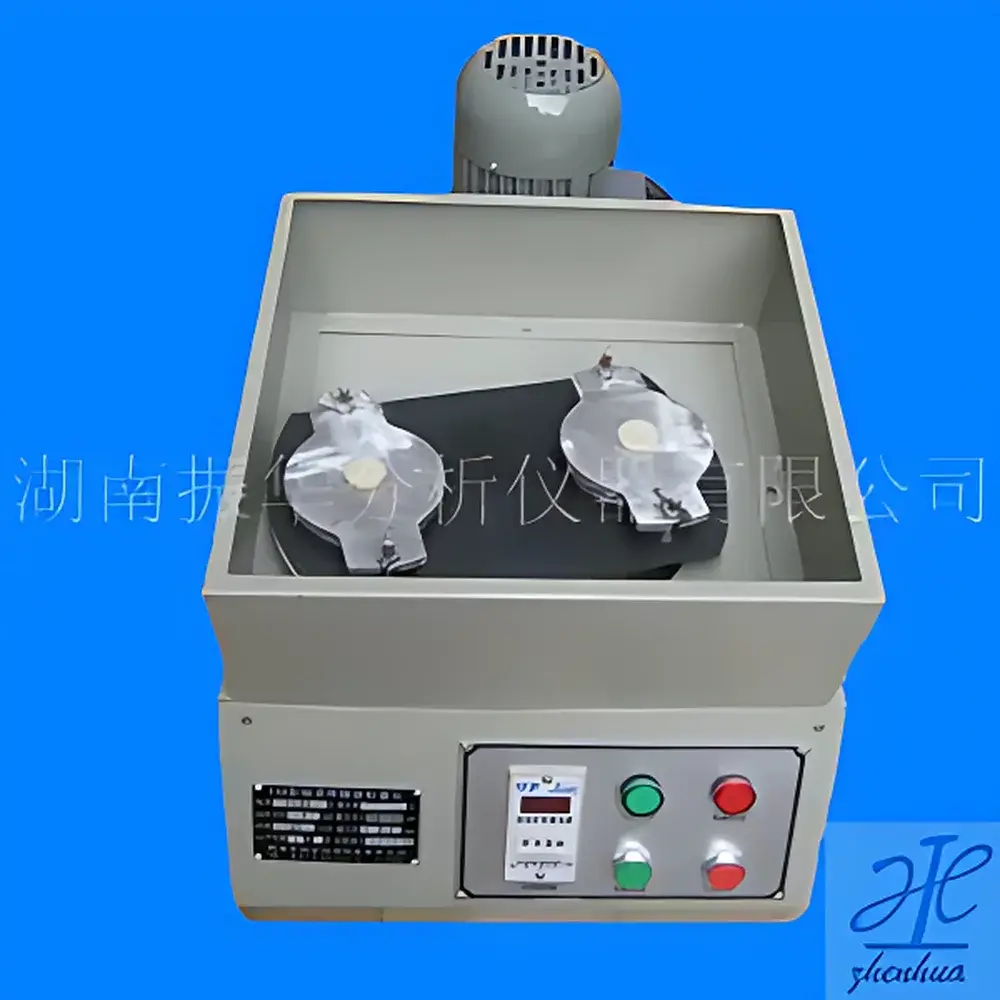
Ceramic Glaze Abrasion Tester LM
| Origin | Hunan, China |
|---|---|
| Manufacturer Type | Distributor |
| Origin Category | Domestic |
| Model | LM |
| Pricing | Upon Request |
| Sample Capacity | 2 or 8 tiles (selectable) |
| Sample Size | 100 × 100 mm |
| Rotational Speed Range | 300–3000 rpm |
Overview
The LM Ceramic Glaze Abrasion Tester is a precision-engineered instrument designed to quantitatively evaluate the surface wear resistance of glazed ceramic tiles in strict accordance with GB/T 3810.7–2006, the Chinese national standard equivalent to ISO 10545-7 for determination of abrasion resistance of ceramic tile glazes. It operates on the principle of controlled rotary abrasion using standardized abrasive discs under defined load and rotational conditions, simulating long-term mechanical wear encountered during service life. The tester delivers reproducible, traceable results essential for quality assurance in tile manufacturing, R&D laboratories, and third-party certification bodies. Its robust mechanical architecture ensures consistent torque transmission, minimal speed drift, and stable sample clamping—critical factors influencing inter-laboratory repeatability.
Key Features
- Configurable sample capacity: supports simultaneous testing of either 2 or 8 ceramic tiles (100 × 100 mm), enabling efficient batch evaluation without compromising test integrity.
- Precision digital speed control: adjustable rotational speed range from 300 to 3000 rpm with ±2 rpm accuracy, ensuring compliance with standard-specified test cycles (e.g., 150, 300, 600, or 1200 revolutions per test sequence).
- Calibrated loading mechanism: maintains constant vertical force on abrasive discs via calibrated weights, meeting the 1.0 ± 0.05 N/mm² pressure requirement specified in GB/T 3810.7–2006.
- Integrated timer and revolution counter: real-time digital display with automatic stop function upon reaching preset rotation count, minimizing operator intervention and reducing measurement variability.
- Stainless steel test chamber and dust-resistant enclosure: enhances operational safety, extends component service life, and prevents abrasive particulate contamination of adjacent lab equipment.
- Modular disc holder design: accommodates standard CS-10 or H-18 abrasive wheels (per ASTM D4060 and ISO 5470-1), facilitating cross-standard method validation where required.
Sample Compatibility & Compliance
The LM tester accepts flat, rigid ceramic specimens measuring exactly 100 × 100 mm and up to 20 mm in thickness, including glazed porcelain stoneware, vitrified tiles, and monoporosa wall tiles. Specimens must be free of edge chipping, warping > 0.5 mm/m, or pre-existing surface defects that could bias wear track formation. The instrument is validated for use in GLP-compliant environments and supports audit-ready documentation when paired with external lab notebooks or LIMS integration. While GB/T 3810.7–2006 is its primary reference, test protocols may be adapted to align with ISO 10545-7 Annex A (dry abrasion method) and ASTM C1027 (standard test method for determining visible abrasion resistance of glazed ceramic tile) through documented SOPs and periodic performance verification.
Software & Data Management
The LM model operates via embedded microcontroller firmware with no proprietary PC software dependency—ensuring long-term maintainability and eliminating license renewal risks. All operational parameters (speed setpoint, target revolutions, elapsed time) are stored in non-volatile memory with timestamped logs accessible via USB data export (CSV format). For regulated environments, users may integrate the device into broader QA workflows by connecting its digital output signals (TTL-level pulse train per revolution + status flags) to SCADA systems or ELN platforms supporting IEC 61508 or FDA 21 CFR Part 11 compliant audit trails. Calibration records—including speed verification using certified tachometers and load verification via traceable force gauges—are recommended annually or after 500 operational hours.
Applications
- Quality control release testing of production batches prior to shipment.
- Comparative evaluation of glaze formulations (e.g., alumina-rich vs. zirconia-doped frits) during R&D.
- Validation of firing schedules’ impact on surface densification and hardness.
- Third-party certification testing for CE marking, CCC, or Green Building Material certifications.
- Root cause analysis of field failures related to premature gloss loss or micro-scratching in high-traffic commercial installations.
FAQ
Does the LM tester comply with international standards beyond GB/T 3810.7–2006?
Yes—its mechanical configuration and operational parameters allow direct adaptation to ISO 10545-7 and ASTM C1027 through minor procedural adjustments documented in internal SOPs.
Can it accommodate tiles thicker than 10 mm?
The standard fixture supports specimens up to 20 mm thick; custom spacers are available upon request for non-standard geometries.
Is calibration traceable to national metrology institutes?
Speed and load calibration can be performed using NIST-traceable tachometers and force standards; full calibration certificates are issued by accredited third-party labs upon customer request.
What maintenance intervals are recommended?
Lubrication of drive shaft bearings every 250 operating hours and inspection of abrasive disc mounting hardware every 100 cycles are advised to ensure long-term repeatability.
Is technical support available outside mainland China?
Yes—remote diagnostics, English-language operation manuals, and application engineering consultation are provided globally via authorized regional distributors.



