
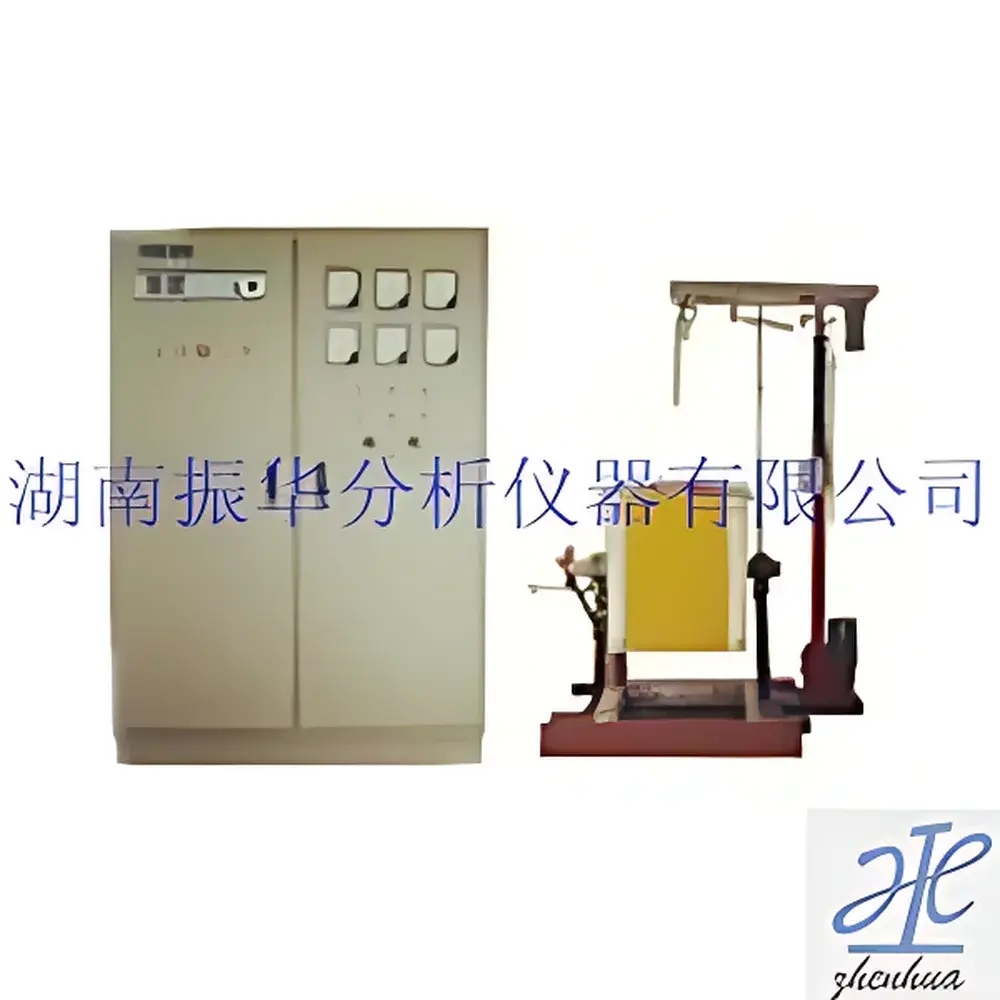
High-Temperature Oxidation Resistance Test Furnace GYH-A
| Origin | Hunan, China |
|---|---|
| Manufacturer Type | Authorized Distributor |
| Origin Category | Domestic (China) |
| Model | GYH-A |
| Pricing | Available Upon Request |
| Max Operating Temperature | 1650 °C |
| Heating Rate | 0–10 °C/min |
| Temperature Uniformity at Hold | ±2 °C |
| Gas Flow Control Range | 1–10 L/min |
Overview
The GYH-A High-Temperature Oxidation Resistance Test Furnace is a precision-engineered thermal testing system designed specifically for evaluating the oxidation behavior of carbon-containing refractory materials under controlled atmospheric conditions. It operates on the principle of dynamic isothermal exposure—where test specimens are heated to elevated temperatures in a defined oxidizing gas environment (typically air or synthetic air), and mass change is monitored over time to quantify oxidation kinetics. This methodology aligns with the fundamental thermogravimetric principles embedded in GB/T 13244—*Test Method for Oxidation Resistance of Carbon-Containing Refractories*—and supports quantitative assessment of material degradation mechanisms including carbon burnout, pore formation, and protective oxide layer development.
Key Features
- Robust dual-zone molybdenum disilicide (MoSi₂) heating element configuration enabling stable operation up to 1650 °C with minimal thermal drift;
- Digital PID temperature controller with programmable ramp-hold profiles, supporting multi-step thermal cycles and precise dwell control within ±2 °C uniformity across the hot zone;
- Integrated mass flow controller (MFC) calibrated for 1–10 L/min range, compatible with air, O₂, or N₂/O₂ mixtures to simulate service-relevant atmospheres;
- Automated data acquisition system synchronized with thermocouple readings and optional high-resolution microbalance (not included, but interface-ready);
- Refractory-lined chamber constructed from high-purity alumina fiber insulation and corrosion-resistant Inconel 600 flanges, ensuring long-term stability during repeated thermal cycling;
- Front-loading horizontal tube design with water-cooled flange and sealed quartz or recrystallized alumina tube (customizable), facilitating rapid specimen insertion and gas-tight operation.
Sample Compatibility & Compliance
The GYH-A accommodates standard refractory test bars per GB/T 13244 (typically 25 mm × 25 mm × 120 mm) and is equally suitable for cylindrical pellets, crucibles, or custom geometries up to Ø60 mm × 150 mm. All structural and control subsystems comply with IEC 61000-6-2 (immunity) and IEC 61000-6-4 (emissions) for industrial environments. The furnace meets mechanical safety requirements per GB 5226.1 and supports traceable calibration via PtRh10-Pt thermocouples (Type S, Class 1). While not certified to ASTM C878 or ISO 22456 directly, its operational parameters and procedural alignment make it fully deployable in GLP-compliant laboratories conducting internal method validation or supplier qualification per ISO/IEC 17025.
Software & Data Management
The embedded control interface provides real-time display of temperature, gas flow, and elapsed time, with configurable alarm thresholds for over-temperature, flow deviation, or door interlock breach. Test logs—including setpoint history, actual temperature profile, and user annotations—are exported in CSV format for post-processing in Excel, MATLAB, or specialized thermal analysis platforms. Optional RS485/Modbus RTU or Ethernet/IP connectivity enables integration into centralized SCADA or LIMS environments. Audit trails are maintained locally with timestamped operator login events and parameter modification records—supporting basic 21 CFR Part 11 readiness when paired with institutional electronic signature protocols.
Applications
- Quantitative comparison of antioxidant additives (e.g., Al, Si, Mg, B₄C) in MgO–C and Al₂O₃–C refractories;
- Development and screening of novel carbon-free or low-carbon alternatives for EAF and BOF linings;
- Correlation studies between oxidation weight loss, porosity evolution (via post-test mercury intrusion), and hot strength retention;
- Accelerated lifetime modeling of ladle and tundish components exposed to secondary refining atmospheres;
- Supporting technical documentation for CE marking dossiers where oxidation resistance is a declared performance characteristic.
FAQ
What refractory standards does the GYH-A furnace support?
It is explicitly engineered to meet the equipment specifications outlined in GB/T 13244. Its thermal and gas delivery performance also satisfies functional equivalency with ASTM C878 (for carbon-containing refractories) and ISO 22456 Annex A test conditions.
Is the furnace compatible with inert or reducing atmospheres?
Yes—the MFC and sealed tube architecture support N₂, Ar, CO, or CO/CO₂ mixtures; however, hydrogen-containing gases require additional safety interlocks and are not covered under standard configuration.
Can test data be exported to LIMS or ERP systems?
Via optional Modbus TCP or OPC UA gateway modules, raw sensor outputs and event logs can be streamed to enterprise-level data infrastructure with configurable polling intervals and metadata tagging.
What maintenance is required for long-term accuracy?
Annual verification of thermocouple calibration against a reference standard and MFC recalibration using certified gas flow meters are recommended. Heating element resistance should be monitored quarterly to detect early-stage degradation.



