
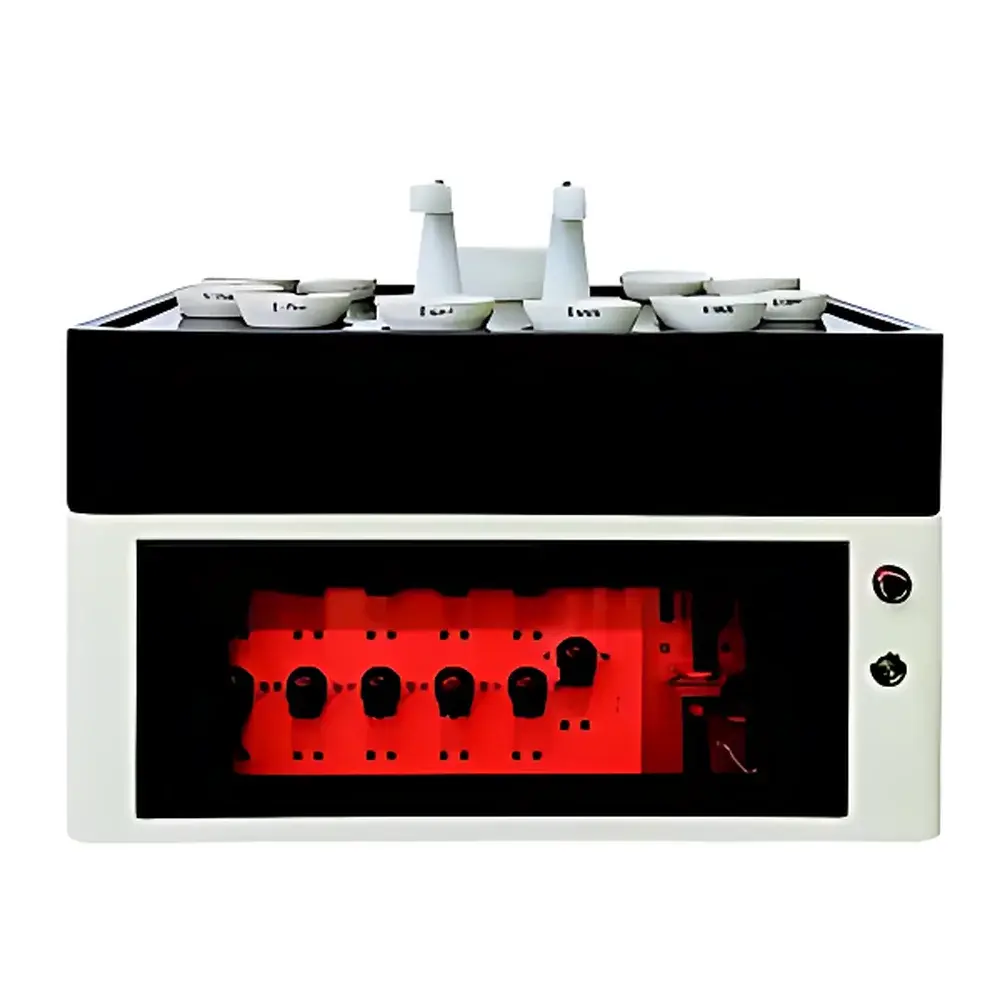
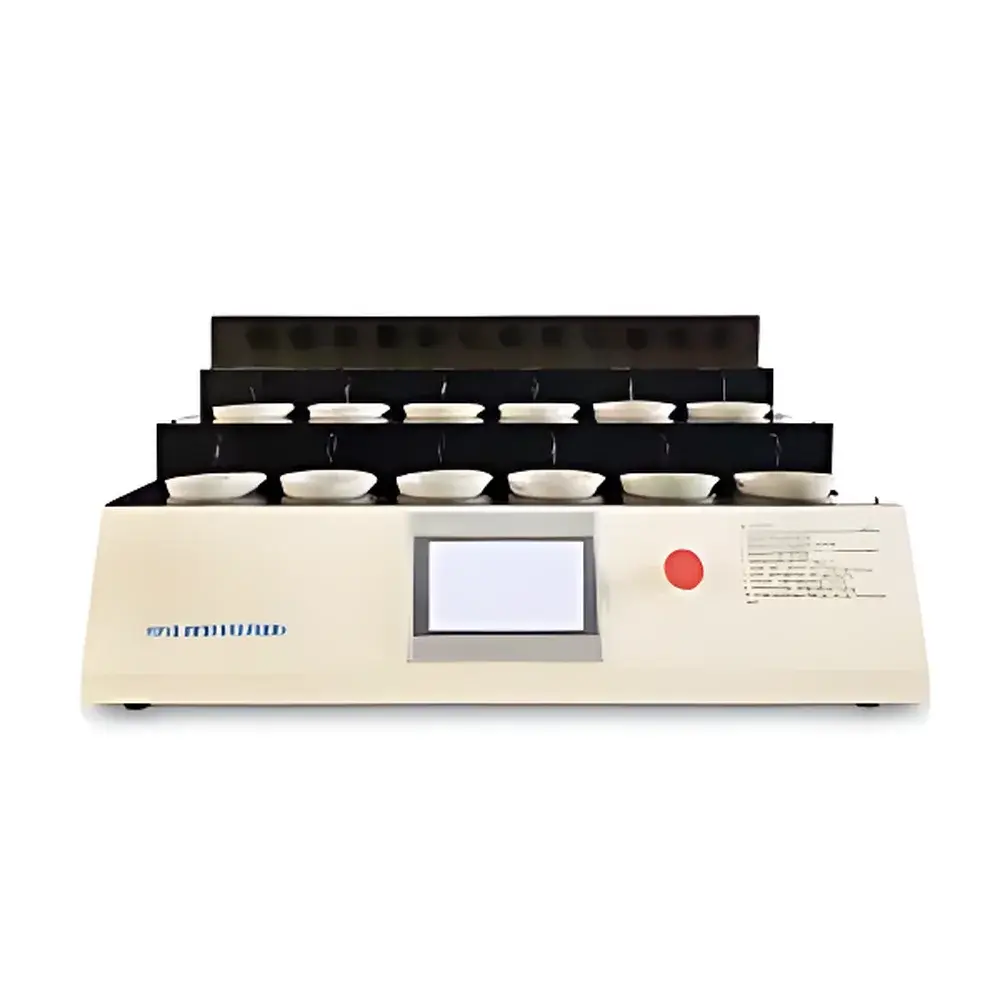
Radioactive Water Sample Evaporative Concentrator with Acid Removal (HUANKONG Model 7000)
| Brand | HUANKONG |
|---|---|
| Origin | Shandong, China |
| Manufacturer Type | Direct Manufacturer |
| Country of Origin | China |
| Model | 7000 |
| Instrument Type | Automated Quantitative Evaporative Concentrator |
| Compliance | Designed per Chinese National Standards (e.g., GB/T 14883, GB/T 5750.13, HJ 61-2021) |
| Control System | PC-based programmable logic control with embedded HMI |
| Heating Method | Independent carbon-fiber heating elements per channel |
| Acid Handling | Automated acid addition, salting-out, and high-temperature ashing sequence |
| Safety Features | Power-failure resume, real-time temperature/level monitoring, corrosion-resistant chamber and fluidic pathways |
| Cleaning | Fully automated post-run tube and manifold rinsing cycle |
| Material Compatibility | PTFE, quartz, borosilicate glass, and acid-resistant alloys (e.g., Hastelloy C-276 for critical zones) |
Overview
The HUANKONG Model 7000 Radioactive Water Sample Evaporative Concentrator with Acid Removal is an automated, multi-channel benchtop system engineered for the precise, unattended evaporation, concentration, and acid removal of aqueous environmental and radiological samples. It operates on the principle of controlled conductive heating combined with programmable liquid-level sensing and gravimetric or volumetric endpoint detection—enabling quantitative residue recovery without manual transfer or intermediate handling. Designed in alignment with key Chinese national standards—including HJ 61-2021 (Environmental Radiation Monitoring Technical Specification), GB/T 14883 (Food and Environmental Radioactivity Testing Methods), and GB/T 5750.13 (Standard Methods for Examination of Drinking Water: Radioactivity)—the instrument replaces labor-intensive, error-prone hotplate-and-beaker workflows with a reproducible, auditable, and GLP-compliant process. Its architecture eliminates cross-contamination risk, minimizes operator exposure to volatile radionuclides (e.g., 3H, 14C, 90Sr, 137Cs), and ensures full traceability from sample loading to dry residue.
Key Features
- Multi-channel independent operation: Each channel features dedicated carbon-fiber heating elements with real-time thermal feedback control, enabling differential ramp profiles and simultaneous processing of heterogeneous sample matrices (e.g., seawater, groundwater, rainwater, and air particulate leachates).
- Quantitative endpoint determination: Integrated load-cell-based mass monitoring or optical level sensing triggers automated termination at user-defined residual volumes (e.g., 0.5–2.0 mL) or dryness thresholds, ensuring consistent yield across batches.
- Automated reagent handling: Programmable syringe pumps dispense HNO3, HClO4, or H2SO4 for acid digestion and salting-out; subsequent high-temperature ashing (up to 550 °C) is executed under inert gas purge to prevent volatile nuclide loss.
- Corrosion-resilient construction: Chamber interior, sample holders, and fluidic manifolds are fabricated from PTFE-coated stainless steel, quartz, and Hastelloy C-276—validated for continuous exposure to concentrated mineral acids and elevated temperatures (>200 °C).
- Fully autonomous cleaning protocol: Post-run, the system executes sequential flushes with deionized water and ethanol, followed by nitrogen purging—eliminating carryover and reducing downtime between runs.
- Robust power management: Built-in UPS-compatible circuitry preserves operational state during grid interruption; resumption occurs automatically at the exact step and setpoint where the event occurred.
Sample Compatibility & Compliance
The Model 7000 accommodates standard 50–500 mL borosilicate glass or quartz evaporation dishes, as well as custom-fit Teflon vessels. It supports regulatory workflows for 226Ra (via BaSO4 co-precipitation), 210Po (spontaneous deposition), 90Sr (fuming nitric acid digestion), and gross alpha/beta analysis per ISO 10703 and EPA Method 900.0. All software logs—including method parameters, temperature/time profiles, acid addition volumes, mass change curves, and cleaning cycles—are timestamped and stored locally with optional network backup. Audit trails comply with basic data integrity requirements aligned with ALCOA+ principles (Attributable, Legible, Contemporaneous, Original, Accurate) and support internal GLP audits.
Software & Data Management
The embedded Windows-based control interface provides intuitive method creation, real-time graphical monitoring (mass vs. time, temperature vs. time), and export of CSV/Excel-formatted raw data. User roles (Operator, Supervisor, Administrator) enforce password-protected access to calibration, maintenance, and audit log functions. While not FDA 21 CFR Part 11-certified out-of-the-box, the system’s deterministic behavior, electronic signature capability (via optional USB token), and immutable log files enable qualification for regulated environments upon site-specific validation.
Applications
- Radiochemical analysis of surface water, groundwater, drinking water, and wastewater for alpha- and beta-emitting radionuclides.
- Pre-concentration of air filter leachates (e.g., TSP, PM2.5) for 7Be, 210Pb, and artificial fission products.
- Determination of dissolved solids (TDS) per ISO 2566-1 and ASTM D5907, including gravimetric residue quantification after chloride removal.
- Sample preparation for subsequent alpha spectrometry, liquid scintillation counting (LSC), or ICP-MS analysis.
- High-throughput environmental monitoring labs requiring >20 samples/day with minimal hands-on time.
FAQ
What safety certifications does the Model 7000 hold?
It conforms to GB 4793.1 (Electrical Safety for Laboratory Equipment) and GB/T 18204.1 (Hygienic Inspection Methods for Public Places). CE marking is available upon request for EU export configurations.
Can the system handle hydrofluoric acid (HF)?
No—HF is incompatible with standard wetted materials. Only HNO3, HCl, H2SO4, and HClO4 are supported per design specifications.
Is remote monitoring supported?
Yes—Ethernet connectivity enables real-time status viewing and alarm notifications via SNMP or HTTP API; however, remote method editing requires local authentication.
What maintenance intervals are recommended?
Quarterly verification of temperature sensors and mass calibration; annual replacement of acid-resistant tubing and pump valves under typical usage (≤1000 cycles/year).
Does the instrument support LIMS integration?
Raw data export (CSV/Excel) is native; direct LIMS push requires custom middleware or third-party drivers (e.g., LabWare, Thermo SampleManager).
Related Products



