
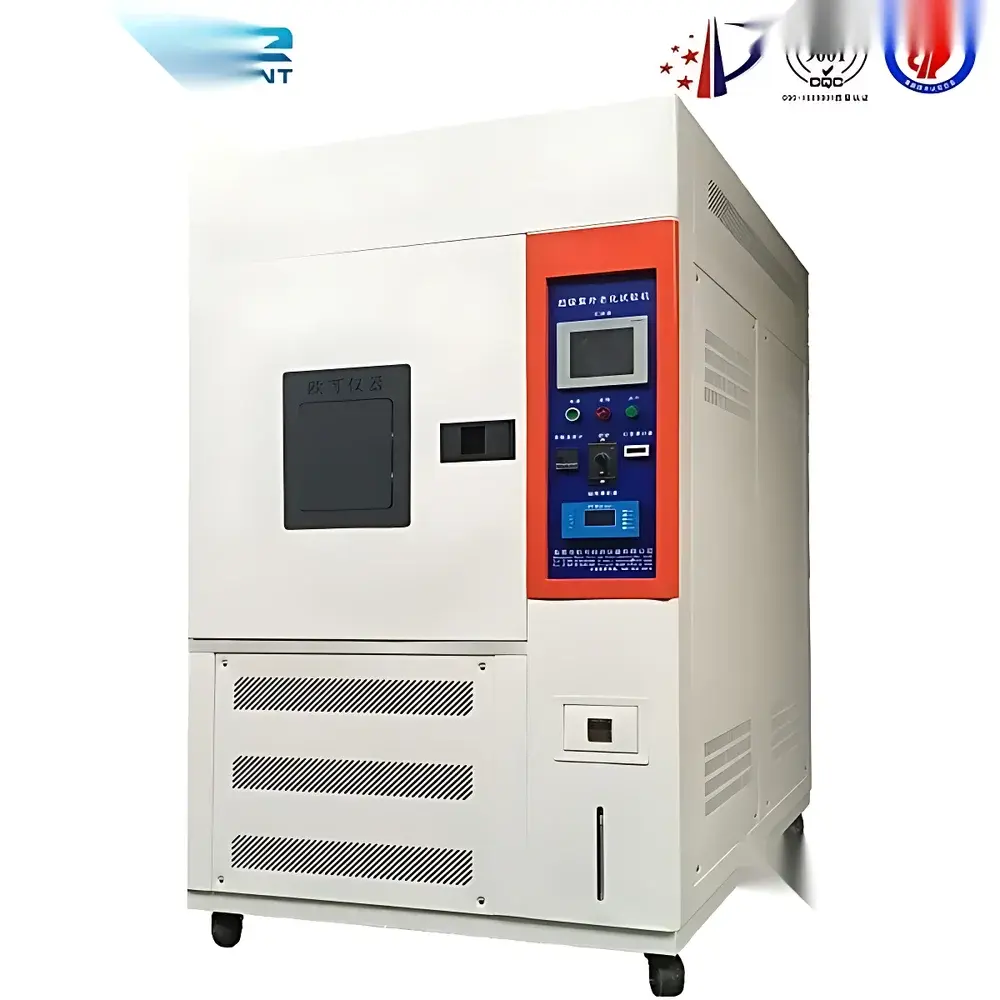
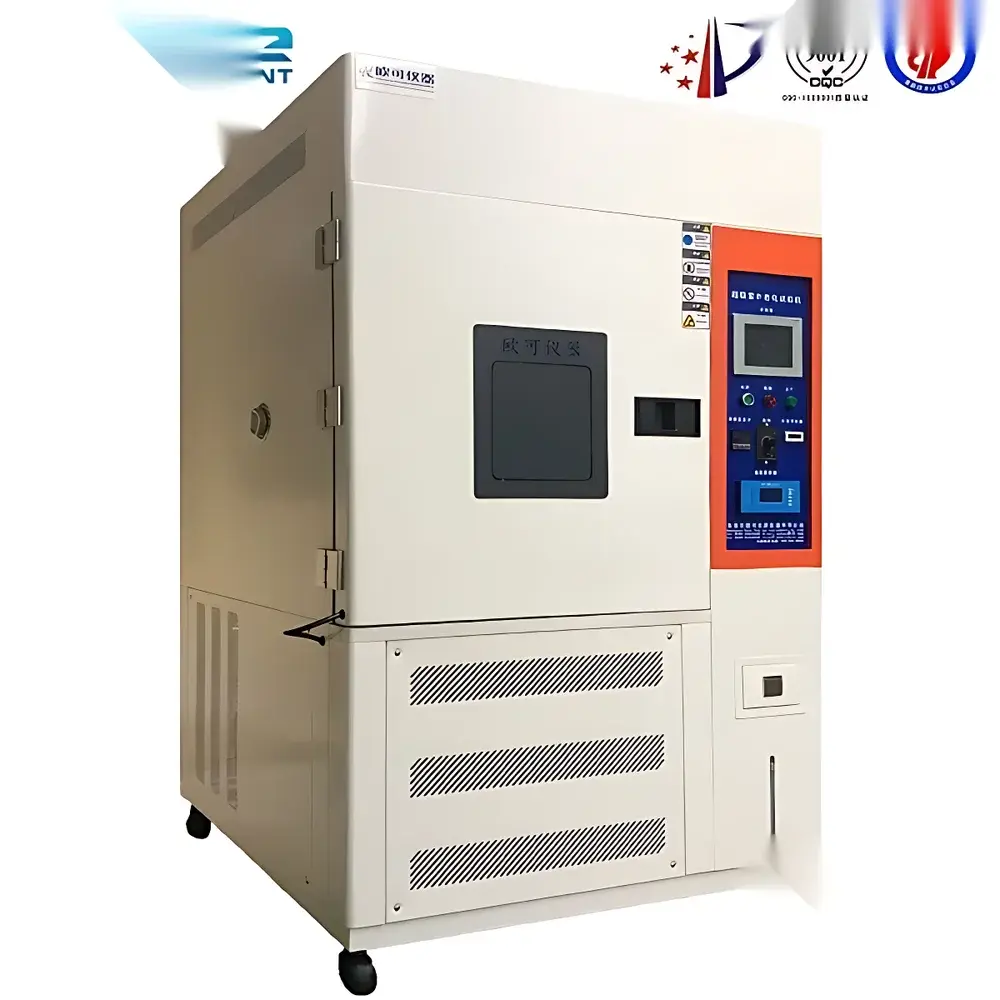
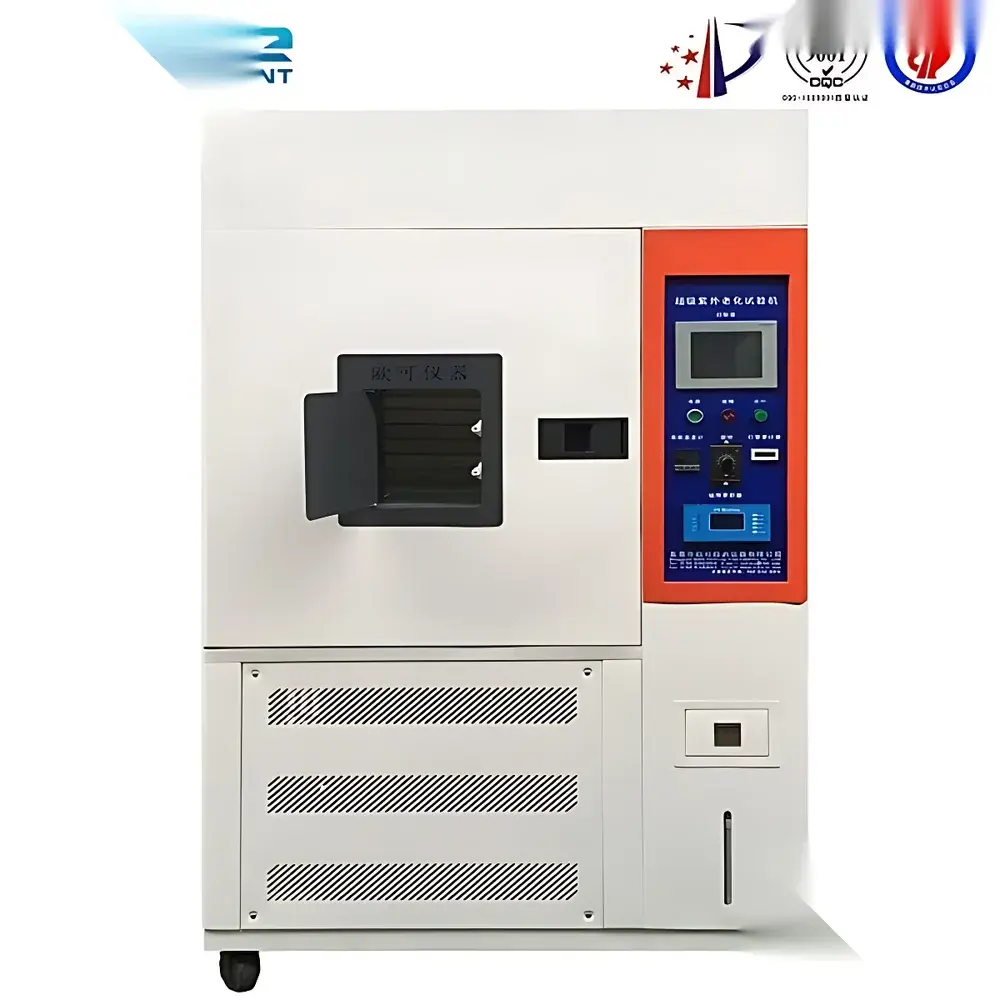
SuperUV Advanced UV Accelerated Weathering Test Chamber
| Brand | Other Brands |
|---|---|
| Origin | Imported |
| Manufacturer Type | General Distributor |
| Price | USD 21,500 (approx.) |
| Temperature Range | RT to 85°C (operational test temp: 50 ± 10°C) |
| Humidity Range | 40–70% RH (lighting), 50–90% RH (dark cycle) |
| Temp. Control Accuracy | ±0.5°C |
| Humidity Control Accuracy | ±2.0% RH |
| Temp. Uniformity | ±2.0°C |
| Humidity Uniformity | ±3.0% RH |
| Heating Rate | ≤25 min (RT → 85°C) |
| Light Source | 2.5 kW air-cooled metal halide lamp (1 unit) |
| Sample Rack | 500 × 400 mm stainless steel rack |
| Irradiation Geometry | Top-mounted, direct-reflection configuration |
| Spectral Range | 295–450 nm |
| Irradiance | 200 ± 8 W/m² (at sample plane) |
| Irradiance Uniformity | ≥90% across exposure area |
Overview
The SuperUV Advanced UV Accelerated Weathering Test Chamber is an engineered environmental simulation system designed to replicate the photochemical, thermal, and hygric stresses experienced by materials under natural outdoor exposure—accelerated over days or weeks rather than months or years. Unlike conventional fluorescent UV systems, this chamber employs high-intensity air-cooled metal halide lamps emitting a continuous spectral output from 295 nm to 450 nm, closely matching the terrestrial solar ultraviolet and visible irradiance profile after atmospheric filtration (equivalent to 3-mm borosilicate glass transmission). This spectral fidelity enables realistic simulation of photodegradation mechanisms—including polymer chain scission, chromophore degradation, oxidation, and hydrolysis—driven primarily by UV-B and UV-A radiation in conjunction with controlled temperature and humidity cycling. The chamber complies with core principles outlined in ISO 4892-2 (Plastics — Methods of exposure to laboratory light sources — Part 2: Xenon-arc lamps) and ASTM G155 (Standard Practice for Operating Xenon Arc Light Apparatus for Exposure of Non-Metallic Materials), adapted for metal halide spectral equivalence where applicable.
Key Features
- High-fidelity solar-spectrum simulation using a single 2.5 kW air-cooled metal halide lamp, delivering irradiance of 200 ± 8 W/m² within the 295–450 nm band at the specimen plane
- Precise dual-parameter control: temperature (RT to 85°C, ±0.5°C accuracy; uniformity ±2.0°C) and relative humidity (40–70% RH during irradiation, 50–90% RH during dark condensation cycles, ±2.0% RH accuracy; uniformity ±3.0% RH)
- Optimized optical geometry: top-mounted lamp with reflective irradiation path ensures ≥90% irradiance uniformity across the 500 × 400 mm stainless steel sample rack
- Programmable multi-stage test profiles supporting simultaneous UV exposure, thermal soak, humidity conditioning, and water spray (optional integrated nozzle system for simulated rain/condensation)
- Robust chamber construction with corrosion-resistant interior cladding, insulated double-wall housing, and fail-safe thermal cutoffs meeting IEC 61000-6-2 EMC immunity requirements
Sample Compatibility & Compliance
The chamber accommodates flat-panel specimens up to 500 × 400 mm and is routinely deployed for evaluating automotive exterior components (paints, plastics, seals), photovoltaic module encapsulants and backsheets, aerospace composites, architectural coatings, and consumer electronics housings. Its operational envelope supports standardized test protocols aligned with ISO 11341 (Paints and varnishes — Artificial weathering and exposure to artificial radiation — Exposure to filtered open-flame carbon-arc radiation), ISO 20340 (Petroleum and natural gas industries — Protective coating systems for offshore and related structures), and SAE J2527 (Surface Vehicle Recommended Practice — Accelerated Exposure of Automotive Exterior Materials Using a Controlled Irradiance Xenon-Arc Apparatus), with documented spectral correlation to metal halide-based validation matrices. All control firmware and data logging meet GLP audit requirements, including time-stamped event logs and user-access-level permissions.
Software & Data Management
Equipped with a dedicated Windows-based control interface, the system provides real-time monitoring of irradiance (via calibrated broadband UV sensor), chamber temperature/humidity, and lamp operating parameters (voltage, current, cooling airflow). Test sequences are defined via intuitive drag-and-drop scheduling, supporting up to 99 program steps with conditional branching (e.g., “if irradiance drops below 192 W/m², trigger lamp recalibration”). Raw measurement data—including timestamped irradiance, thermal, and hygric traces—is exported in CSV format compliant with LIMS integration. Audit trails record all operator actions, parameter modifications, and calibration events in accordance with FDA 21 CFR Part 11 requirements for electronic records and signatures.
Applications
- Accelerated evaluation of UV resistance in automotive clearcoats, thermoplastic olefin (TPO) bumpers, and polypropylene interior trims
- Qualification testing of ethylene-vinyl acetate (EVA) encapsulants and fluoropolymer backsheets used in crystalline silicon PV modules per IEC 61215-2 MQT 10
- Correlation studies between laboratory aging and field performance of marine-grade anti-fouling coatings
- Development and validation of UV-stabilized polycarbonate lenses for LED lighting and headlamp assemblies
- Comparative ranking of pigment fade resistance in architectural acrylic latex paints under cyclic UV/humidity stress
FAQ
What spectral standard does the metal halide lamp emulate?
It replicates the global solar irradiance spectrum transmitted through 3-mm borosilicate glass—covering 295–450 nm with peak intensity near 365 nm—matching the UV-A/UV-B weighting used in ISO 4892-2 Annex B reference spectra.
Is the irradiance level adjustable during a test?
Yes; irradiance setpoints can be modified dynamically within the 180–220 W/m² range via closed-loop feedback from the integrated broadband UV sensor.
Can the chamber perform condensation-only cycles without UV exposure?
Yes; the control software supports independent humidity ramping and dwell phases with zero irradiance, enabling dark-condensation aging per ISO 6270-2 protocols.
What maintenance intervals are recommended for the lamp and optical system?
Lamp replacement is advised every 1,200 hours of operation; quartz filter and reflector cleaning is required every 200 hours to maintain spectral fidelity and irradiance uniformity.
Does the system support third-party calibration traceability?
Yes; optional NIST-traceable irradiance calibration certificates are available, and the chamber’s temperature/humidity sensors are compatible with external metrology-grade reference probes per ISO/IEC 17025 guidelines.



