
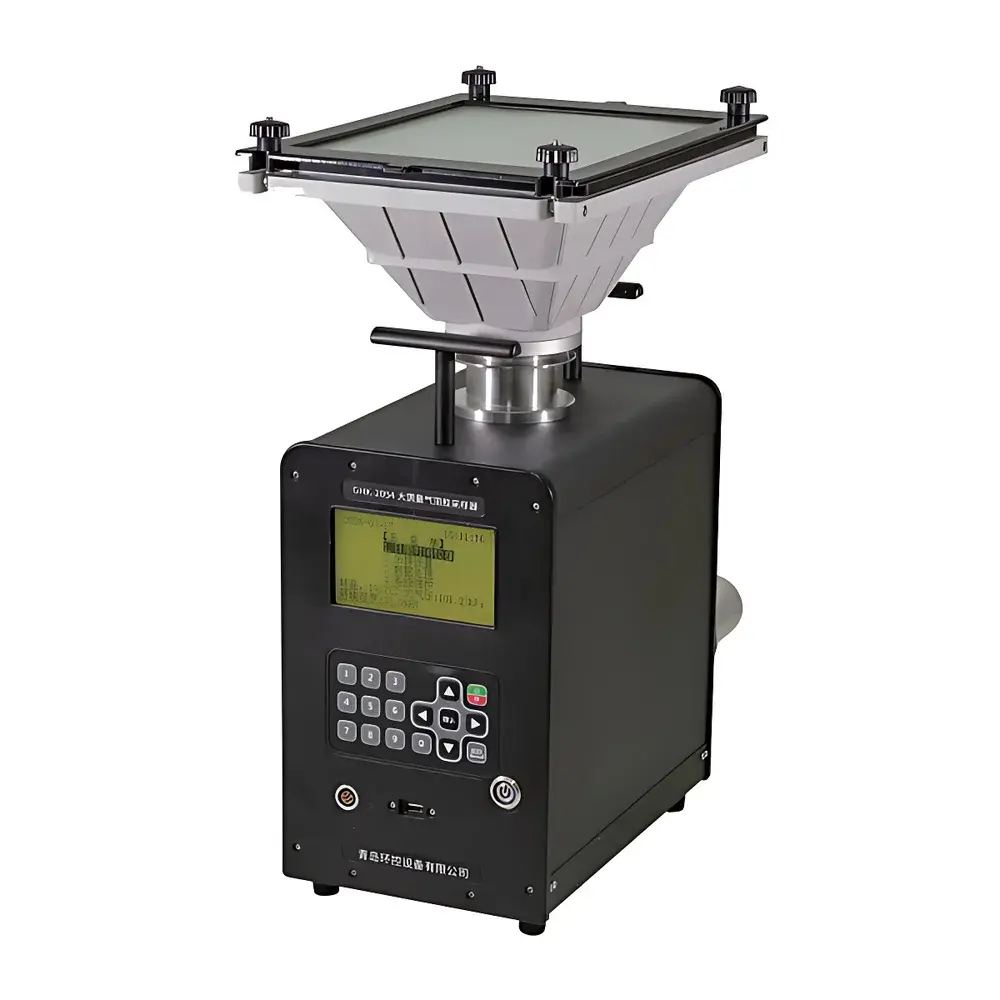
HUANKONG GHK-2054 High-Flow Radioactive Aerosol Sampler for Environmental Radiation Monitoring
| Brand | HUANKONG |
|---|---|
| Origin | Shandong, China |
| Manufacturer | Yes |
| Country of Origin | China |
| Model | GHK-2054 |
| Pricing | Available Upon Request |
Overview
The HUANKONG GHK-2054 High-Flow Radioactive Aerosol Sampler is an engineered field-deployable instrument designed for continuous, quantitative collection of airborne radioactive particulates in environmental radiation monitoring programs. It operates on the principle of high-volume isokinetic sampling—drawing ambient air through a certified filter medium (typically 8×10 inch or 20.3×25.4 cm glass fiber or quartz fiber filters) at precisely controlled flow rates up to 1.2 m³/min (72 m³/h), enabling statistically robust detection of low-activity gamma-emitting radionuclides such as 137Cs, 60Co, 131I, and natural series isotopes (e.g., 210Po, 234Th). Its core function supports regulatory compliance with national radiation surveillance frameworks, particularly where long-term trend analysis, emergency response screening, or baseline characterization of atmospheric radioactivity is required. The system integrates real-time environmental parameter acquisition—ambient temperature, barometric pressure, and volumetric flow—with microcontroller-based closed-loop feedback control to maintain flow stability under variable inlet resistance and weather conditions.
Key Features
- Microprocessor-controlled constant-flow sampling with automatic compensation for filter loading, temperature drift, and pressure variation.
- Integrated high-efficiency brushless DC blower (imported origin) delivering stable airflow up to 1.2 m³/min with low acoustic emission (10,000 h MTBF).
- Real-time digital acquisition of operational parameters: actual flow rate (working condition), cumulative sampled volume, ambient temperature (±0.3 °C), atmospheric pressure (±0.1 kPa), elapsed time, and power interruption duration.
- Digital calibration capability for flow sensor (thermal mass or orifice-based), temperature sensor (PT100-class), and pressure transducer—traceable to national metrological standards.
- Programmable sampling modes: time-based (1 min–999 h), volume-based (0.01–9999.99 m³), or hybrid scheduling with multi-stage protocols.
- Overload protection logic: automatic shutdown if measured flow deviates >±10% from setpoint for ≥5 consecutive minutes—preventing filter breakthrough and data invalidation.
- Non-volatile memory storing up to 100 complete sampling sessions, including timestamps, environmental metadata, and diagnostic flags.
- Power failure resilience: retains all active session data during blackout; resumes sampling upon power restoration without manual reconfiguration.
- Modular tripod-mountable chassis with adjustable height (0.5–2.0 m) for standardized sampling elevation per IAEA TRS-459 and HJ 1149–2020.
Sample Compatibility & Compliance
The GHK-2054 is validated for use with standard 20.3×25.4 cm (8×10 in) filter substrates compliant with ISO 29463-3:2017 (high-efficiency particulate air filtration) and ASTM D1213–19 (filter media specifications). It meets the mechanical and metrological requirements of China’s statutory environmental radiation monitoring standards: HJ 1149–2020 (γ-spectrometric analysis of aerosol filters), HJ 61–2021 (technical specification for radiation environmental monitoring), and HJ 1009–2019 (operation of automated air monitoring stations). While not certified to IEC 61508 or EN 61326-1 out-of-the-box, its architecture supports integration into GLP-compliant workflows when paired with auditable laboratory information management systems (LIMS) and documented calibration records.
Software & Data Management
Data output is accessible via built-in LCD interface (backlit, 128×64 pixel) and external USB 2.0 port. Sample metadata—including date/time stamps, flow profiles, environmental corrections, and fault logs—are stored in CSV-compatible format. Exported files are structured for direct import into gamma spectrometry software (e.g., Genie 2000, GammaVision, or custom Python/Pandas pipelines) and regulatory reporting templates. The system supports audit-trail-capable data handling when used within facilities adhering to GB/T 27025–2019 (equivalent to ISO/IEC 17025) and enables traceability of calibration events, operator IDs, and environmental correction factors applied during volume normalization (e.g., STP conversion per HJ 1149–2020 Annex A).
Applications
- Long-term atmospheric radioactivity baseline studies near nuclear facilities, uranium processing sites, or legacy contamination zones.
- Emergency response monitoring following radiological incidents (e.g., reactor anomalies, transport accidents, or orphan source discoveries).
- Validation of dispersion modeling outputs using empirically derived deposition fluxes.
- Research on radionuclide speciation, particle size distribution (when coupled with cascade impactors), and resuspension dynamics.
- Quality assurance for national radiation monitoring networks requiring inter-laboratory comparability and metrological traceability.
FAQ
What filter types are compatible with the GHK-2054?
Standard 20.3 × 25.4 cm glass fiber (e.g., Whatman GF/C) or quartz fiber (e.g., Pallflex Tissuquartz QMA) filters meeting EPA Method IO-3.2 and HJ 1149–2020 specifications.
Does the sampler support STP (standard temperature and pressure) volume correction?
Yes—automatically calculates and logs both working-condition and STP-normalized volumes using real-time T/P inputs per HJ 1149–2020 Section 7.2.
Is firmware upgrade possible in the field?
Firmware updates are supported via USB-connected PC using manufacturer-provided configuration utility; version history and checksum verification are maintained in device memory.
Can multiple GHK-2054 units be synchronized for networked monitoring?
While no native wireless mesh protocol is embedded, time synchronization via GPS module add-on (optional) and centralized LIMS ingestion enable coordinated temporal alignment across distributed deployments.
What maintenance intervals are recommended?
Blower inspection every 6 months; flow sensor recalibration annually or after 2000 operating hours; full metrological verification recommended prior to critical campaigns or regulatory audits.







