
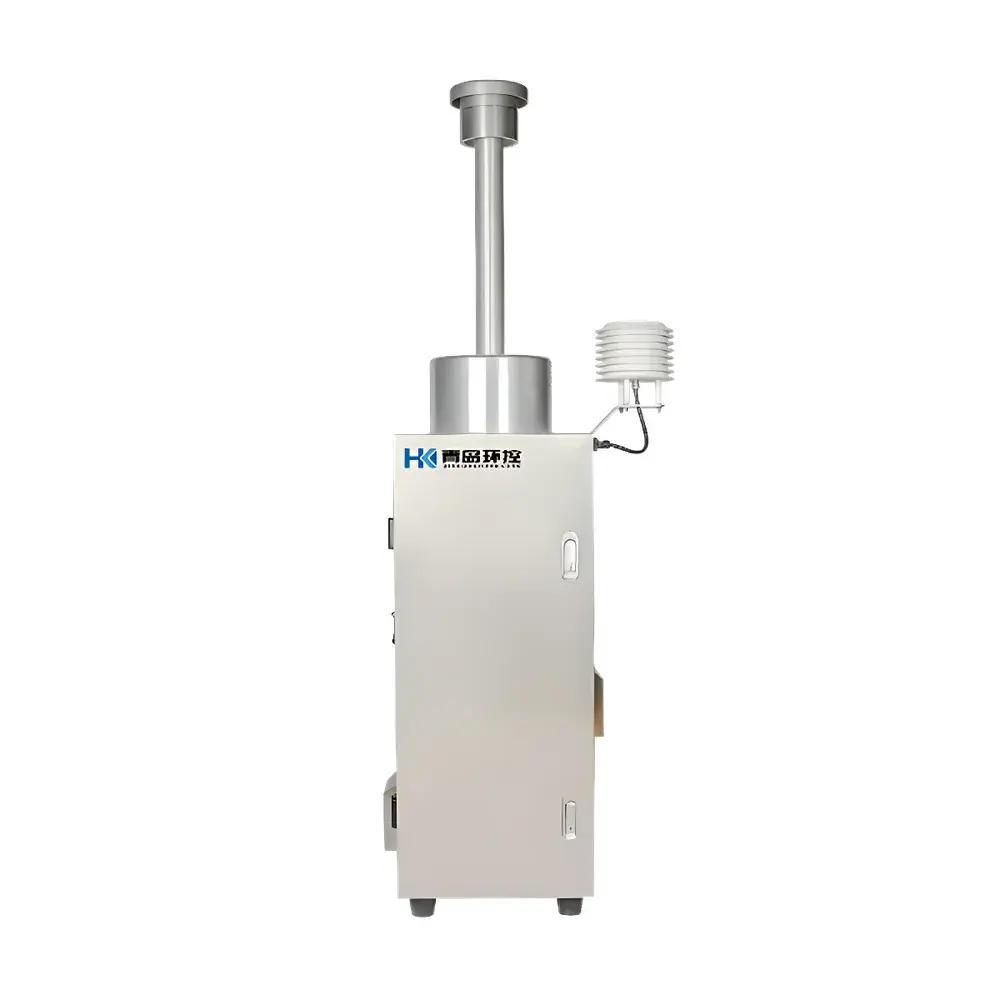
HUANKONG GHD-SM4 Quad-Channel Ambient Air Particulate Matter Sampler
| Brand | HUANKONG |
|---|---|
| Origin | Shandong, China |
| Manufacturer Type | Direct Manufacturer |
| Model | GHD-SM4 |
| Configuration | Integrated Quad-Channel Particulate Sampler |
| Compliance | JJG 943–2011, HJ 93–2013, HJ 656–2013, HJ 618–2011 |
| Sampling Modes | Immediate, Timed, Interval |
| Flow Control | Independent PID-regulated mass flow control per channel |
| Pump Type | Brushless DC vacuum pumps |
| Data Interface | RS232, USB, Built-in thermal printer |
| Environmental Sensors | Ambient temperature, barometric pressure, actual flow (m³/min), standardized flow (m³/min at 25°C & 101.325 kPa) |
| Protection Features | Overload shutdown, power-fail memory retention |
| Particle Size Cuts | TSP, PM₁₀, PM₂.₅, PM₁ (via certified impactor or filter-based separation stages) |
Overview
The HUANKONG GHD-SM4 Quad-Channel Ambient Air Particulate Matter Sampler is an engineered solution for simultaneous, independent collection of airborne particulate fractions under field-deployable conditions. Designed around a true co-source multi-channel architecture, the instrument draws ambient air through four physically separate sampling trains—each equipped with its own brushless DC vacuum pump, precision thermal mass flow sensor, and dedicated flow control circuitry. This architecture eliminates cross-channel interference and ensures gravimetric integrity across parallel measurements. The system operates on the principle of inertial separation (for size-selective inlets) combined with isokinetic filtration, enabling compliant sampling of total suspended particulates (TSP), PM₁₀, PM₂.₅, and PM₁ according to internationally referenced methodologies. Its mechanical and electronic design adheres to the metrological traceability requirements defined in JJG 943–2011 and the performance specifications outlined in HJ 93–2013 and HJ 618–2011—making it suitable for regulatory monitoring networks, ambient air quality assessment programs, and method validation studies requiring concurrent multi-fraction data.
Key Features
- Four independent sampling channels with co-located inlet geometry, ensuring identical air mass exposure history across all filters
- Dedicated brushless DC vacuum pumps per channel—rated for >20,000 hours MTBF and delivering stable suction pressure up to 30 kPa
- Real-time PID-controlled mass flow regulation (±1% setpoint accuracy) with automatic compensation for temperature and pressure drift
- Integrated environmental sensing suite: calibrated thermistor (±0.3°C), piezoresistive barometer (±0.1 kPa), and volumetric flow transducers traceable to NIM standards
- Three operational modes: immediate start, programmable timed sampling (up to 999 hours), and interval sampling with configurable on/off cycles
- On-device data logging with timestamped records of flow rate, temperature, pressure, accumulated volume (actual and standard), and pump status
- RS232 serial interface and USB 2.0 port for bidirectional communication with external PCs or data loggers; supports ASCII and Modbus RTU protocols
- Built-in thermal printer for immediate hard-copy output of sampling parameters and summary statistics without external peripherals
- Power-fail recovery: retains configuration, elapsed time, and cumulative volume in non-volatile memory during blackout events
- Overload protection logic automatically halts sampling if differential pressure across the filter exceeds preconfigured thresholds (e.g., >15 kPa), preserving sample integrity and pump longevity
Sample Compatibility & Compliance
The GHD-SM4 accommodates standard 47 mm and 90 mm diameter quartz fiber, PTFE, or cellulose ester filters—compatible with EPA IO-4.3, ISO 7708, and EN 12341 weight-based analysis workflows. Each channel may be fitted with interchangeable inlet assemblies—including TSP hoods, PM₁₀ sharp-cut cyclones (with 50% cut-point at 10.0 ± 0.5 µm), PM₂.₅ WINS impactors (50% cut-point at 2.5 ± 0.2 µm), or custom-engineered PM₁ diffusive denuders—enabling flexible deployment across research, compliance, and source apportionment applications. All hardware and firmware comply with the measurement uncertainty, calibration frequency, and field verification requirements specified in HJ 656–2013 for manual PM₂.₅ reference methods. Instrument-level documentation includes factory calibration certificates traceable to national metrology institutes, and audit-ready event logs meet GLP-aligned data integrity expectations.
Software & Data Management
The embedded firmware supports full local configuration via intuitive menu navigation and optional PC-based configuration software (Windows-compatible, no runtime dependencies). Sample metadata—including operator ID, site code, filter ID, sampling duration, and environmental conditions—is automatically embedded into each data record. Export formats include CSV and XML, with optional integration into LIMS environments via configurable HTTP POST or FTP push. Audit trail functionality logs all parameter changes, start/stop commands, and error events with user attribution and UTC timestamps—supporting 21 CFR Part 11 readiness when deployed in regulated laboratories. Firmware updates are performed via USB stick with cryptographic signature verification to ensure integrity.
Applications
- Ambient air quality monitoring networks requiring synchronized PM fraction data for trend analysis and model input
- Method comparison studies between gravimetric reference samplers and continuous monitors (e.g., beta attenuation, TEOM)
- Source characterization campaigns involving spatially distributed sampling with temporal alignment across particle size bins
- Indoor air quality investigations where differential deposition behavior of PM₁ vs. PM₂.₅ must be resolved
- Calibration and verification of low-cost sensor arrays using co-located high-accuracy reference sampling
- Long-term epidemiological exposure assessments requiring archived filters for subsequent chemical speciation (e.g., ICP-MS, IC, GC-MS)
FAQ
Does the GHD-SM4 support simultaneous sampling of four different particle size fractions?
Yes—the four channels can be independently configured with distinct size-selective inlets (e.g., TSP, PM₁₀, PM₂.₅, PM₁) and operated concurrently under identical meteorological conditions.
Is flow calibration traceable to national standards?
Each unit ships with individual flow sensor calibration certificates issued by an accredited laboratory, with traceability to China’s National Institute of Metrology (NIM) or equivalent international bodies (e.g., NIST, PTB).
Can the instrument operate unattended for extended periods?
With AC power and optional external battery backup, the GHD-SM4 supports continuous operation for ≥30 days; internal memory retains >10,000 timestamped records even during power loss.
What filter types and diameters are supported?
Standard configurations accept 47 mm circular filters (quartz, PTFE, nylon); optional 90 mm holders are available for high-volume applications requiring lower mass loading errors.
How is data security ensured during remote transmission?
When configured for networked data transfer, TLS 1.2 encryption is enforced for HTTPS endpoints, and all local storage uses write-protected sectors to prevent accidental overwrites.







