
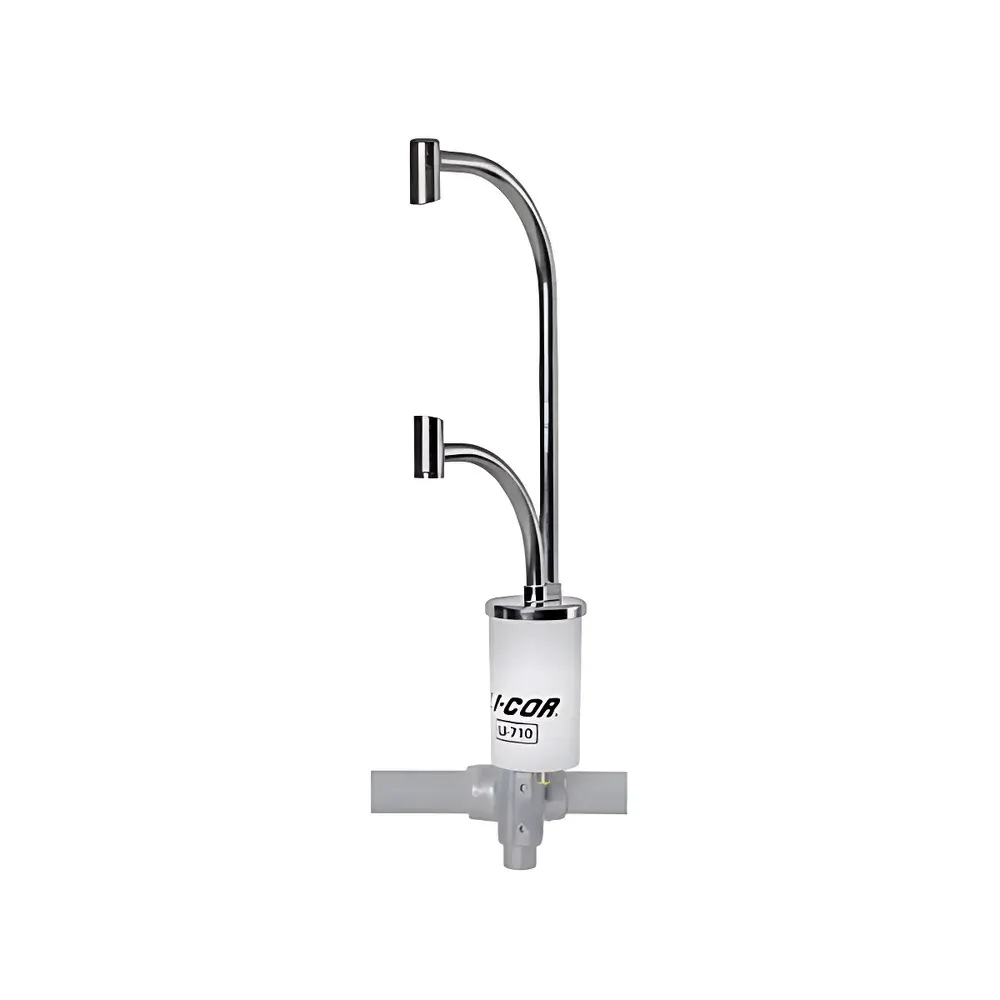
LI-COR LI-710 Eddy Covariance Evapotranspiration Analyzer
| Brand | LI-COR |
|---|---|
| Origin | USA |
| Model | LI-710 |
| Operating Temperature | 5–50 °C |
| Relative Humidity Limit | ≤85% RH (non-condensing) |
| Communication Protocol | SDI-12 |
| Input Voltage | 8–33 V DC |
| Power Consumption | ≤1.5 W |
| Weight | 1.4 kg |
| Dimensions | 58 × 17.5 × 7.6 cm |
| Mounting | Compatible with 1" mast and NuRail hardware |
| Minimum Sonic Anemometer Separation | ≥2 m |
| Minimum Installation Height | ≥2 m |
| Ingress Protection | IP54 (IEC 60529) |
| H₂O Mole Fraction Range | 0–60 mmol/mol |
| Sample Flow Rate | 0.3 L/min (typical) |
| Output Parameters | ET (mm), LE (W/m²), H (W/m²), VPD (kPa), Pa (kPa), Ta (°C), RH (%), AH (g/m³), SVP (kPa), Td (°C) |
Overview
The LI-COR LI-710 Eddy Covariance Evapotranspiration Analyzer is a field-deployable, self-contained instrument engineered for direct, continuous measurement of ecosystem-scale evapotranspiration (ET) using the eddy covariance (EC) method. Unlike indirect estimation approaches—such as those relying on crop coefficients (Kc) and reference evapotranspiration (ETo) calculated via Penman-Monteith or Hargreaves equations—the LI-710 acquires high-temporal-resolution turbulent fluxes of water vapor and vertical wind velocity to compute latent heat flux (LE), which is then converted to ET in millimeters per time interval. This physics-based, first-principles approach eliminates dependency on empirical calibration parameters, thereby reducing systematic bias in water balance quantification. The system integrates a fast-response infrared gas analyzer (IRGA) for H₂O mole fraction detection at 10 Hz, synchronized with a co-located 3D sonic anemometer (not included, but required), enabling covariance computation of vertical wind velocity (w′) and water vapor density fluctuations (q′). Data are processed onboard using standardized EC algorithms compliant with AmeriFlux and ICOS protocols, delivering fully quality-controlled, gap-filled ET values at 30-minute intervals.
Key Features
- Direct eddy covariance measurement of evapotranspiration—no Kc, no ETo assumptions, no model parameterization
- Integrated IRGA with 0–60 mmol/mol H₂O dynamic range and 0.3 L/min sample flow, optimized for low-power, long-term operation
- Onboard data processing engine applying standard EC corrections: coordinate rotation, WPL correction for density effects, spectral attenuation compensation, and stationarity filtering
- Low-power design (≤1.5 W) suitable for solar-battery deployments in remote locations
- Ruggedized aluminum housing rated IP54, validated for outdoor exposure across diverse climatic zones (5–50 °C, ≤85% RH non-condensing)
- SDI-12 interface enables seamless integration with common environmental data loggers (e.g., Campbell Scientific CR series, Onset HOBO, Decagon EM50)
- Compact form factor (58 × 17.5 × 7.6 cm) and 1.4 kg mass facilitate rapid installation on standard 1-inch masts and compatibility with NuRail mounting systems
Sample Compatibility & Compliance
The LI-710 is designed for deployment over homogeneous, relatively flat surfaces—including agricultural fields, grasslands, forests, wetlands, and managed turf—where surface roughness length and displacement height can be reasonably estimated. It complies with core methodological standards for micrometeorological flux measurements, including the AmeriFlux Metadata Standard v2.1 and the ICOS Ecosystem Thematic Centre QA/QC framework. While not a certified device under ISO/IEC 17025, its measurement traceability aligns with NIST-traceable H₂O vapor standards used in LI-COR’s factory calibration procedures. All output variables—including ET (mm), LE (W/m²), H (W/m²), VPD (kPa), atmospheric pressure (kPa), air temperature (°C), relative humidity (%), absolute humidity (g/m³), saturation vapor pressure (kPa), and dew point (°C)—are reported in SI-conformant units and adhere to FAO-56 and ASCE-EWRI reporting conventions. The system supports GLP-aligned metadata tagging (site ID, instrument ID, calibration date, tilt correction applied) to facilitate audit readiness in regulatory or funded research contexts.
Software & Data Management
Raw 10-Hz H₂O signal and diagnostic outputs are accessible via SDI-12 for external logging and real-time telemetry. Pre-processed 30-minute ET and ancillary fluxes are stored internally and retrievable via serial command interface. LI-COR provides the free, open-source ECOffice post-processing toolkit (compatible with Windows/macOS/Linux), which implements extended QC flags (e.g., u* thresholding, turbulence intensity screening, footprint modeling), flux partitioning (using the nighttime RE method or daytime residual approach), and uncertainty propagation based on random error estimates per Foken et al. (2004). Export formats include CSV, NetCDF-4 (CF-1.8 compliant), and SQL-ready tables. For regulated environments requiring electronic records integrity, the LI-710 can be deployed within a 21 CFR Part 11–compliant infrastructure when paired with validated third-party data acquisition software that enforces audit trails, electronic signatures, and role-based access control.
Applications
- Precision irrigation scheduling and water use efficiency assessment across row crops, orchards, and vineyards
- Regional water budget modeling and drought severity indexing for state and federal water resource agencies
- Ground-truthing of satellite-derived ET products (e.g., MOD16, SSEBop, PT-JPL) under varying land cover and soil moisture regimes
- Quantifying ecohydrological feedbacks in response to climate variability, land-use change, or restoration interventions
- Supporting eddy covariance network expansion where full EC towers are cost-prohibitive or logistically constrained
- Supplementing meteorological station networks with surface energy balance components (LE, H, VPD) for boundary-layer process studies
FAQ
Does the LI-710 include a sonic anemometer?
No—the LI-710 requires an externally mounted, co-located 3D sonic anemometer (e.g., Gill WindMaster, Metek uSonic-3 Class A, or Campbell CSAT3B) positioned ≥2 m above the sensor inlet and ≥2 m horizontally from obstructions.
What is the minimum recommended installation height?
A minimum height of 2 meters above the vegetation canopy is required to ensure adequate turbulence sampling and minimize ground interference in the flux footprint.
Can the LI-710 operate autonomously for extended periods?
Yes—its low power draw (≤1.5 W) and SDI-12 compatibility enable multi-month deployments powered by 12 V battery + solar charging systems typical in unattended environmental monitoring stations.
Is calibration traceable to international standards?
Factory calibrations are performed using NIST-traceable H₂O vapor standards; users receive a calibration certificate specifying date, span gas concentration, and uncertainty budget per ISO/IEC 17025 guidance principles.
How is data quality assurance implemented?
The onboard processor applies real-time diagnostics (signal amplitude, noise floor, zero drift) and flags data based on turbulence criteria (e.g., friction velocity u*, integral turbulence time scale), with configurable thresholds aligned with FLUXNET Level 2 QA/QC protocols.







