
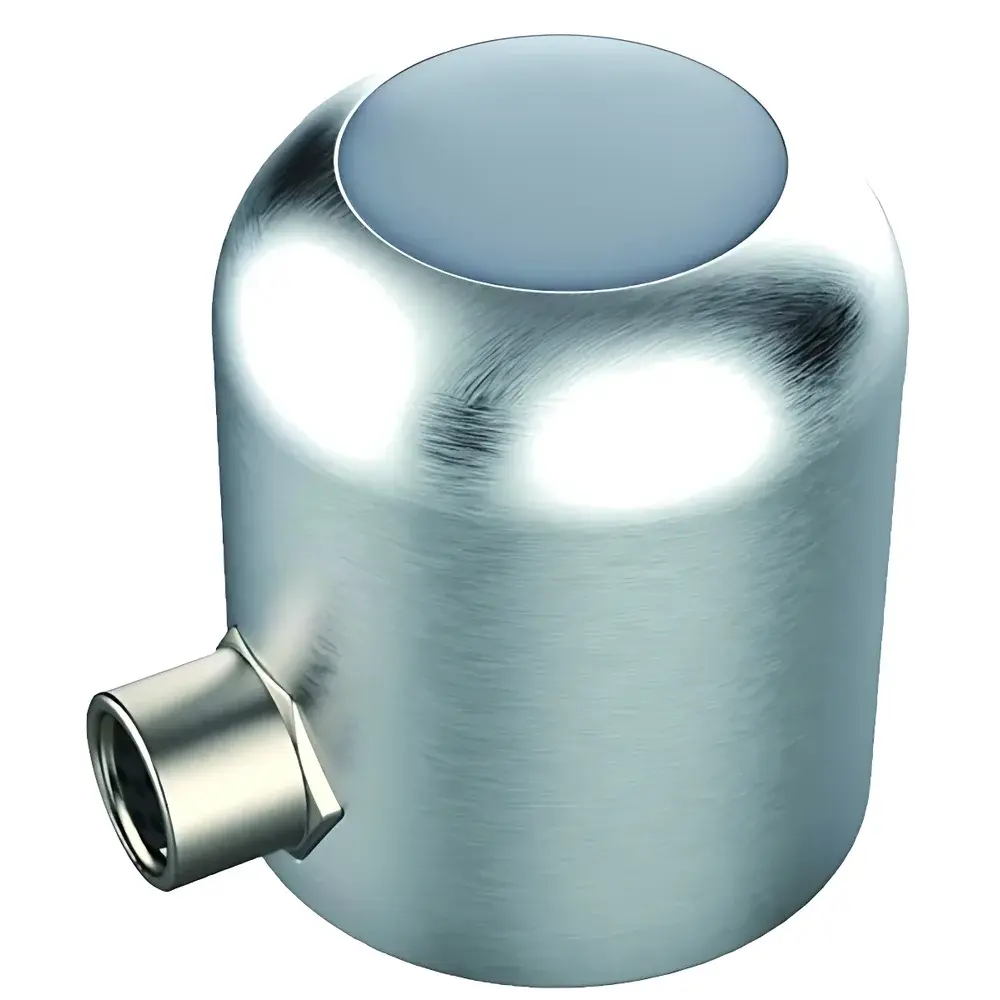
METER SU-221 UV-A Sensor
| Brand | METER |
|---|---|
| Origin | USA |
| Model | SU-221 |
| Measurement Range | 300–400 nm (UV-A) |
| Accuracy | ±10% |
| Full-Scale Output | 0–100 W·m⁻² |
| Linearity Error | <1% |
| Long-Term Drift | <2% per year |
| Response Time | 0.6 s |
| Field of View | 180° (Cosine-Corrected) |
| Directional Response | ±2% @ 45°, ±5% @ 75° |
| Temperature Dependence | <0.1% / °C |
| Operating Environment | −30 to +85 °C, 0–100% RH |
| Dimensions | Ø30.5 mm × 37 mm |
| Weight (incl. 5 m cable) | 140 g |
| Cable | 5 m shielded twisted-pair with TPR jacket, M8 IP68 connector, 4-conductor |
| Compatible Data Loggers | METER ZL6, EM60, ZSC, ProCheck |
| Output Interface | Analog voltage (0–2.5 V), compatible with ZL6’s differential analog input channels |
Overview
The METER SU-221 UV-A Sensor is a precision-calibrated, cosine-corrected radiometric instrument engineered for continuous, field-deployable measurement of ultraviolet-A irradiance (300–400 nm) in natural and controlled environments. Based on a photodiode with spectrally selective optical filtering and temperature-compensated analog signal conditioning, the SU-221 adheres to fundamental principles of actinometry—quantifying photon flux density in biologically and photochemically relevant UV-A bands. Its design prioritizes long-term stability under variable thermal and humidity conditions, making it suitable for ecological monitoring, horticultural light management, material degradation studies, and environmental UV exposure assessment. Unlike broadband UV sensors lacking spectral discrimination, the SU-221 delivers spectrally resolved irradiance data traceable to NIST-traceable calibration standards, enabling compliance with ISO 17025–accredited measurement protocols when deployed within validated data acquisition systems.
Key Features
- True cosine-corrected optical diffuser ensuring accurate angular response: ±2% deviation at 45° incidence and ±5% at 75°, critical for albedo-inclusive outdoor irradiance measurements;
- IP68-rated stainless-steel M8 connector and marine-grade cable assembly, certified for permanent submersion and resistant to UV degradation, salt fog, and mechanical abrasion;
- Integrated temperature compensation circuitry limiting sensitivity drift to <0.1% per °C across the full operating range (−30 to +85 °C);
- Low-power analog output (0–2.5 V) optimized for high-resolution digitization by METER ZL6 and EM60 series loggers, supporting 24-bit ADC resolution and programmable sampling intervals from 1 second to 24 hours;
- Self-cleaning surface geometry minimizing dust accumulation and reducing maintenance frequency in unattended deployments;
- Compact form factor (Ø30.5 mm × 37 mm) with minimal thermal mass, enabling rapid thermal equilibration and reducing measurement lag during diurnal ambient shifts.
Sample Compatibility & Compliance
The SU-221 is designed for direct exposure to ambient solar radiation, artificial lighting (e.g., fluorescent, LED, and metal halide UV-A sources), and reflective surfaces in open-field, greenhouse, and indoor laboratory settings. It meets IEC 60529 for IP68 ingress protection and conforms to ASTM G177–22 Annex A1 for spectral weighting in UV-A actinic irradiance reporting. When integrated into METER’s ZL6–ZENTRA Cloud ecosystem, data collection workflows support audit-ready metadata tagging, time-synchronized logging, and GLP-compliant electronic records—including automatic timestamping, sensor ID embedding, and firmware version tracking. While the sensor itself does not require FDA 21 CFR Part 11 certification, its output integration with ZL6 loggers supports configurable audit trails and user-access controls required for regulated research environments.
Software & Data Management
Data from the SU-221 is acquired via METER’s ZL6 or EM60 data loggers, which provide native support for analog voltage scaling using factory-provided calibration coefficients (mV per W·m⁻²). Raw voltage readings are automatically converted to irradiance units in real time and transmitted to ZENTRA Cloud—a secure, ISO 27001–certified platform offering role-based access, automated QC flagging (e.g., out-of-range saturation, cable disconnect alerts), and export in CSV, NetCDF, or CF-compliant formats. ZENTRA Cloud also enables cross-sensor correlation—for example, synchronizing SU-221 UV-A data with concurrent PAR, temperature, and relative humidity measurements from co-located METER sensors—facilitating multivariate environmental modeling and trend analysis over multi-year deployments.
Applications
- Monitoring UV-A exposure thresholds for photobiological safety assessments in agricultural lighting systems;
- Quantifying UV-A dose accumulation in plant phenotyping trials assessing flavonoid synthesis and epidermal UV shielding;
- Validating spectral output stability of UV-curing lamps in industrial coating and printing processes;
- Long-term climatological UV-A trend analysis in ecological observatories and LTER (Long Term Ecological Research) networks;
- Calibration reference for handheld UV-A meters in field service and QA/QC laboratories;
- Integration into smart greenhouse control systems for dynamic UV-A supplementation based on real-time irradiance feedback.
FAQ
Is the SU-221 calibrated against a NIST-traceable standard?
Yes—each unit is individually calibrated using a spectroradiometric reference system traceable to NIST Standard Reference Material (SRM) 2032, with calibration certificates provided upon shipment.
Can the SU-221 be used underwater?
The sensor head and M8 connector are IP68 rated for continuous submersion up to 10 m depth; however, spectral transmission through water alters UV-A attenuation—application-specific correction factors must be applied for aquatic deployment.
Does the SU-221 require periodic recalibration?
METER recommends recalibration every 24 months for critical applications; annual verification against a reference sensor is advised for high-accuracy field networks.
What is the maximum cable length supported without signal degradation?
The standard 5 m shielded twisted-pair cable maintains signal integrity up to 10 m; for longer runs, active signal conditioning or RS-485 conversion modules (e.g., METER SDI-12 adapters) are recommended.
Is spectral responsivity data available for custom weighting functions?
Yes—full spectral responsivity curves (300–400 nm, 1 nm resolution) and cosine error tables are included in the product documentation package and accessible via METER’s technical support portal.







