
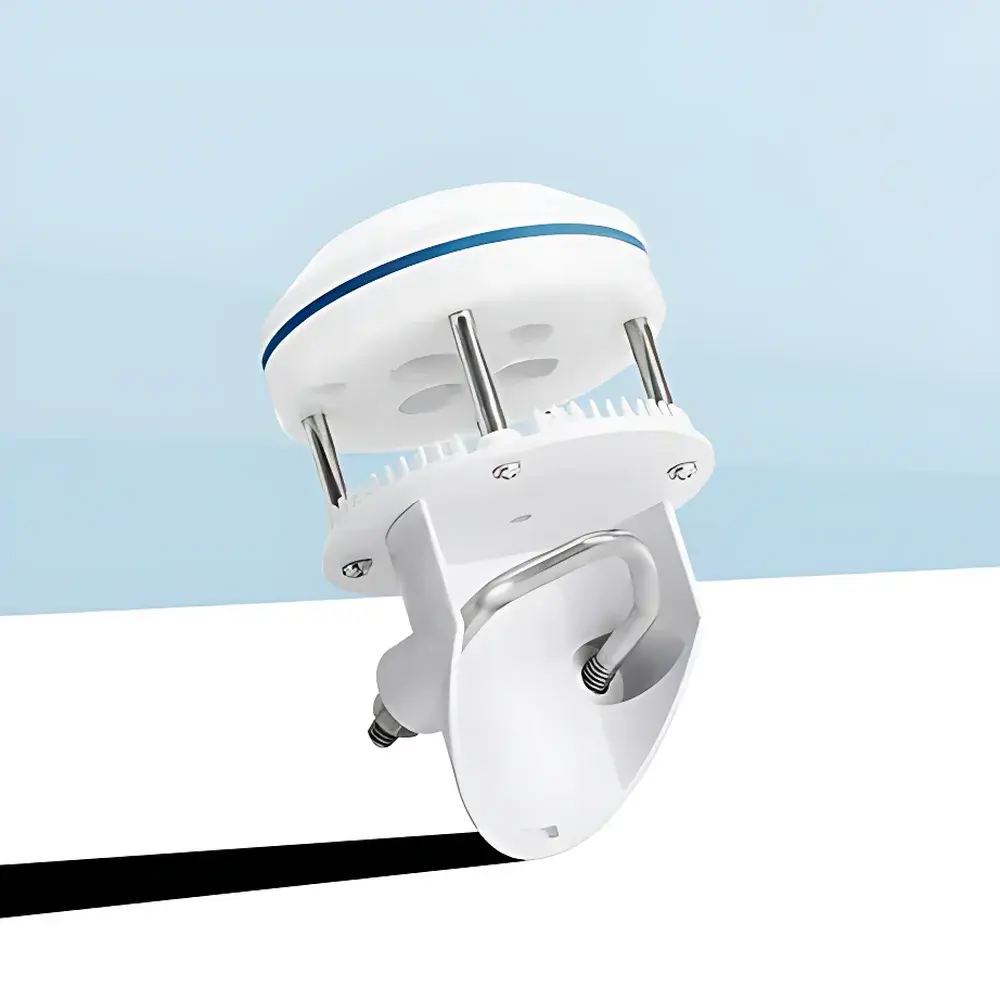
METER ATMOS 22 Two-Dimensional Ultrasonic Anemometer
| Brand | METER |
|---|---|
| Origin | USA |
| Model | ATMOS 22 |
| Resolution | 0.01 m/s |
| Wind Speed Range | 0–30 m/s |
| Wind Gust Range | 0–30 m/s |
| Wind Direction Range | 0–359° |
| Wind Direction Accuracy | ±5° |
| Tilt Range | 0–180° |
| Tilt Accuracy | ±1° |
| Dimensions | 10 cm (diameter) × 16 cm (height) |
| Cable Length | Standard 5 m (customizable) |
| Operating Temperature | −40 to +50 °C |
| Power Supply | 3.6–15.0 VDC |
| Typical Measurement Current | 0.125 mA |
| Standby Current | 0.125 mA |
| Measurement Interval | 110 ms (typical) |
| Startup Time (SDI-12 Ready) | 10 s (typical) |
| Compliance | ISO 9001:2015, ISO/IEC 17050:2010 (CE) |
Overview
The METER ATMOS 22 Two-Dimensional Ultrasonic Anemometer is a research-grade, maintenance-free sensor engineered for precise, long-term measurement of horizontal wind velocity and direction in low-energy atmospheric environments. Unlike cup or propeller anemometers, the ATMOS 22 employs time-of-flight ultrasonic transit-time principle across two orthogonal transducer pairs—eliminating moving parts, mechanical wear, lubrication requirements, and inertia-related lag. Its zero-start threshold (0 m/s) and high-resolution output (0.01 m/s) enable reliable quantification of subtle airflow dynamics within plant canopies, forest understories, soil-atmosphere interfaces, and boundary-layer microsites where conventional sensors fail to respond. Designed for unattended field deployment, it operates across extreme climatic conditions (−40 to +50 °C) with ultra-low power consumption (<125 µA typical during measurement), making it ideal for solar-powered or battery-limited environmental monitoring networks.
Key Features
- Zero-threshold wind detection: Capable of resolving wind speeds from 0.00 m/s, critical for canopy-scale flux studies and sheltered microclimate characterization.
- Robust ultrasonic transducer array: Patented planar sensing surface with micro-textured pin features minimizes rain-induced signal attenuation and acoustic scattering—enhancing data continuity during precipitation events.
- SDI-12 digital interface: Enables direct integration with industry-standard data loggers including METER ZL6, EM50/EM60 series, and Campbell Scientific CR1000X, CR6, and CR300 platforms without external signal conditioning.
- Compact, low-profile form factor: Cylindrical housing (10 cm diameter × 16 cm height) reduces flow distortion and simplifies mounting on towers, masts, or portable frames using standard 1/4″-20 threaded inserts.
- Energy-efficient architecture: Draws ≤125 µA during active measurement cycles; standby current remains stable at ≤125 µA—supporting multi-year deployments on small lithium-thionyl chloride or alkaline battery packs.
- Factory-calibrated and traceable: Manufactured under ISO 9001:2015 quality management system; CE-marked per ISO/IEC 17050:2010 for conformity with EU electromagnetic compatibility and safety directives.
Sample Compatibility & Compliance
The ATMOS 22 is validated for continuous operation in natural terrestrial ecosystems—including agricultural fields, riparian zones, boreal forests, alpine tundra, and urban green infrastructure—where spatial heterogeneity and low-wind persistence demand high-fidelity temporal resolution. It complies with foundational meteorological instrumentation standards referenced in ASTM D5096 (Standard Practice for Determining Wind Speed and Direction), ISO 16622 (Wind measurement—Ultrasonic anemometers), and supports GLP-aligned data acquisition workflows when paired with SDI-12 loggers equipped with audit-trail-capable firmware (e.g., ZL6 v3.2+). Its passive, non-intrusive measurement principle avoids thermal perturbation or momentum extraction—ensuring physical fidelity required for eddy covariance pre-screening, aerodynamic roughness estimation, and inverse dispersion modeling.
Software & Data Management
Raw measurements are transmitted via asynchronous SDI-12 protocol as ASCII-encoded strings containing wind speed (m/s), wind direction (°), and tilt angle (°)—all timestamped by the host data logger. METER’s ZL6 Logger Manager software provides native parsing, unit conversion, and QC flagging (e.g., rain artifact detection based on signal-to-noise ratio thresholds). Export formats include CSV, NetCDF, and CF-compliant metadata templates suitable for ingestion into FAO AquaCrop, USGS StreamStats, or ICOS Tier-1 processing pipelines. When deployed in regulatory contexts, the system supports 21 CFR Part 11–compliant electronic records when used with validated logger firmware and secure cloud synchronization (e.g., METER ZENTRA Cloud v4.1+ with role-based access control and immutable audit logs).
Applications
- Microclimatology: Quantifying vertical wind profiles within crop canopies to parameterize stomatal conductance models and irrigation scheduling algorithms.
- Ecohydrology: Estimating evapotranspiration gradients across heterogeneous land cover using coupled ATMOS 22 + TEROS 21 soil moisture sensor arrays.
- Wildfire behavior modeling: Capturing near-ground wind shear and gust frequency in fuel-break zones for fire spread simulation inputs.
- Urban climate resilience: Mapping pedestrian-level ventilation efficiency in street canyons and green roof installations.
- Long-term ecological research (LTER): Supporting NEON-style atmospheric forcing datasets with >95% data completeness over multi-season deployments.
- Calibration reference: Serving as a field-truthing standard for Doppler lidar and sonic anemometer intercomparison studies under IAGLR and WMO-GAW protocols.
FAQ
What is the minimum detectable wind speed?
The ATMOS 22 resolves wind speeds starting at 0.00 m/s, with a resolution of 0.01 m/s across its full 0–30 m/s range.
Does it require periodic recalibration?
No routine field recalibration is required. The sensor is factory-calibrated against NIST-traceable wind tunnel standards; drift is <0.1% per year under normal operating conditions.
Can it be powered directly from a 12 V solar battery system?
Yes—the device accepts 3.6–15.0 VDC input and includes built-in overvoltage protection; typical current draw during measurement is 0.125 mA.
Is rain interference mitigated?
Yes—its patented planar transducer surface incorporates micro-scale protrusions that disrupt water film formation and reduce ultrasonic beam deflection during light-to-moderate rainfall.
Which data loggers are natively compatible?
METER ZL6, EM50, EM60, and Campbell Scientific CR6, CR1000X, and CR300 loggers support plug-and-play SDI-12 communication with default command sets.







