
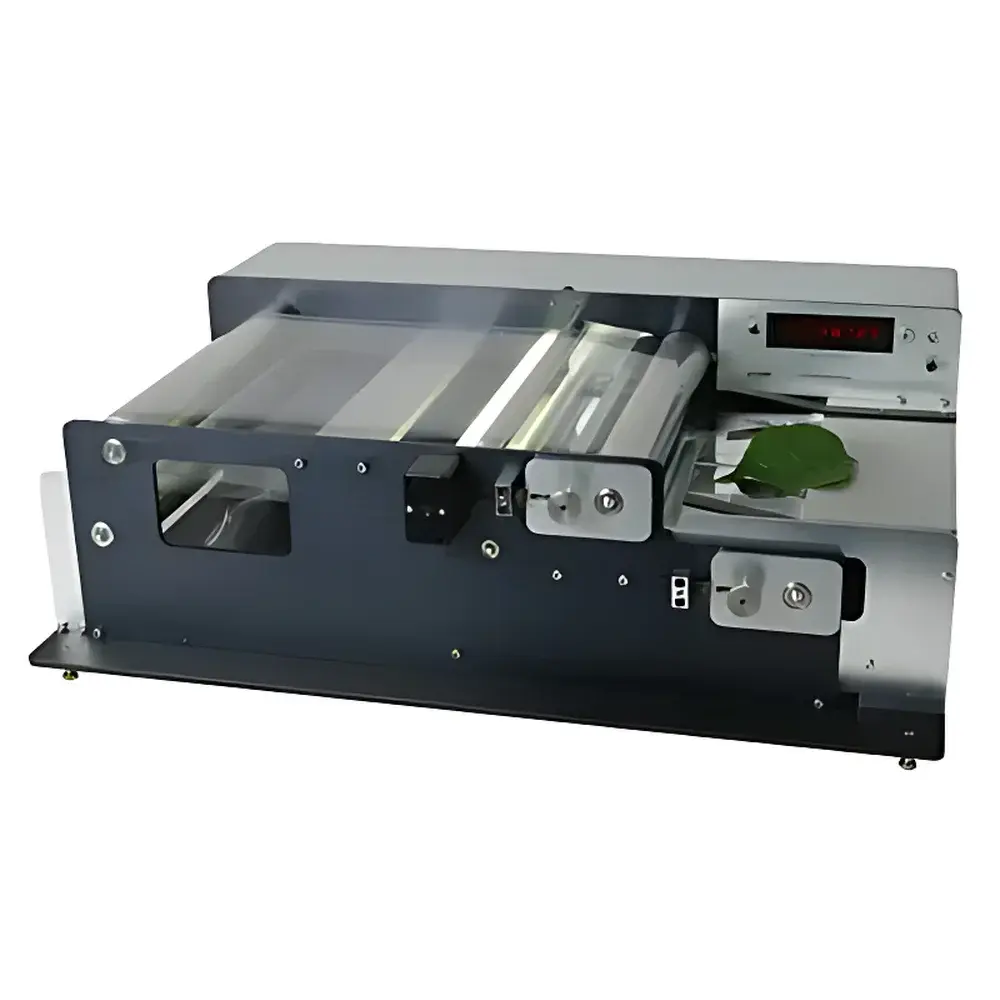
LI-COR LI-3100C Desktop Leaf Area Meter
| Brand | LI-COR |
|---|---|
| Origin | USA |
| Model | LI-3100C |
| Power Supply | 108–126 / 216–252 V AC, 48–66 Hz, ≤100 W |
| Dimensions | 73.0 × 60.0 × 25.0 cm (L×W×H) |
| Weight | 43 kg |
| Operating Temperature | 15–55 °C |
| Storage Temperature | −20–65 °C |
| Light Source | 15 W fluorescent tube |
| Transport Belt Material | Reinforced transparent vinyl |
| Transport Speed | 8.0 cm/s @ 60 Hz, 6.7 cm/s @ 50 Hz |
| Maximum Sample Width | 25.4 cm |
| Minimum Sample Width | 1.5–3.0 mm |
| Maximum Thickness | 2.0 cm (extendable to 2.5 cm) |
| Length | Unlimited |
| Display | 8-digit LED |
| Area Range (1 mm² res.) | 0.01–999,999.99 cm² |
| Area Range (0.1 mm² res.) | 0.001–99,999.999 cm² |
| Accuracy (1 mm²) | ±2.0% (≥10 cm²), ±3.0% (≥3 cm²), ±6.0% (≥1 cm²), ±10.0% (≥0.3 cm²) |
| Accuracy (0.1 mm²) | ±1.0% (≥1 cm²), ±1.5% (≥0.3 cm²), ±3.0% (≥0.1 cm²), ±5.0% (≥0.01 cm²) |
| Interface | RS-232 and USB |
| Software | Windows-based LI-3100C Control & Analysis Software |
Overview
The LI-COR LI-3100C Desktop Leaf Area Meter is a high-precision, non-destructive optical instrument engineered for quantitative leaf surface area measurement in plant physiology, agronomy, forestry, and ecological research. It operates on the principle of transmitted light imaging: a motorized transport belt conveys the leaf through a calibrated fluorescence-illuminated optical chamber, where its silhouette is captured by a fixed-position CCD scanning camera via mirror-reflected optics. This dual-path optical architecture eliminates parallax error and ensures consistent illumination geometry across variable sample morphologies—including lobed, serrated, perforated, or highly irregular leaves. Unlike contact-based caliper or planimeter methods, the LI-3100C requires no physical tracing or manual digitization, thereby eliminating operator-induced variability and enabling traceable, repeatable measurements compliant with GLP-aligned laboratory workflows.
Key Features
- Two selectable resolution modes: 1 mm² for rapid throughput of large samples (e.g., maize, banana, or broadleaf species), and 0.1 mm² for high-fidelity analysis of small or delicate tissues (e.g., seedlings, moss gametophytes, or conifer needles).
- Adjustable pressure roller system that gently flattens curled, folded, or epinastic leaves between two tensioned transparent vinyl belts—maintaining anatomical integrity while ensuring optimal optical plane alignment.
- Real-time 8-digit LED display showing cumulative area, individual leaf area, count, and status flags; supports immediate verification without external software dependency.
- Integrated dual-interface connectivity (RS-232 and USB) enables direct data streaming to Windows-based acquisition software, supporting automated logging, batch export, and metadata tagging per sample.
- Robust mechanical design accommodates specimens up to 25.4 cm wide and 2.5 cm thick, with unlimited length capability—ideal for measuring entire branches, compound leaves, or herbarium sheets.
Sample Compatibility & Compliance
The LI-3100C accepts fresh, dried, pressed, or laminated leaf material without requiring chemical treatment or mounting media. Its optical path tolerates moderate translucency variation (e.g., young vs. mature leaves, variegated cultivars), and the low-intensity fluorescent source avoids photobleaching or thermal distortion. The instrument conforms to ASTM E1318-22 (Standard Practice for Quantitative Image-Based Leaf Area Determination) and supports ISO/IEC 17025-compliant calibration documentation. All firmware and control software are validated for audit-ready operation under FDA 21 CFR Part 11 requirements when configured with electronic signature and audit-trail modules.
Software & Data Management
The included Windows application provides full instrument control, real-time preview, and post-acquisition analysis. Users may define custom measurement protocols—including auto-threshold adjustment, background subtraction, and outlier rejection based on aspect ratio or perimeter-to-area ratio. Data files are stored in CSV and XML formats, preserving raw pixel counts, timestamp, operator ID, and environmental metadata. Exported datasets integrate natively with R, Python (via pandas), and commercial statistical platforms (e.g., JMP, SAS), facilitating reproducible analysis pipelines aligned with FAIR data principles.
Applications
- Longitudinal leaf expansion kinetics in growth chamber or greenhouse studies.
- Quantification of herbivory damage or pathogen lesion area in resistance screening programs.
- Leaf area index (LAI) component validation for canopy modeling and remote sensing ground-truthing.
- Phenotypic characterization in crop breeding trials (e.g., drought-responsive leaf rolling metrics).
- Ecophysiological assessment of shade-adapted vs. sun-exposed foliage morphology.
- Quality control of tissue-cultured plantlets prior to acclimatization.
FAQ
Can the LI-3100C measure leaves with holes or complex margins?
Yes—the optical segmentation algorithm distinguishes true leaf boundaries from internal voids using adaptive edge detection and binary morphology operations, delivering accurate area values even for palmate, pinnate, or fenestrated specimens.
Is calibration required before each use?
No routine recalibration is needed; the system employs factory-characterized optical scaling and belt-speed synchronization. A single annual verification using NIST-traceable reference targets is recommended for ISO 17025 compliance.
Does it support batch processing of multiple leaves without manual intervention?
Yes—continuous feed mode allows unattended measurement of >100 leaves per hour, with automatic separation detection and individual area assignment based on inter-leaf gaps.
Can needle-like leaves (e.g., pine or spruce) be measured reliably?
Yes—using the 0.1 mm² resolution mode and the fine-width transport setting, conifer needles as narrow as 1.5 mm are resolved with ≤1.5% area uncertainty at lengths ≥2 cm.
Is the software compatible with modern Windows OS versions?
Yes—the current release supports Windows 10 and 11 (64-bit), with driver-signed installation packages and TLS 1.2+ secure communication for networked lab environments.




