
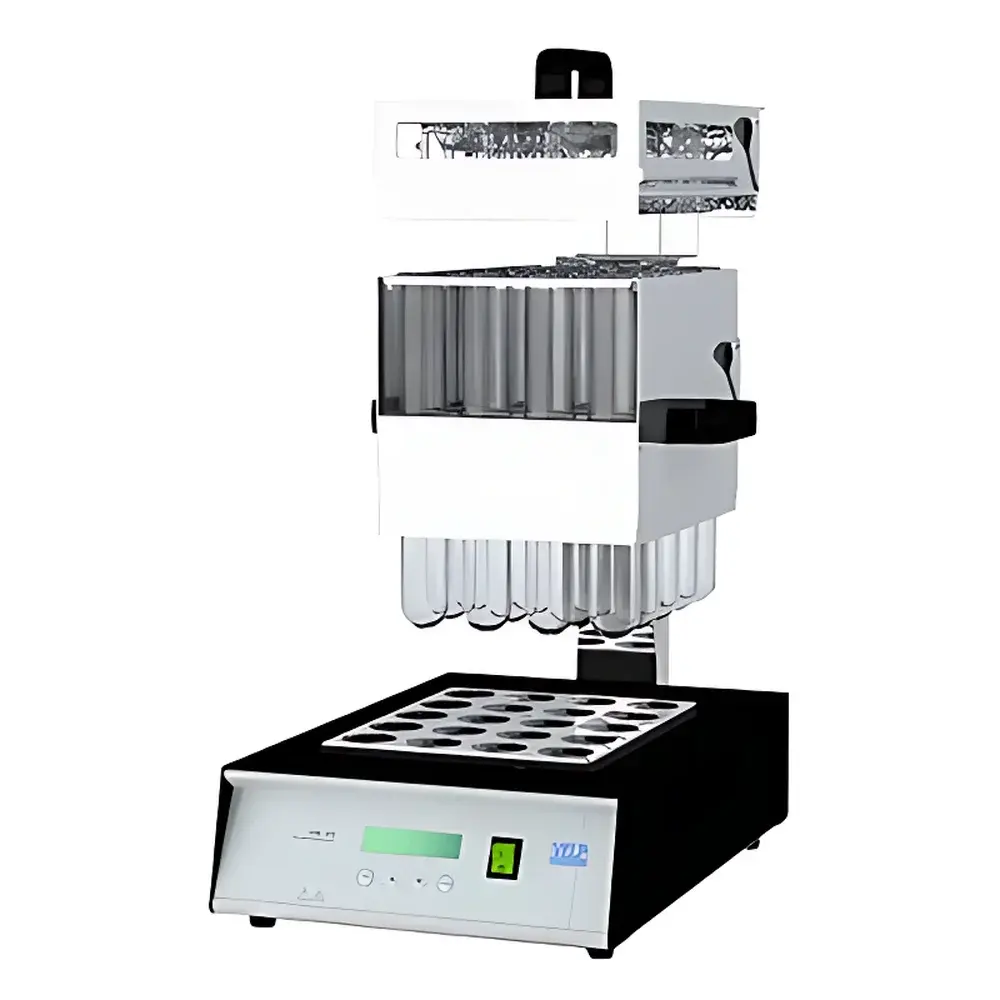
VELP DK Series Electric Heating Digestion System
| Brand | VELP |
|---|---|
| Origin | Italy |
| Instrument Type | Electric Heating Digestion Instrument |
| Automation Level | Semi-Automatic |
| Digestion Positions | 20 |
| Max. Heating Temperature | 450 °C |
| Temperature Control Accuracy | ±0.5 °C |
| Heating Block Material | Aluminum Alloy |
| Reagent Channels | 20 |
| Programmable Methods | 20 user-editable methods, up to 4 ramp stages per method |
| Digestion Time Range | 1–999 min (1-min increments) |
| Display | Digital °C/°F |
| Interface | RS232 |
| Safety Features | Overtemperature Protection, Probe Fault Detection with Audible Alert |
| Compliance | Designed for GLP/GMP environments |
Overview
The VELP DK Series Electric Heating Digestion System is a semi-automated, aluminum-block-based thermal digestion platform engineered for reproducible, controlled acid digestion of solid and semi-solid samples prior to elemental analysis (e.g., ICP-OES, ICP-MS, AAS, or COD determination). It operates on the principle of conductive heating via a precisely machined, high-thermal-mass aluminum heating block, ensuring exceptional temperature uniformity across all digestion positions—critical for minimizing inter-vial variability in digestion efficiency and analyte recovery. Unlike open-flame or microwave-assisted systems, the DK Series provides stable, programmable ramp-and-hold thermal profiles under ambient atmospheric pressure, making it suitable for routine, high-throughput laboratories requiring robustness, operational transparency, and full traceability without pressurized vessel handling.
Key Features
- High-integrity aluminum heating block delivering ±0.5 °C temperature control accuracy and ≤±2 °C intra-block uniformity at 450 °C—validated per ASTM E220 and ISO/IEC 17025 calibration guidelines.
- 20 independently addressable digestion positions compatible with multiple tube geometries (e.g., Φ26×300 mm, Φ42×300 mm, Φ48×260 mm), supporting scalable throughput from R&D to QC batch processing.
- 20 fully customizable digestion programs, each configurable with up to four sequential temperature ramps and dwell times (1–999 min, 1-min resolution), enabling method standardization across instruments and operators.
- Digital dual-scale display (°C/°F) with real-time countdown timer and audible end-of-cycle alert—integrated with hardware-level overtemperature cutoff and probe fault detection.
- Modular accessory architecture: dedicated sample tube holders, suction caps with integrated fume extraction ports, support frames, and anti-drip trays ensure safe, spill-resistant operation during aggressive acid digestions (e.g., HNO₃/H₂SO₄/HClO₄ mixtures).
- RS232 serial interface enables direct connection to LIMS or laboratory PCs for automated data logging, method transfer, and audit-ready record generation—fully compliant with FDA 21 CFR Part 11 when paired with validated software.
Sample Compatibility & Compliance
The DK Series accommodates a broad spectrum of sample matrices—including soils, sediments, biological tissues, foodstuffs, polymers, and wastewater sludges—when processed using EPA Method 3050B, ISO 11466, DIN 38405-16, or USP . Its open-vessel design permits direct visual monitoring and manual reagent addition, while the optional cold air module (A00001041) and PTFE conical sleeves (A00001042) mitigate volatilization losses of Hg, As, or Se. All units are constructed from epoxy-coated stainless steel chassis, meeting IP20 environmental rating for laboratory use. Factory-issued IQ/OQ qualification packages (A00000075) support GxP validation workflows, including documented temperature mapping, ramp verification, and alarm response testing.
Software & Data Management
While the DK Series operates as a stand-alone instrument, its RS232 port supports bidirectional communication with third-party laboratory software (e.g., LabWare LIMS, Thermo Fisher SampleManager) for electronic method deployment and raw parameter export (setpoint, actual temp, elapsed time, program ID). Optional printer (A00001009) with serial cable (A00000010) generates hard-copy run logs containing timestamped start/stop events, final temperature, and active program number—satisfying ALCOA+ data integrity principles. All firmware revisions undergo traceable version control, and configuration changes are logged internally with operator ID (where integrated authentication is deployed).
Applications
- Preparation of environmental samples for heavy metal quantification (Pb, Cd, Cr, Ni) per ISO 17294-2 and EPA 6010D.
- Routine digestion of agricultural feed and plant tissue for macro/micronutrient profiling (K, Ca, Mg, Zn, Cu) prior to flame AAS or ICP-OES.
- COD (Chemical Oxygen Demand) sample digestion using dedicated COD tubes (A00000145) and matching holders (A00001049/A00000237), aligned with ISO 6060 and APHA 5220D protocols.
- Pharmaceutical excipient and API digestion for residual catalyst (e.g., Pd, Pt) screening under ICH Q2(R2) method validation frameworks.
- Quality control of recycled plastics and e-waste leachates requiring total digestion prior to RoHS-compliant screening.
FAQ
Is the DK Series compatible with perchloric acid digestion?
Yes—when used with optional PTFE conical sleeves (A00001042) and fume extraction via suction cap (A00001096/A00001101), the DK Series supports controlled HClO₄ digestion up to 250 °C. Full risk assessment and local safety approval are required prior to use.
Can digestion programs be password-protected?
Program editing requires physical access and no built-in user authentication; however, method files exported via RS232 may be managed under IT-controlled permissions in LIMS or ELN systems to enforce change control.
What validation documentation is included?
Each unit ships with a factory calibration certificate. Comprehensive IQ/OQ kits (A00000075) include protocol templates, test scripts, acceptance criteria, and blank execution records—designed for direct adoption in regulated pharmaceutical or environmental labs.
Does the system support gradient temperature profiles for difficult-to-digest polymers?
Yes—multi-stage ramp programming (up to 4 segments per method) allows gradual heating (e.g., 120 °C → 220 °C → 350 °C → 450 °C), minimizing foaming and bumping during digestion of polymeric or lipid-rich matrices.
Are spare parts and service supported globally?
VELP-certified service partners operate across North America, EMEA, and APAC. All heating blocks, sensors, power supplies, and mechanical components carry 24-month traceable part numbers and are stocked by authorized distributors.



