
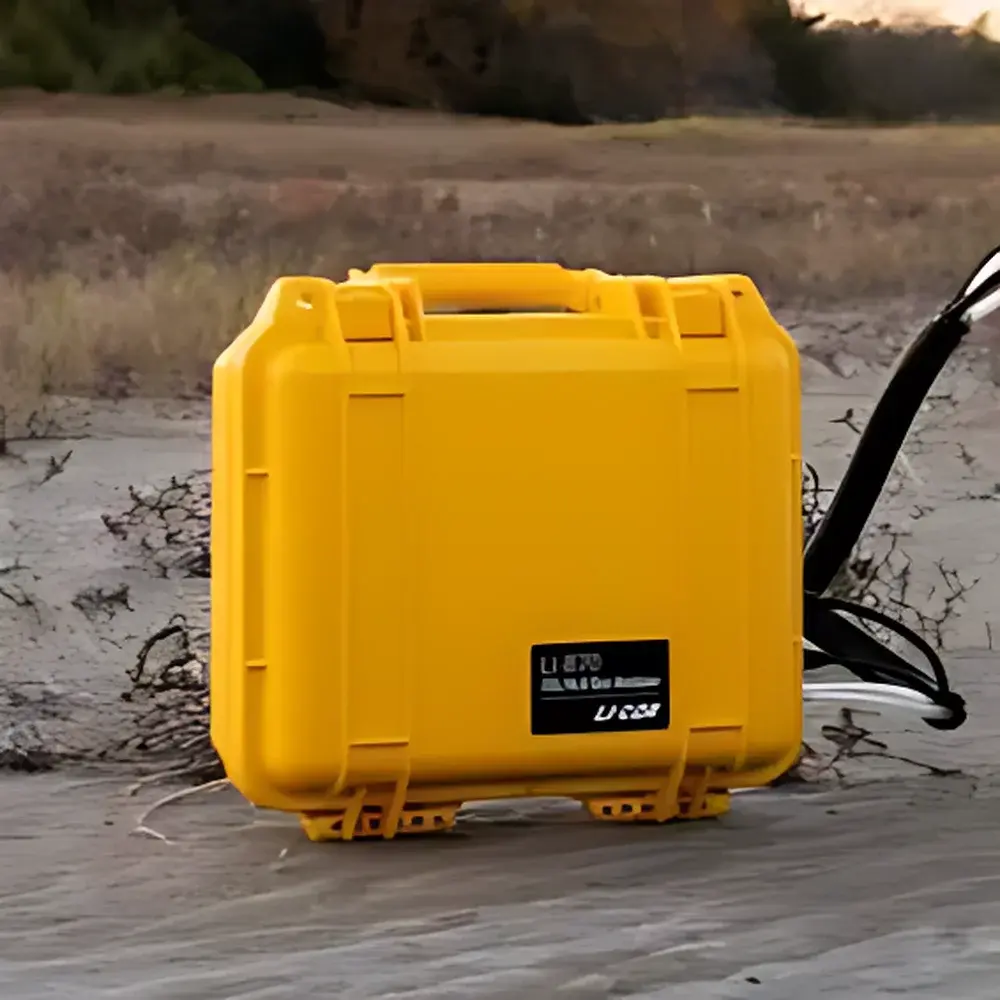
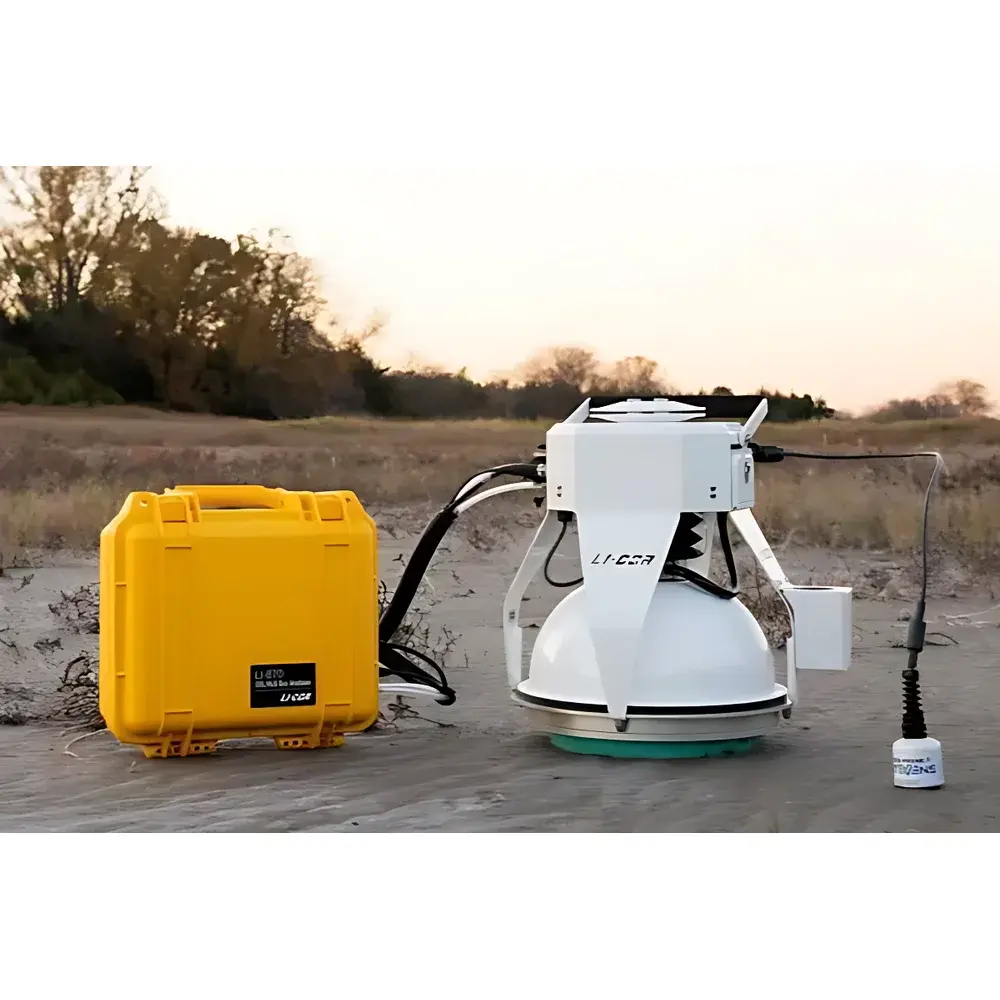
LI-COR LI-870 Portable Soil Carbon Flux Measurement System
| Brand | LI-COR |
|---|---|
| Origin | USA |
| Model | LI-870 |
| CO₂ Range | 0–20,000 µmol/mol |
| H₂O Range | 0–60 mmol/mol |
| CO₂ & H₂O Accuracy | ±1.5% of reading |
| Measurement Frequency | 1 Hz |
| Dimensions (Analyzer) | 28.4 × 27.9 × 12.4 cm |
| Weight (Analyzer) | 2.31 kg |
| Operating Temperature | −20 to +45 °C |
| Relative Humidity | 0–95% RH (non-condensing) |
| Pressure Range | 50–110 kPa |
| Flow Rate | 0.75 L/min |
| Power Input | 10–17 VDC, max 2 A |
| Battery Life | Up to 20 h (with two batteries) |
| Measurement Principle | NDIR (Non-Dispersive Infrared) |
| Chamber | 8200-01S Smart Chamber (integrated GPS, Wi-Fi, SoilFluxPro™ software, pressure-balanced venting, bowl-shaped design, active air mixing) |
Overview
The LI-COR LI-870 Portable Soil Carbon Flux Measurement System is a field-deployable, integrated solution engineered for high-precision, real-time quantification of soil CO₂ efflux—the primary component of soil respiration. It combines the compact, low-power LI-870 dual-gas (CO₂/H₂O) NDIR analyzer with the autonomous 8200-01S Smart Chamber to deliver traceable, reproducible flux measurements under variable environmental conditions. Unlike conventional closed-chamber systems susceptible to pressure-induced artifacts, the LI-870 system employs a patented pressure-balanced venting mechanism and dynamic air-mixing architecture within the chamber to minimize boundary-layer disturbance and eliminate pressure-driven advective bias. The system operates on the principle of time-series concentration change (dC/dt) within a sealed, temperature-stabilized measurement volume—calculated via Fick’s first law and corrected for ambient temperature, moisture, and atmospheric pressure in real time. Designed for ecological carbon cycling studies, edaphic climate feedback research, and long-term ecosystem monitoring, the LI-870 meets the physical and metrological requirements for field use in ISO 14064-2 (GHG project quantification) and aligns with methodological best practices outlined in AmeriFlux and ICOS protocols.
Key Features
- Integrated NDIR-based CO₂ and H₂O analysis with simultaneous 1 Hz sampling and on-board temperature/pressure compensation
- Self-contained 8200-01S Smart Chamber featuring GPS geotagging, embedded Wi-Fi for local data streaming, and onboard SoilFluxPro™ software for real-time flux computation
- Robust optical path design in the LI-870 analyzer—field-serviceable without factory recalibration—and IP54-rated weather-resistant connectors for dust and splash protection
- Low-power architecture enabling up to 20 hours of continuous operation on dual rechargeable batteries (10–17 VDC input)
- Bowl-shaped chamber geometry with active internal air mixing and pressure-equalizing vents to suppress advective error and enhance spatial representativeness
- Modular compatibility: supports connection to LI-8250 multiplexer for multi-chamber deployments or integration into existing eddy covariance or automated soil gas monitoring networks
Sample Compatibility & Compliance
The LI-870 system is validated for use across diverse soil types—including sandy loam, clay, organic peat, and volcanic ash—with minimal disturbance during collar insertion. Its non-invasive measurement protocol complies with ASTM D6913 (Standard Test Methods for Particle-Size Distribution of Soil), and its flux calculation algorithms adhere to the standardized chamber methodology described in ISO 16634-2 (Soil quality — Determination of total nitrogen — Part 2: Inorganic nitrogen). Data integrity is maintained through timestamped, GPS-referenced acquisition and automatic logging of chamber closure duration, ambient T/RH, and barometric pressure—enabling full traceability for GLP-compliant reporting. While not FDA-regulated, the system’s audit-ready metadata structure and deterministic calibration workflow support 21 CFR Part 11–aligned data governance when deployed in regulated environmental assessment contexts.
Software & Data Management
SoilFluxPro™—embedded in the 8200-01S chamber—executes all flux calculations using the linear regression slope method (dC/dt) with automatic rejection of non-linear segments and outlier detection based on residual variance thresholds. Raw and processed datasets (including CO₂, H₂O, soil temperature at multiple depths, volumetric water content, and derived flux values) are stored internally in CSV-compatible format and streamed via Wi-Fi to tablet or laptop interfaces. Exported files include full metadata headers compliant with CF (Climate and Forecast) conventions, facilitating direct ingestion into R, Python (via eddyproc or fluxnetr), or MATLAB workflows. Optional integration with LI-COR’s EddyPro® software enables cross-platform harmonization with eddy covariance tower data for landscape-scale carbon budget modeling.
Applications
- Quantifying diurnal and seasonal dynamics of soil respiration across forest, grassland, tundra, and agricultural ecosystems
- Evaluating impacts of land-use change, drought stress, nitrogen fertilization, and warming manipulations (e.g., open-top chambers, infrared heaters) on belowground C cycling
- Validating and parameterizing biogeochemical models such as CENTURY, DAYCENT, and ORCHIDEE
- Supporting carbon credit verification under Verra VM0042 (Improved Forest Management) and Plan Vivo standards
- Long-term monitoring at LTER (Long Term Ecological Research) sites and NEON (National Ecological Observatory Network) sensor arrays
- Field education and graduate-level experimental ecology coursework requiring portable, self-contained instrumentation
FAQ
What is the recommended collar installation depth for optimal flux measurement?
A minimum 5 cm insertion depth is advised to minimize edge effects and ensure thermal equilibration between the collar and surrounding soil profile.
Can the LI-870 operate continuously over multiple days without manual intervention?
Yes—the 8200-01S chamber supports programmable measurement schedules (e.g., hourly cycles over 72 h) with autonomous battery management and data buffering; external solar charging is compatible via the 12 V DC input port.
Is calibration traceable to NIST standards?
The LI-870 analyzer is factory-calibrated against NIST-traceable CO₂ and H₂O reference gases; users may perform span checks in the field using certified zero air and span gas cylinders (not included).
Does the system correct for diffusion gradients caused by soil moisture heterogeneity?
While not a direct sensor of diffusion coefficients, the system’s real-time H₂O measurement and temperature-compensated CO₂ flux algorithm implicitly account for vapor-pressure-driven diffusivity shifts per the Penman–Monteith framework.
How does the pressure-balanced venting system reduce measurement uncertainty?
By equalizing internal and external static pressure during chamber closure, it eliminates advective CO₂ transport through soil macropores—a dominant source of systematic bias in traditional static chambers.







