
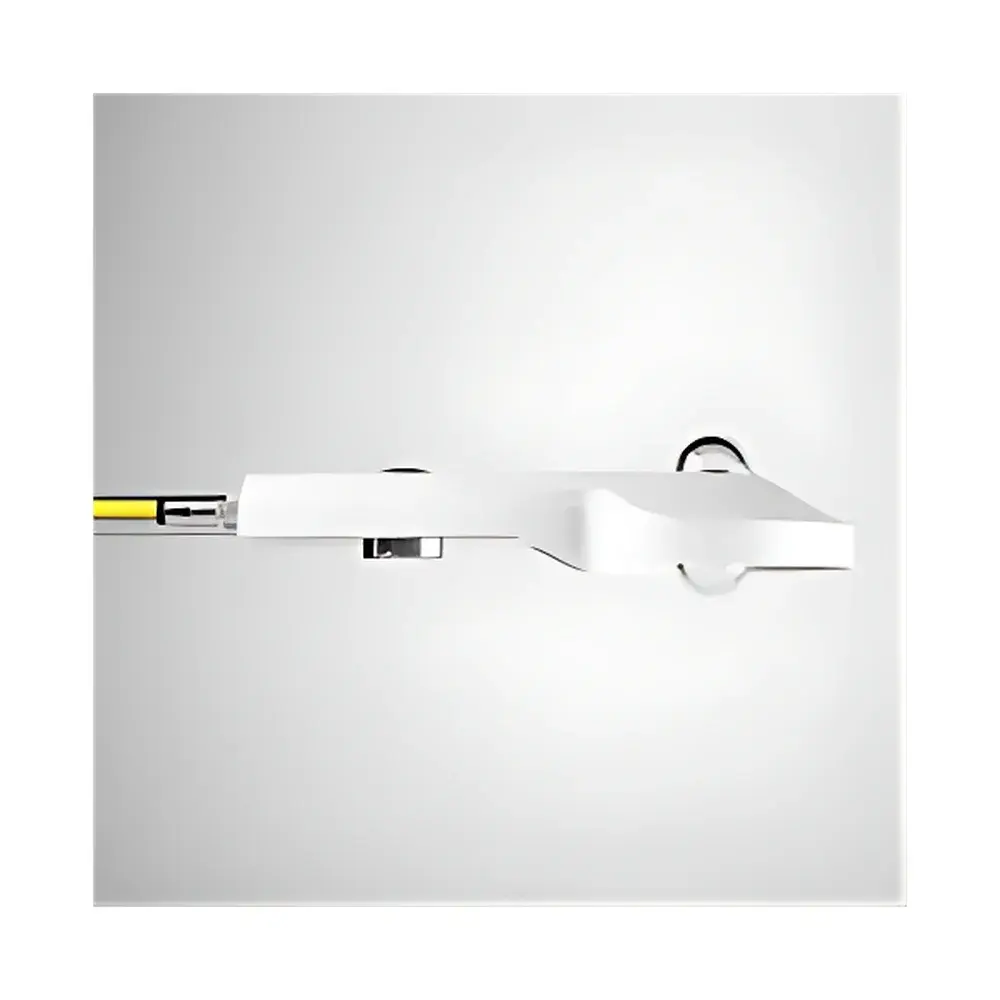
Kipp & Zonen NR Lite2 Net Radiometer
| Brand | Kipp & Zonen |
|---|---|
| Origin | Netherlands |
| Model | NR Lite2 |
| Spectral Range | 200–100,000 nm |
| Sensitivity | 10 µV/W/m² |
| Response Time | < 20 s |
| Operating Temperature Range | -30 °C to +70 °C |
| Compliance | CE |
Overview
The Kipp & Zonen NR Lite2 Net Radiometer is a robust, maintenance-optimized instrument engineered for continuous outdoor measurement of net radiation—the algebraic sum of downward and upward shortwave (SW) and longwave (LW) irradiance components. Unlike traditional pyrgeometers or dual-dome net radiometers, the NR Lite2 employs a thermopile-based detection principle without fragile plastic domes. Its dual-side black conical absorbers—coated with hydrophobic, weather-resistant material—ensure stable thermal equilibrium under variable solar elevation, wind, and precipitation conditions. The absence of optical domes eliminates spectral distortion, condensation artifacts, and mechanical fragility, making it particularly suitable for remote, unattended monitoring stations where field servicing is infrequent. The sensor outputs a millivolt signal linearly proportional to net radiation flux (W/m²), directly compatible with standard data loggers featuring mV input channels. Its design adheres to fundamental radiometric principles defined in ISO 9060:2018 (Class C specification for broadband radiometers) and supports long-term climate monitoring in accordance with WMO guidelines.
Key Features
- Thermopile-based dual-surface construction—no optical domes, eliminating dew, frost, and spectral transmission errors
- Hydrophobic, anti-stick protective coating on both absorber surfaces enhances durability in high-humidity and dusty environments
- Integrated vertical bird deterrent rod minimizes biological interference with signal stability
- CE-compliant enclosure rated for continuous outdoor operation from -30 °C to +70 °C
- High-reproducibility calibration traceable to the World Radiometric Reference (WRR) via Kipp & Zonen’s accredited laboratory
- Standard yellow cable with IP68-rated connector ensures reliable signal integrity in harsh environmental deployments
Sample Compatibility & Compliance
The NR Lite2 is designed for direct integration into meteorological networks, eddy covariance systems, and agricultural microclimate observatories. It requires no external power supply and operates passively—ideal for solar-powered remote stations. While not classified as a WMO “high-precision” instrument (e.g., CNR4-grade), its performance meets WMO “standard” classification criteria for net radiation monitoring in operational weather services. The sensor complies with CE marking requirements under Directive 2014/30/EU (EMC) and 2014/35/EU (LVD). Its spectral response (200–100,000 nm) covers the full solar and terrestrial atmospheric window, enabling reliable estimation of surface energy balance terms in land-surface models (e.g., SEBAL, METRIC). Calibration certificates include uncertainty budgets per ISO/IEC 17025:2017.
Software & Data Management
The NR Lite2 delivers analog output only; no embedded firmware or digital interface is present. Data acquisition relies on externally connected dataloggers (e.g., Campbell Scientific CR1000X, Delta-T DL6, or HOBO RX3000) configured for mV differential input with appropriate scaling (10 µV/W/m²). Users must apply temperature compensation manually if ambient drift exceeds ±5 °C from calibration reference temperature—though built-in thermal mass minimizes sensitivity drift. Kipp & Zonen provides calibration reports with individual slope and offset values, traceable to national metrology institutes. For networked deployments, the sensor integrates seamlessly into data pipelines compliant with FAO-56, AmeriFlux, and ICOS metadata standards. No FDA 21 CFR Part 11 or GLP audit trail functionality is applicable, as the device is non-regulated for pharmaceutical or clinical use.
Applications
- Surface energy balance studies in hydrological modeling and watershed-scale evapotranspiration estimation
- Long-term climate station networks requiring low-maintenance, high-reliability net radiation data
- Agricultural research: irrigation scheduling, canopy energy partitioning, and crop water stress index derivation
- Urban heat island monitoring where dome-based sensors suffer from soiling and thermal lag
- Educational field labs—its simplicity, ruggedness, and direct mV output support hands-on instrumentation training
- Validation of satellite-derived radiation products (e.g., CERES, MODIS, GERB)
FAQ
Does the NR Lite2 require periodic recalibration?
Yes—Kipp & Zonen recommends recalibration every two years for critical applications, or annually under high UV exposure or abrasive particulate conditions. Field verification against a reference pyranometer/pyrgeometer pair is advised quarterly.
Can the NR Lite2 be used indoors or under artificial lighting?
No—it is optimized for broadband outdoor solar/terrestrial radiation fields. Artificial light sources (e.g., LEDs, halogen lamps) exhibit narrowband spectra outside its calibrated response envelope and will yield non-physical net radiation values.
Is the NR Lite2 compatible with Campbell Scientific dataloggers?
Yes—when configured for differential mV input with excitation disabled and appropriate scaling (e.g., 10 µV/W/m² = 0.1 mV per 10 W/m²), it interfaces natively with CR6, CR1000X, and CR300 series loggers.
What mounting options are available?
The sensor ships with a standard 16 mm stainless steel mounting tube (M12 thread). Optional leveling bases, tilt-adjustable brackets, and marine-grade anodized aluminum poles are available through authorized distributors.
How does the NR Lite2 compare to the CNR4 in measurement accuracy?
The CNR4 provides spectrally separated SW/LW components with active ventilation and temperature-compensated LW detectors, achieving <1% nonlinearity and WMO high-end classification. The NR Lite2 offers integrated net radiation only, with higher thermal inertia and no active correction—suitable for applications where absolute component separation is not required but long-term reliability is prioritized.
Related Products







