
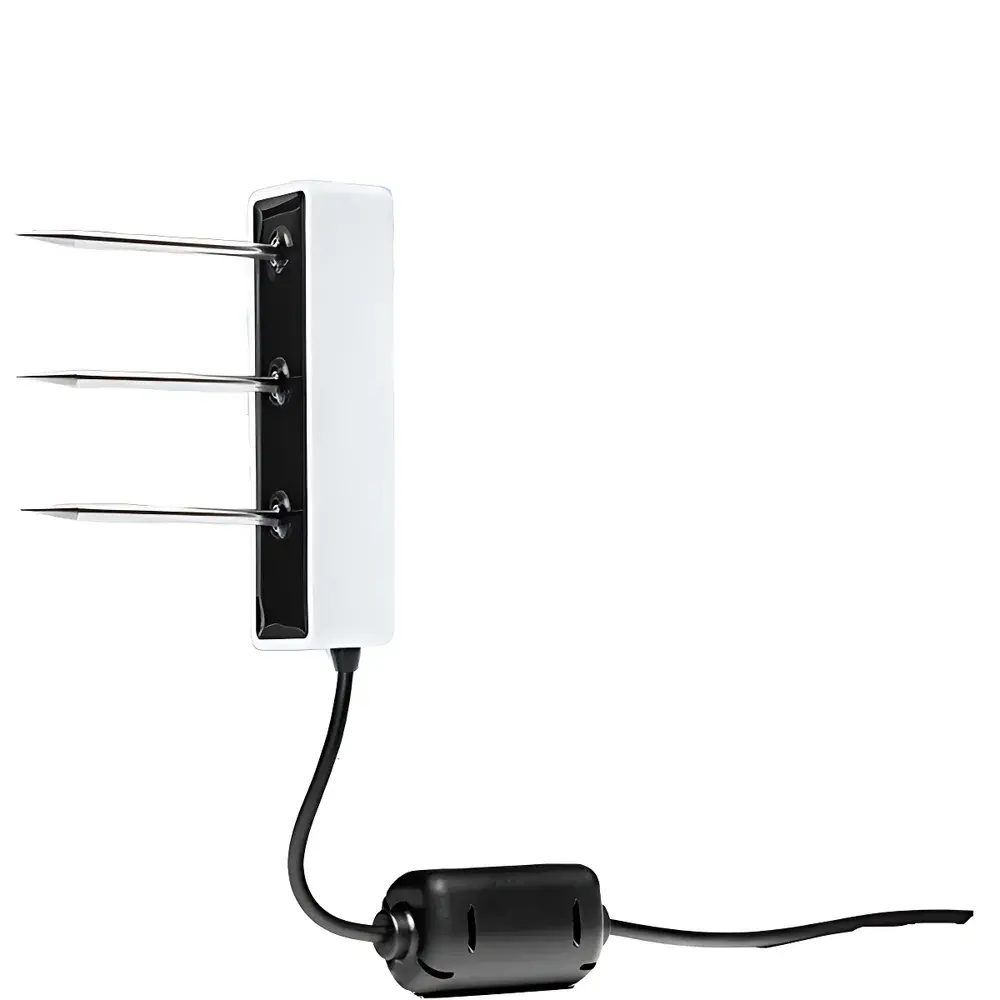
METER TEROS 12 Soil Moisture, Temperature, and Electrical Conductivity Sensor
| Brand | METER |
|---|---|
| Origin | USA |
| Model | TEROS 12 |
| Measurement Principle | Frequency Domain Reflectometry (FDR) at 70 MHz |
| Output Options | SDI-12 or DDI Serial Interface |
| Volumetric Water Content Range | 0.00–0.70 m³/m³ (mineral soils), 0.0–1.0 m³/m³ (non-soil media) |
| EC Range | 0–20 dS/m |
| Temperature Range | −40 to +60 °C |
| Accuracy (VWC) | ±0.03 m³/m³ (±3% VWC) with generic mineral soil calibration |
| Resolution (VWC) | 0.001 m³/m³ |
| Resolution (EC) | 0.001 dS/m |
| Resolution (Temp) | 0.1 °C |
| Probe Length | 5.5 cm |
| Sensor Dimensions | 9.4 × 2.4 × 7.5 cm |
| Measurement Volume | 1010 cm³ |
| Typical Power Consumption | 3.6 mA during measurement, 0.03 mA in standby |
| Cable Length | Standard 5 m (custom up to 75 m) |
| Compliance | ISO 9001:2015, CE (2014/30/EU & 2011/65/EU), EN 61326-1:2013, EN 55022/CISPR 22 |
Overview
The METER TEROS 12 is a tri-parameter soil sensor engineered for high-fidelity, long-term field deployment in environmental monitoring, agricultural research, hydrological modeling, and ecological studies. It employs frequency domain reflectometry (FDR) at a stable 70 MHz operating frequency to measure volumetric water content (VWC), bulk electrical conductivity (EC), and temperature simultaneously within the same soil volume. Unlike time-domain transmission (TDT) or time-domain reflectometry (TDR) systems, the TEROS 12’s FDR architecture delivers rapid, low-power measurements with minimal sensitivity to soil texture and salinity-induced dielectric dispersion—enabling robust performance across diverse pedological conditions. Its epoxy-filled stainless-steel probe assembly ensures mechanical integrity and chemical resistance during multi-year burial, while its compact form factor and standardized SDI-12/DDI interface facilitate seamless integration into heterogeneous data acquisition networks.
Key Features
- Simultaneous, co-located measurement of volumetric water content (VWC), bulk electrical conductivity (EC), and temperature—reducing spatial uncertainty inherent in multi-sensor arrays.
- 70 MHz FDR technology optimized to minimize dielectric nonlinearity from dissolved salts and clay-bound water, improving accuracy in saline and fine-textured soils.
- Embedded thermistor integrated into the central probe rod for precise in-situ temperature compensation of both VWC and EC readings.
- Full-range VWC detection from 0.00 to 0.70 m³/m³ (mineral soils) and up to 1.0 m³/m³ (porous media such as rockwool or peat), with resolution of 0.001 m³/m³.
- Ruggedized stainless-steel probe geometry designed for consistent insertion and interfacial contact across sandy, loamy, and clay-rich profiles.
- Low-power operation: 3.6 mA peak current during measurement (25–150 ms duration), <0.03 mA in quiescent state—ideal for solar-powered remote stations.
- IP68-rated housing with epoxy encapsulation rated for >10 years of continuous underground exposure under standard environmental conditions.
Sample Compatibility & Compliance
The TEROS 12 is validated for use in mineral soils, organic substrates, and engineered growing media. Its generic mineral soil calibration (±0.03 m³/m³ VWC accuracy) applies to soils with solution EC < 8,000 µS/cm; higher-accuracy performance (±0.01–0.02 m³/m³) is achievable via site-specific calibration using known reference media. The sensor complies with ISO 9001:2015 quality management standards and carries CE marking per EU directives 2014/30/EU (EMC) and 2011/65/EU (RoHS). Electromagnetic compatibility is certified to EN 61326-1:2013 (industrial environments) and EN 55022/CISPR 22 (Class B radiated emissions). While not inherently GLP/GMP-validated, its traceable calibration methodology and stable output protocol support audit-ready data collection when paired with compliant data loggers (e.g., METER ZL6 with 21 CFR Part 11-compliant firmware).
Software & Data Management
The TEROS 12 interfaces natively with METER’s ZL6 intelligent data logger via SDI-12 or DDI protocols, enabling automatic sensor discovery, configuration, and time-synchronized cloud upload through METER’s ZENTRA Cloud platform. Raw outputs—including apparent dielectric permittivity (εa), VWC, temperature-corrected EC, and diagnostic flags—are timestamped and stored with metadata (sensor ID, firmware version, battery voltage). Third-party loggers supporting SDI-12 (e.g., Campbell Scientific CR1000X, Onset HOBO RX3000) can acquire TEROS 12 data without proprietary drivers. All output values adhere to SI unit conventions and are compatible with common environmental data workflows (e.g., R, Python pandas, MATLAB), including USDA-SCS, FAO-56, and HYDRUS-1D model inputs.
Applications
- Irrigation scheduling and precision agriculture: Real-time VWC-EC-temperature triads inform dynamic water-nutrient delivery thresholds.
- Critical zone observatories: Long-term co-monitoring of soil moisture dynamics and solute transport in hillslope, vadose zone, and riparian settings.
- Climate change impact studies: Tracking seasonal freeze-thaw cycles, drought propagation, and soil thermal buffering capacity.
- Green infrastructure performance: Quantifying infiltration rates and retention volumes in bioswales, rain gardens, and permeable pavements.
- Laboratory soil physics: Controlled experiments on hysteresis, hydraulic conductivity estimation, and pore-water electrical properties.
FAQ
What is the recommended calibration approach for mineral soils?
A generic mineral soil calibration is factory-applied and suitable for most field applications where solution EC remains below 8,000 µS/cm. For higher-accuracy work, users should perform medium-specific calibration using gravimetric VWC and saturated paste EC measurements.
Can the TEROS 12 be used in frozen soil?
Yes—the sensor operates continuously from −40 to +60 °C. However, dielectric response in ice-dominated matrices deviates from liquid-water calibration curves; specialized interpretation models (e.g., Topp equation modifications) are advised for sub-zero VWC estimation.
Is cable length extension supported beyond 75 meters?
Standard configurations support up to 75 m. Longer runs require signal integrity analysis and may necessitate active repeaters or RS-485 conversion to maintain SDI-12 timing compliance.
How does the sensor handle high-salinity conditions?
Bulk EC accuracy degrades above 10 dS/m (±5% + 0.01 dS/m); between 10–20 dS/m, error increases to ±8%. Users should apply empirical or physics-based correction factors derived from concurrent solution EC measurements.
Does the TEROS 12 require periodic recalibration in the field?
No—its solid-state construction and epoxy-sealed electronics eliminate drift-related recalibration needs. Long-term stability is verified through accelerated aging tests per IEC 60068-2 standards.
Related Products







