
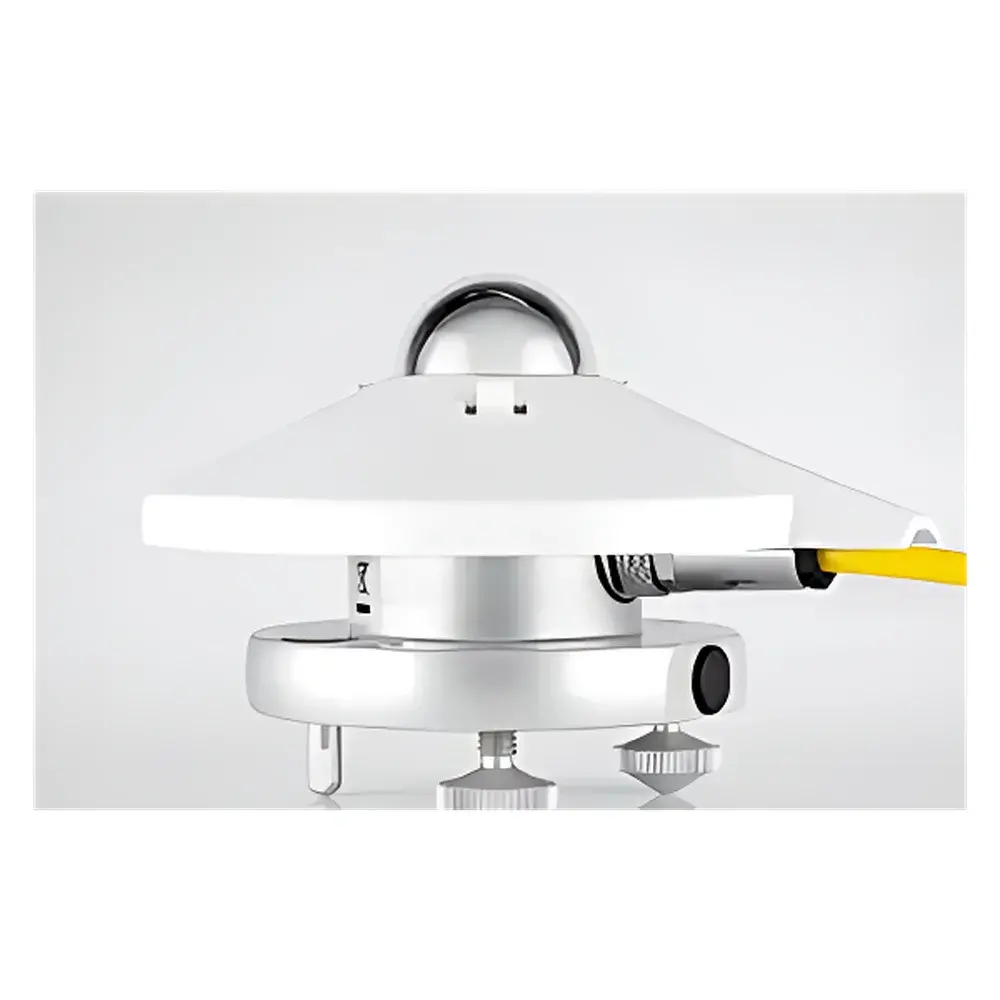
Kipp & Zonen SMP12 Pyranometer with Albedo Measurement Kit
| Brand | Kipp & Zonen |
|---|---|
| Origin | Netherlands |
| Model | SMP12 Pyranometer with Albedo Measurement Kit |
| Classification | ISO 9060:2018 Class A (Secondary Standard) |
| Spectral Range | 285–3000 nm |
| Response Time (95%) | < 1.5 s |
| Zero Offset (Thermal, 5 K/h) | ±1 W/m² |
| Non-linearity | < ±0.2 % (0–2000 W/m²) |
| Tilt Error | < ±1 % (0–90°, 1000 W/m²) |
| Operating Temperature | −40 °C to +80 °C |
| Output Signal | Analog (mV) and Digital (RS-485 / Modbus RTU) |
| Heating | Integrated dome heater (12–30 VDC, max 2.5 W) |
| Compliance | ISO 9060:2018 Class A, IEC 61724-1:2021, WMO Guide to Instruments (2022) |
Overview
The Kipp & Zonen SMP12 Pyranometer with Albedo Measurement Kit is a high-accuracy, dual-instrument system engineered for continuous, traceable measurement of global horizontal irradiance (GHI) and reflected shortwave radiation—enabling precise albedo (surface reflectance) calculation in solar resource assessment, climate monitoring, and land-surface modeling. Based on thermopile detection technology with spectrally flat quartz domes, the SMP12 complies with ISO 9060:2018 Class A (formerly “Secondary Standard”) specifications, delivering superior spectral response (285–3000 nm), minimal thermal offset (< ±1 W/m² under 5 K/h temperature change), and rapid dynamic response (< 1.5 s to 95% of final value). Its integrated dome heater eliminates dew, frost, and snow accumulation without mechanical moving parts—critical for unattended operation across arctic, desert, and high-humidity environments. The albedo kit comprises two matched SMP12 units: one upward-facing for GHI, one downward-facing for reflected irradiance, mounted on a rigid, thermally stable cross-arm assembly with precise angular alignment and shadow-band compatibility.
Key Features
- ISO 9060:2018 Class A performance—validated against WRR (World Radiometric Reference) via Kipp & Zonen’s calibration traceability to PMOD/WRC (Davos, Switzerland)
- Dual analog (mV) and digital (RS-485/Modbus RTU) output—enabling seamless integration into SCADA, data loggers (e.g., Campbell Scientific CR6, Delta-T DL6), and cloud-based monitoring platforms
- Integrated low-power dome heater (12–30 VDC, ≤2.5 W)—operates continuously or on-demand; prevents condensation and ice without compromising thermal stability or zero-offset behavior
- Enhanced surge protection (IEC 61000-4-5 Level 4 compliant)—withstands lightning-induced transients common in open-field solar farms and remote meteorological stations
- Optimized thermal design—stainless-steel housing, blackened thermopile sensor, and dual-quartz dome geometry minimize directional (tilt) error (< ±1% up to 90°) and cosine response deviation
- Low maintenance architecture—no batteries, no moving parts, no desiccant replacement required; dry nitrogen purge sealed during manufacture ensures long-term stability
Sample Compatibility & Compliance
The SMP12 Albedo Kit is designed for outdoor deployment on fixed mounts, solar tracker arms, or meteorological towers. It accommodates standard mounting hardware (M6 thread, 3/8″–16 UNC adapter available) and integrates with industry-standard leveling bases (e.g., Kipp & Zonen ML-020). Each instrument undergoes individual factory calibration with full uncertainty budgeting per ISO/IEC 17025:2017, including spectral mismatch, temperature dependence, and non-linearity contributions. The system meets requirements for IEC 61724-1:2021 (Photovoltaic system performance monitoring), WMO No. 8 (Guide to Meteorological Instruments and Methods of Observation), and supports GLP-compliant data acquisition when paired with audit-trail-enabled data loggers. Calibration certificates include NIST-traceable reference values and are valid for two years under normal operating conditions.
Software & Data Management
Raw mV outputs are linearly proportional to irradiance (10 µV per W/m² nominal sensitivity); digital Modbus registers provide real-time compensated values (temperature-corrected, heater status, diagnostic flags). Kipp & Zonen’s Solys 2 and NetAtmo software suites support automated albedo computation (ρ = Greflected/Gglobal), QA/QC flagging (e.g., nighttime filtering, saturation detection), and export to CF-netCDF or PVsyst-compatible CSV formats. When deployed with third-party systems compliant with FDA 21 CFR Part 11 (e.g., Siemens Desigo CC, Honeywell Experion), the SMP12’s digital interface supports electronic signatures, audit trails, and secure user access control—fulfilling regulatory requirements for solar bankability studies and utility-scale PV performance guarantees.
Applications
- Solar energy resource assessment for utility-scale PV plant site selection and yield modeling
- Albedo validation in Earth observation satellite ground truthing (e.g., Sentinel-3 SLSTR, MODIS)
- Surface energy balance studies in hydrology, agronomy, and permafrost monitoring
- Long-term climate trend analysis within national meteorological networks (e.g., NOAA SURFRAD, BSRN)
- Performance testing of reflective roofing materials, snow cover dynamics, and urban heat island mitigation strategies
- Calibration transfer and intercomparison campaigns between reference stations and commercial monitoring systems
FAQ
What is the recommended recalibration interval for the SMP12 in an albedo configuration?
Kipp & Zonen recommends recalibration every two years for research-grade applications and every three years for routine operational monitoring—subject to field exposure history and data quality review per IEC 61724-1 Annex D.
Can the downward-facing SMP12 be installed on sloped or vegetated surfaces without bias?
Yes—provided the instrument is leveled independently of surface slope using its built-in bubble level and mounted at ≥1.5 m height to minimize local heterogeneity effects; vegetation height should remain below 10% of mounting height to avoid view-angle truncation.
Does the integrated heater affect measurement accuracy during daytime operation?
No—the heater operates only during sub-zero or high-humidity conditions and is thermally decoupled from the thermopile sensor; temperature compensation algorithms embedded in the digital firmware account for any residual thermal gradient.
Is the SMP12 Albedo Kit compatible with existing CMP-series infrastructure?
Yes—mechanical mounting dimensions and electrical interfaces are backward-compatible with Kipp & Zonen’s legacy CMP6/CMP21 installations; however, digital functionality requires RS-485 wiring and Modbus-capable data acquisition.
How is cosine response error quantified and corrected in post-processing?
Cosine deviation is characterized during ISO 9060:2018 testing and supplied in the calibration certificate; correction factors are applied in Solys 2 or custom Python/Matlab scripts using incidence angle and solar zenith data from co-located GNSS receivers or astronomical models.
Related Products







