
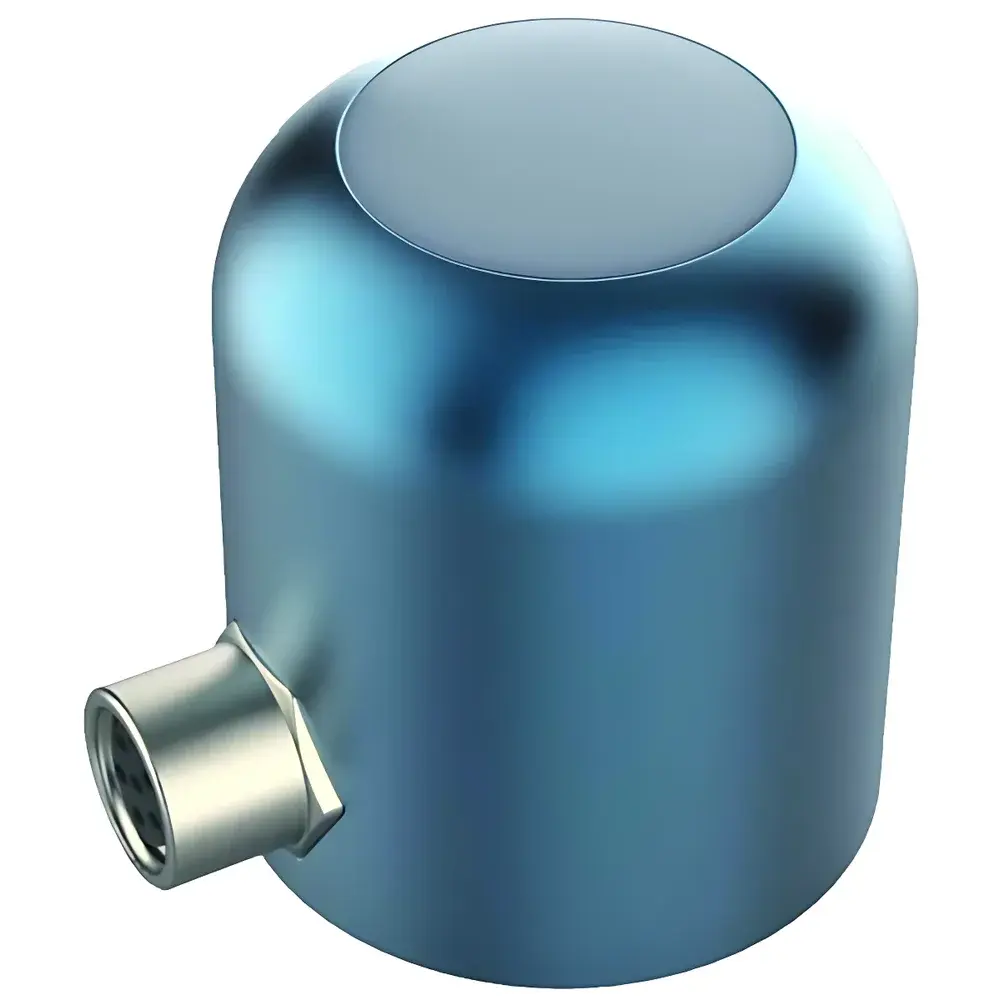
METER SQ-521 Quantum Sensor for Photosynthetically Active Radiation (PAR)
| Brand | METER |
|---|---|
| Origin | USA |
| Model | SQ-521 |
| Voltage Input | 5.5–24 V DC |
| Current Consumption | 1.4 mA (standby), 1.8 mA (active) |
| Accuracy | ±5% |
| Measurement Range | 0–4000 μmol·m⁻²·s⁻¹ |
| Precision | <1% up to 5000 μmol·m⁻²·s⁻¹ |
| Long-term Drift | <2% per year |
| Response Time | 0.6 s |
| Field of View | 180° |
| Spectral Range | 389–692 nm ±5 nm (≥50% relative response) |
| Spectral Selectivity | <10% @ 412–682 nm ±5 nm |
| Cosine Response | ±2% @ 45° zenith angle, ±5% @ 75° zenith angle |
| Azimuth Error | <0.5% |
| Tilt Error | <0.5% |
| Temperature Response | −0.11 ± 0.04 %/°C |
| Daily Total Uncertainty | <5% |
| Detector | Blue-enhanced silicon photodiode |
| Housing | Anodized aluminum with acrylic diffuser |
| IP Rating | IP68 |
| Operating Environment | −40 to 70 °C |
| Dimensions (SN ≥3033) | Ø30.5 mm × 37 mm |
| (SN 0–3032) | Ø24 mm × 37 mm |
| Weight (with 5 m cable) | 140 g (SN ≥3033), 100 g (SN 0–3032) |
| Cable Length | 5 m |
| Connector | 3.5 mm stereo plug |
| Compatible Data Loggers | METER EM50/50G, EM60, ZL6, ZSC, ProCheck |
Overview
The METER SQ-521 Quantum Sensor is a high-precision, NIST-traceable instrument engineered for the accurate measurement of photosynthetically active radiation (PAR) — defined as the spectral irradiance within the 400–700 nm range weighted by the photosynthetic action spectrum. Unlike broadband pyranometers, the SQ-521 employs a blue-enhanced silicon photodiode coupled with a precision acrylic diffuser to deliver spectrally selective quantum response across 389–692 nm (±5 nm at ≥50% relative responsivity). Its 180° field of view and rigorously characterized cosine correction ensure minimal angular dependence — critical for reliable PAR quantification under highly variable illumination geometries, including direct sun, diffuse skylight, and directional artificial sources such as LED, fluorescent, and HID lamps. Designed for continuous deployment in uncontrolled environments, the sensor meets IP68 ingress protection and operates reliably from −40 to 70 °C, with submersibility to 30 meters. Each unit undergoes multi-source pre-calibration against reference standards traceable to the National Institute of Standards and Technology (NIST), enabling consistent inter-laboratory comparability required in agronomic research, controlled-environment agriculture (CEA), and ecological monitoring.
Key Features
- Quantum-specific spectral response optimized for plant photobiology (389–692 nm ±5 nm, ≥50% responsivity)
- NIST-traceable calibration performed under multiple light sources — including solar simulators, white LEDs, and narrowband phosphor-converted LEDs — ensuring accuracy across natural and artificial lighting conditions
- Optimized cosine collector geometry: ±2% deviation at 45° zenith angle; ±5% at 75°, minimizing errors during low-sun-angle measurements
- Low thermal drift (−0.11 ± 0.04 %/°C) and long-term stability (<2% annual drift), validated under accelerated aging protocols per ISO 9060:2018 Class C requirements for spectral sensors
- Robust anodized aluminum housing with integrated acrylic diffuser — reduces soiling frequency and eliminates need for routine dome cleaning while maintaining optical integrity
- Integrated leveling base ensures mechanical alignment perpendicular to incident irradiance, directly supporting GLP-compliant installation practices
- Low-power operation (1.4 mA standby / 1.8 mA active) compatible with battery- or solar-powered remote networks
Sample Compatibility & Compliance
The SQ-521 is validated for use across heterogeneous radiation fields typical in agricultural science applications: open-field canopies, greenhouse compartments, vertical farms, growth chambers, and aquatic mesocosms. Its spectral selectivity (<10% deviation over 412–682 nm ±5 nm) satisfies the spectral matching criteria outlined in ASTM E2915–22 for quantum sensors used in plant productivity studies. The device complies with IEC 61215-2 MQT 15 (for environmental robustness) and supports audit-ready data collection under FDA 21 CFR Part 11 when deployed with METER’s ZL6 logger and ZentraCloud platform — providing electronic signatures, immutable audit trails, and role-based access control. All calibrations are documented with unique serial-numbered certificates containing uncertainty budgets per GUM (JCGM 100:2008).
Software & Data Management
The SQ-521 interfaces seamlessly with METER’s ecosystem via a standardized 3.5 mm stereo plug, enabling plug-and-play integration with ZL6, EM50/50G, EM60, ZSC, and ProCheck data loggers. Raw analog voltage output (0–2.5 V) is converted onboard the logger with 16-bit resolution and temperature-compensated scaling. Data streams automatically synchronize to ZentraCloud — a secure, ISO 27001-certified SaaS platform offering real-time visualization, automated quality control flags (e.g., saturation, out-of-range, thermal excursion), and export to CSV, NetCDF, or CF-compliant formats. API access enables programmatic ingestion into third-party analytics pipelines (e.g., R Shiny dashboards, Python-based phenotyping models, or farm management information systems adhering to ADAPT or AgGateway standards).
Applications
- Quantifying daily light integral (DLI) in greenhouse crop production to optimize supplemental lighting schedules and energy use
- Validating spectral output and uniformity of horticultural LED arrays per ASABE S640.2 standards
- Monitoring canopy-level PAR interception in eddy covariance flux towers and forest understory studies
- Calibrating radiative transfer models (e.g., SAIL, PROSAIL) used in satellite-based vegetation index derivation
- Supporting GLP-compliant photobioreactor characterization in algal biofuel and pharmaceutical cultivation
- Long-term ecological monitoring of light availability in wetland, tundra, and marine benthic habitats
FAQ
Is the SQ-521 suitable for underwater PAR measurements?
Yes — its IP68 rating and 30 m submersibility enable deployment in shallow aquatic systems, including mesocosms, aquaculture tanks, and coral reef monitoring stations. Calibration remains valid underwater provided the acrylic diffuser is free of biofouling or micro-scratches.
Does the sensor require periodic recalibration?
While long-term drift is specified at <2% per year, METER recommends annual verification against a reference standard in accordance with ISO/IEC 17025-accredited laboratories — especially prior to critical seasonal campaigns or regulatory submissions.
Can the SQ-521 distinguish between photosynthetic photon flux density (PPFD) and energy-based irradiance (W·m⁻²)?
No — it reports quantum yield exclusively in µmol·m⁻²·s⁻¹ (PPFD). Conversion to irradiance requires spectral knowledge and is not supported natively; users should apply published conversion factors only when source spectra are well-characterized.
What mounting accessories are recommended for field deployment?
METER offers the AL-100 leveling mount and CM-100 stainless-steel cross-arm for permanent installations. For temporary setups, the included threaded base accepts standard ¼”-20 tripod adapters and weatherproof enclosures compliant with IEC 60529.




