
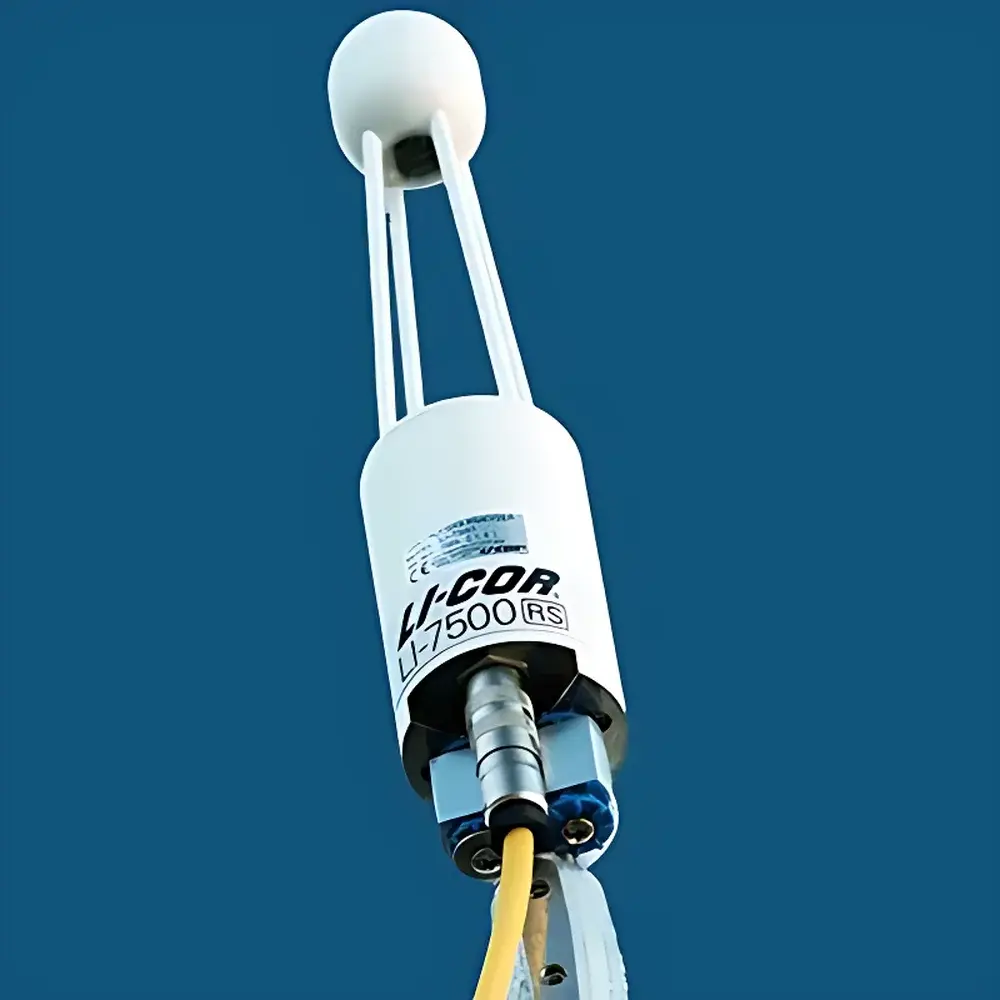
LI-COR LI-7500RS Open-Path CO₂/H₂O Gas Analyzer
| Brand | LI-COR |
|---|---|
| Origin | USA |
| Model | LI-7500RS |
| CO₂ Range | 0–3000 µmol/mol |
| H₂O Range | 0–60 mmol/mol |
| Accuracy (CO₂/H₂O) | <1% |
| Zero Drift (CO₂) | ±0.1 µmol/mol/°C (typ.), ±0.3 µmol/mol/°C (max.) |
| Zero Drift (H₂O) | ±0.03 mmol/mol/°C (typ.), ±0.05 mmol/mol/°C (max.) |
| RMS Noise @5 Hz (CO₂) | 0.08 µmol/mol |
| RMS Noise @5 Hz (H₂O) | 0.0034 mmol/mol |
| Gain Drift (CO₂) | ±0.02% /°C (typ.) |
| Gain Drift (H₂O) | ±0.15% /°C (typ.) |
| Cross-Sensitivity (CO₂ to H₂O) | ±2.0×10⁻⁵ mol CO₂/mol H₂O (typ.) |
| Cross-Sensitivity (H₂O to CO₂) | ±0.02 mol H₂O/mol CO₂ (typ.) |
| Sampling Rate | 150 Hz |
| Bandwidth Options | 5, 10, or 20 Hz |
| Detector | Thermoelectrically Cooled PbSe |
| Optical Path Length | 12.5 cm |
| Air Temperature Sensor | 10 kΩ thermistor (–40 to 70 °C |
| Pressure Sensor | 20–110 kPa (±0.4 kPa accuracy) |
| Operating Temp | –25 to 50 °C (extendable to –40 °C) |
| IP Rating | IP65 |
| Power | 10.5–30 VDC |
| Power Consumption | 4 W (typ.), ≤8 W (full range) |
| Probe Dimensions | Ø6.5 × 30 cm |
| Probe Weight | 0.67 kg (1.3 kg with base) |
| DSI Box Dimensions | 13.24 × 14.64 × 6.24 cm (H×W×D) |
| DSI Box Weight | 0.93 kg |
| Data Interface | Ethernet |
Overview
The LI-COR LI-7500RS is an open-path, non-dispersive infrared (NDIR) gas analyzer engineered for high-frequency, continuous measurement of carbon dioxide (CO₂) and water vapor (H₂O) concentrations in atmospheric boundary layer research. It operates on the principle of dual-wavelength absorption spectroscopy, utilizing thermoelectrically cooled lead selenide (PbSe) detectors and a fixed 12.5 cm optical path to deliver precise, real-time gas concentration data at native 150 Hz sampling—subsequently decimated to user-selectable bandwidths of 5, 10, or 20 Hz for eddy covariance flux computation. Designed specifically for integration into micrometeorological tower systems, the LI-7500RS meets the stringent temporal resolution, stability, and environmental robustness requirements of long-term ecosystem-scale carbon and water vapor flux monitoring. Its deployment forms the analytical core of >90% of global eddy covariance sites within the FLUXNET, AmeriFlux, and ICOS networks, serving as a de facto standard for terrestrial biosphere-atmosphere exchange quantification under GLP-aligned observational protocols.
Key Features
- Open-path NDIR architecture eliminates sample tubing, pumps, dryers, and associated maintenance—enabling true in-situ, zero-lag gas concentration measurement
- Ultra-low power consumption (4 W typical at 25 °C; ≤8 W across full operating range), optimized for solar-powered remote stations and extended unattended operation
- Integrated SmartFlux® system embedded in the DSI (Data Signal Interface) module performs real-time, on-site eddy covariance flux calculations—including coordinate rotation, spectral correction, and Webb-Pearman-Leuning (WPL) density corrections—using identical algorithms and calibration parameters as desktop EddyPro® software
- IP65-rated probe housing ensures reliable performance under harsh field conditions, including rain, dust, snow, and wide thermal gradients (–40 to 50 °C operational envelope)
- Simultaneous co-located measurement of air temperature (10 kΩ thermistor) and barometric pressure (capacitive sensor) enables fully corrected, physically consistent flux partitioning and energy balance closure analysis
- Native Ethernet interface supports TCP/IP communication, remote firmware updates, configuration management, and seamless integration with third-party dataloggers (e.g., Campbell Scientific CR series) and FluxSuite® cloud-based data monitoring infrastructure
Sample Compatibility & Compliance
The LI-7500RS is validated for direct atmospheric sampling without preconditioning—compatible with ambient air containing up to 95% relative humidity (non-condensing) and particulate loadings typical of rural, agricultural, forested, and tundra environments. Its open-path design inherently avoids adsorption/desorption artifacts common in closed-path analyzers, preserving high-frequency turbulent signal fidelity essential for flux computation. The instrument conforms to ASTM D6348–21 (standard test method for determination of gaseous compounds by multi-gas analyzers), supports ISO 14064-2-compliant greenhouse gas inventory reporting workflows, and provides audit-ready metadata logging required for US EPA GHG Reporting Program and IPCC Tier 3 methodology compliance. All internal calibration traceability is maintained against NIST-traceable standards, and raw data streams include timestamped diagnostic flags for data quality assessment per FLUXNET QA/QC guidelines.
Software & Data Management
Data acquisition, real-time processing, and archival are managed via the SmartFlux® system running on the embedded DSI hardware. This Linux-based platform executes EddyPro®-equivalent flux algorithms—including time-lag optimization, planar fit tilt correction, and high-frequency spectral attenuation compensation—producing fully corrected CO₂ and H₂O fluxes (µmol m⁻² s⁻¹ and mmol m⁻² s⁻¹) with sub-second latency. Raw 150 Hz voltage outputs, calibrated gas concentrations, ancillary meteorological variables, and comprehensive diagnostic logs are streamed over Ethernet to local storage or cloud-hosted FluxSuite® servers. The system supports 21 CFR Part 11-compliant user access control, electronic signatures, and immutable audit trails for regulated environmental monitoring applications. Post-processing retains full backward compatibility with EddyPro® v8+ and allows reprocessing with updated corrections or gap-filling methodologies without requiring re-downloading raw data.
Applications
- Long-term eddy covariance measurements of net ecosystem exchange (NEE), gross primary production (GPP), and ecosystem respiration (Reco) across biomes
- Soil-atmosphere CO₂ efflux partitioning using gradient and chamber-integrated measurement strategies
- Evapotranspiration (ET) estimation and land surface model validation through H₂O flux and latent heat flux derivation
- Urban flux studies assessing anthropogenic CO₂ emissions and green infrastructure water use efficiency
- Climate change impact assessments involving drought stress response, phenological shifts, and disturbance recovery dynamics
- Calibration and validation of satellite-derived CO₂ column retrievals (e.g., OCO-2/3, GOSAT) and atmospheric transport models
FAQ
What distinguishes the LI-7500RS from the earlier LI-7500A?
The LI-7500RS introduces enhanced thermal management, improved detector stability, upgraded firmware for SmartFlux® real-time processing, and tighter cross-sensitivity specifications—particularly reduced H₂O interference on CO₂ measurement—while retaining full mechanical and electrical compatibility with existing LI-7500 mounting hardware and data acquisition ecosystems.
Can the LI-7500RS operate independently without an external datalogger?
Yes—the integrated DSI module with SmartFlux® provides autonomous data acquisition, real-time flux computation, local storage, and Ethernet-based telemetry, eliminating dependency on external loggers for core eddy covariance functionality.
Is factory recalibration required annually?
While not mandatory, LI-COR recommends annual verification against certified span gases and zero air; drift performance data indicate typical zero drift of ≤±0.1 µmol/mol/°C for CO₂ and ≤±0.03 mmol/mol/°C for H₂O—well within specification limits for multi-year deployments when operated within rated environmental conditions.
How is data synchronization achieved with ultrasonic anemometers?
The LI-7500RS supports hardware-level time synchronization via IRIG-B or PTP (Precision Time Protocol) over Ethernet, ensuring sub-millisecond alignment between gas concentration and 3D wind vector time series—critical for accurate covariance computation.
Does the system support custom post-processing scripts or API access?
Yes—FluxSuite® provides RESTful APIs for programmatic data retrieval, metadata querying, and alert configuration; raw binary data formats are documented and supported for integration with Python, MATLAB, or R-based analysis pipelines.
Related Products







