
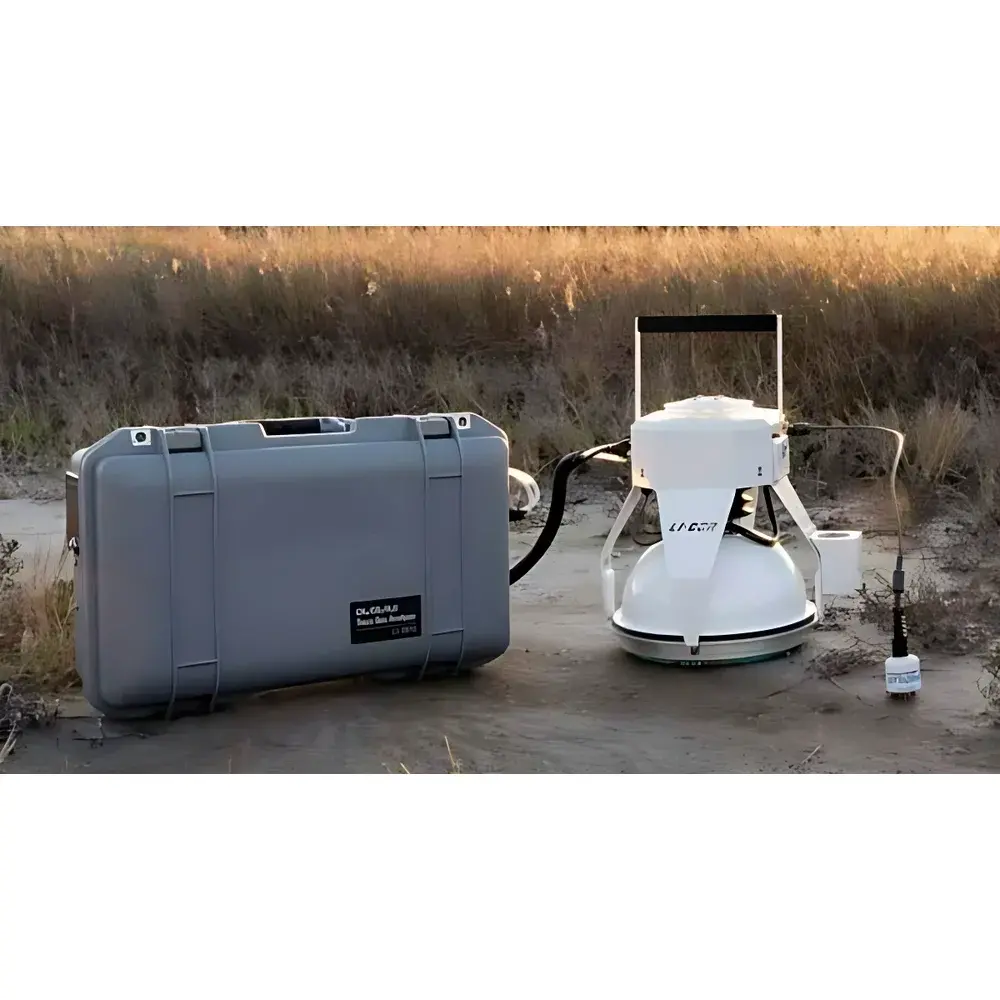
LI-COR LI-7810 Soil Methane Flux Measurement System
| Brand | LI-COR |
|---|---|
| Origin | USA |
| Model | LI-7810 |
| Measurement Principle | Optical Feedback–Cavity Enhanced Absorption Spectroscopy (OF-CEAS) |
| Gases Measured | CH₄, CO₂, H₂O |
| Detection Limits | Sub-ppb CH₄, <0.1 ppm CO₂, <0.01% RH H₂O |
| Power Requirement | 12–24 V DC (LI-7810) |
| Operating Temperature | –25 to 45 °C |
| Communication | Ethernet, Wi-Fi, Bluetooth (8200-01S), USB, RS-232 |
| Data Output | Real-time flux calculations (CH₄ & CO₂), soil temperature & moisture (via optional sensors), diagnostic logs |
| Compliance | Designed for GLP-compliant field deployment |
Overview
The LI-COR LI-7810 Soil Methane Flux Measurement System is a fully integrated, field-deployable solution engineered for high-precision, autonomous quantification of soil-atmosphere methane (CH₄) and carbon dioxide (CO₂) exchange. At its core lies the LI-7810 trace gas analyzer—based on Optical Feedback–Cavity Enhanced Absorption Spectroscopy (OF-CEAS)—a quantum-limited optical technique delivering sub-part-per-trillion sensitivity, exceptional long-term stability, and intrinsic calibration robustness without reliance on external reference gases. Paired with the 8200-01S Smart Chamber, this system implements the closed-chamber dynamic accumulation method in strict accordance with ASTM D6573 and ISO 18587 protocols. The 8200-01S chamber autonomously regulates sealing duration, flow rate, pressure compensation, and mixing dynamics to minimize artifacts from boundary-layer disturbance or pressure-induced advective flux errors—a critical requirement for low-flux soils and heterogeneous terrain. All raw spectral data, environmental metadata (soil T, VWC via optional probes), and final flux values are timestamped, georeferenced (GPS-enabled), and stored onboard with full traceability.
Key Features
- OF-CEAS-based LI-7810 analyzer: No routine zero/span calibration required; <10 ppt CH₄ precision at 1 Hz, <0.05 ppm CO₂ precision, <0.005% RH H₂O precision over 24 h
- 8200-01S Smart Chamber: Integrated pressure-balanced venting, active air-mixing impeller, bowl-shaped geometry, and adaptive drive mechanism to suppress pressure transients during closure
- Real-time flux computation: Onboard ARM Cortex processor executes iterative nonlinear regression (e.g., HMR, linear/nonlinear fitting) per chamber closure cycle—outputting CH₄ and CO₂ flux (µmol·m⁻²·s⁻¹), R², slope uncertainty, and diagnostic flags
- Self-contained operation: Dual power options (external 12 V or internal rechargeable Li-ion); 7-day continuous logging at 30-min intervals on full charge
- Web-native interface: Embedded web server enables remote monitoring and configuration via any HTML5 browser—no proprietary software installation required
- Ruggedized field design: IP65-rated enclosure, -25 to 45 °C operational range, shock-mounted optics, and corrosion-resistant aluminum chassis
Sample Compatibility & Compliance
The LI-7810/8200-01S system is validated for use across diverse edaphic conditions—including mineral soils, organic peats, permafrost margins, rice paddies, landfill covers, and restored wetlands. It accommodates standard 20 cm × 20 cm and 30 cm × 30 cm collars (custom collar integration supported). All firmware and data handling workflows adhere to FAO’s Global Soil Laboratory Network (GLOSOLAN) metadata standards and support direct ingestion into ICOS, AmeriFlux, and FluxNet repositories. Instrument-level compliance includes CE marking (EMC & LVD), RoHS, and FCC Part 15 Class B. For regulatory reporting, the system generates ISO/IEC 17025-aligned uncertainty budgets and supports 21 CFR Part 11–compliant electronic signatures when deployed with validated third-party LIMS integration.
Software & Data Management
Data acquisition, visualization, and export are managed through the LI-COR FluxPro™ web application—accessible locally or remotely via Wi-Fi/Ethernet. Raw spectra, time-series concentration traces, chamber environmental logs, and final flux tables are stored in HDF5 format with embedded CF-1.8 metadata conventions. Batch processing supports gap-filling (using soil temperature-driven Q₁₀ models), outlier rejection (MAD-based), and unit conversion (to mg·m⁻²·h⁻¹ or g·C·m⁻²·d⁻¹). Export options include CSV (tabular), NetCDF (for GIS/Python/R workflows), and PDF reports with embedded QC charts. Audit trails record all user actions, firmware updates, and sensor calibrations—enabling full GLP/GMP traceability for peer-reviewed publications or regulatory submissions.
Applications
- Quantifying CH₄ oxidation and production hotspots in agricultural soils under varying tillage, irrigation, and fertilizer regimes
- Validating biogeochemical model parameters (e.g., DNDC, DayCent) for regional carbon accounting
- Monitoring post-remediation flux dynamics at contaminated sites (e.g., chlorinated solvent plumes)
- Assessing climate feedbacks in thawing permafrost ecosystems using spatially dense, multi-season campaigns
- Supporting Tier 2 and Tier 3 greenhouse gas inventories per IPCC 2006 Guidelines and subsequent refinements
- Calibrating and validating satellite-based CH₄ retrieval algorithms (e.g., TROPOMI, GOSAT-2) at ground truth sites
FAQ
Does the LI-7810 require periodic calibration with certified gas standards?
No—the OF-CEAS optical path is intrinsically stable; factory characterization provides permanent wavelength and absorption cross-section references. Field verification checks (e.g., zero-air test) are recommended annually but not mandatory for routine operation.
Can the 8200-01S operate unattended for extended periods?
Yes—configured with solar charging and cellular telemetry (optional), it supports >60 days of autonomous operation at 1-hour measurement intervals in temperate climates.
Is soil moisture and temperature measurement integrated or optional?
Soil T and VWC sensors (e.g., EC-5, TEROS 21) connect directly to the 8200-01S via analog/digital I/O; data is synchronized and included in all flux calculations and exports.
How does the system handle wind-induced pressure fluctuations during chamber closure?
The 8200-01S employs real-time differential pressure sensing and adaptive venting—activating micro-valves to equalize chamber-to-ambient pressure within ±0.1 hPa, eliminating advective bias per ISO 18587 Annex C.
What level of technical support and firmware updates does LI-COR provide?
All systems ship with 24-month hardware warranty and lifetime access to firmware updates, application notes, and peer-reviewed methodology guides via the LI-COR Environmental Hub portal.
Related Products







