
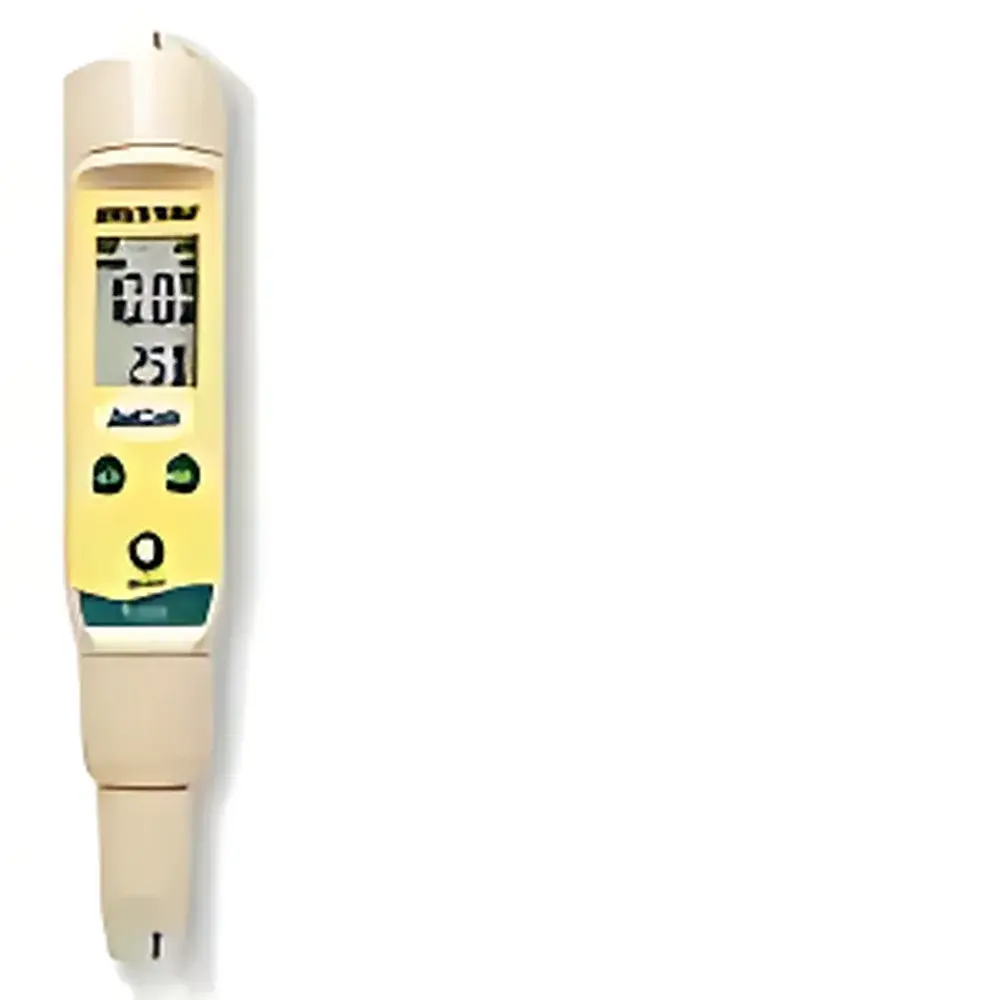
Thermo Fisher Scientific CON700 Benchtop Conductivity Meter
| Brand | Thermo Fisher Scientific |
|---|---|
| Origin | USA |
| Manufacturer Type | Authorized Distributor |
| Product Origin | Imported |
| Model | CON700 |
| Pricing | Available Upon Request |
Overview
The Thermo Fisher Scientific CON700 Benchtop Conductivity Meter is a precision-engineered electrochemical instrument designed for reliable, repeatable measurement of electrical conductivity, total dissolved solids (TDS), and temperature in aqueous solutions. Operating on the principle of two-electrode or four-electrode conductometric sensing—depending on electrode configuration—the CON700 determines solution conductivity by applying an alternating current (AC) voltage across a pair of inert electrodes and measuring the resulting current flow. Conductivity values are reported in microsiemens per centimeter (µS/cm) or millisiemens per centimeter (mS/cm), with automatic temperature compensation (ATC) referenced to 25 °C using either built-in NTC thermistors or external Pt1000 probes. Its benchtop architecture prioritizes laboratory stability, ergonomic operation, and compliance-ready functionality for quality control, environmental testing, and academic research environments.
Key Features
- Broad dynamic range: Five auto-ranging conductivity scales (0–199.9 µS/cm, 200–1999 µS/cm, 2.00–19.99 mS/cm, 20.0–199.9 mS/cm, 200–1999 mS/cm) and corresponding TDS ranges (0–199.9 ppm, 200–1999 ppm, 2.00–19.99 g/L, etc.), all selected automatically based on measured signal magnitude
- Simultaneous dual-parameter display: Real-time concurrent readout of conductivity (or TDS) and temperature on a high-contrast, backlit LCD screen optimized for ambient lab lighting and viewing angles
- Stability-driven acquisition: Visual and audible “stable reading” indication activates only when signal drift falls below user-defined thresholds (±0.5% over 3 seconds), ensuring data integrity before logging
- Configurable cell constant support: Compatible with standard K = 0.1, 1.0, and 10.0 cm⁻¹ conductivity cells; cell constant entered manually or recalled from stored calibration profiles
- Multi-point calibration capability: Up to five-point linear or non-linear calibration using certified KCl standards (e.g., 84 µS/cm, 1413 µS/cm, 12.88 mS/cm), supporting both conductivity and TDS modes
- Onboard data management: Internal memory stores up to 100 measurement records with timestamp, parameter values, temperature, and calibration ID—exportable via optional RS232 or USB-to-serial interface
Sample Compatibility & Compliance
The CON700 is validated for use with deionized water, potable water, wastewater effluents, boiler feedwater, nutrient solutions, and low-viscosity electrolyte solutions. It excludes samples containing suspended solids >50 mg/L, oils, or aggressive oxidizers (e.g., concentrated HNO₃, ClO₄⁻ solutions) that may degrade platinum or stainless-steel electrode surfaces. The instrument meets IEC 61010-1:2010 safety requirements for electrical equipment used in laboratory settings and conforms to CE marking directives. While not inherently 21 CFR Part 11 compliant, its audit-trail-capable firmware (v2.3+) supports GLP/GMP-aligned workflows when paired with validated data export protocols and controlled access procedures.
Software & Data Management
Data retrieval is facilitated through ASCII-based serial communication (RS232, 9600 baud, no parity). Optional Thermo Fisher-provided terminal emulation software enables batch download, CSV formatting, and time-stamped report generation. All stored entries include date/time stamp (real-time clock battery-backed), operator ID field (manually entered), measurement mode flag (conductivity/TDS), temperature value, and active calibration set identifier. No cloud connectivity or proprietary drivers are required; integration with LIMS systems is achievable via standard COM port mapping and script-based parsing.
Applications
- Environmental monitoring: Routine assessment of surface water, groundwater, and treated effluent per EPA Method 120.1 and ISO 7888
- Pharmaceutical water systems: USP compliant conductivity verification of Purified Water (PW) and Water for Injection (WFI) at specified temperatures
- Food & beverage QC: Monitoring rinse water conductivity during CIP validation and brine concentration in pickling operations
- Academic teaching labs: Quantitative correlation of ion concentration, temperature, and mobility in undergraduate physical chemistry experiments
- Power generation: Low-conductivity monitoring of condensate and steam cycle make-up water to detect early-stage corrosion or resin leakage
FAQ
Does the CON700 support automatic temperature compensation (ATC)?
Yes—using either integrated NTC sensors (standard) or optional external Pt1000 probes, with selectable reference temperatures (15–35 °C) and linear or non-linear compensation algorithms.
Can calibration data be transferred between instruments?
No—calibration coefficients are stored internally and not exportable; each unit requires independent multi-point calibration using traceable standards.
Is the instrument suitable for high-purity water applications below 1 µS/cm?
Not recommended for sub-µS/cm measurements; the lower detection limit is 0.1 µS/cm with K=0.1 cell, but accuracy degrades below 1 µS/cm without guarded-cell design or flow-through cell integration.
What electrode types are compatible with the CON700?
Standard DIN/ISO-compliant two-electrode cells with BNC or mini-DIN connectors; four-electrode cells require optional adapter module (sold separately).
How is data security managed for regulated environments?
The device lacks password protection or electronic signature functions; compliance with 21 CFR Part 11 requires procedural controls (e.g., documented SOPs, manual logbooks, and supervised data export).





