
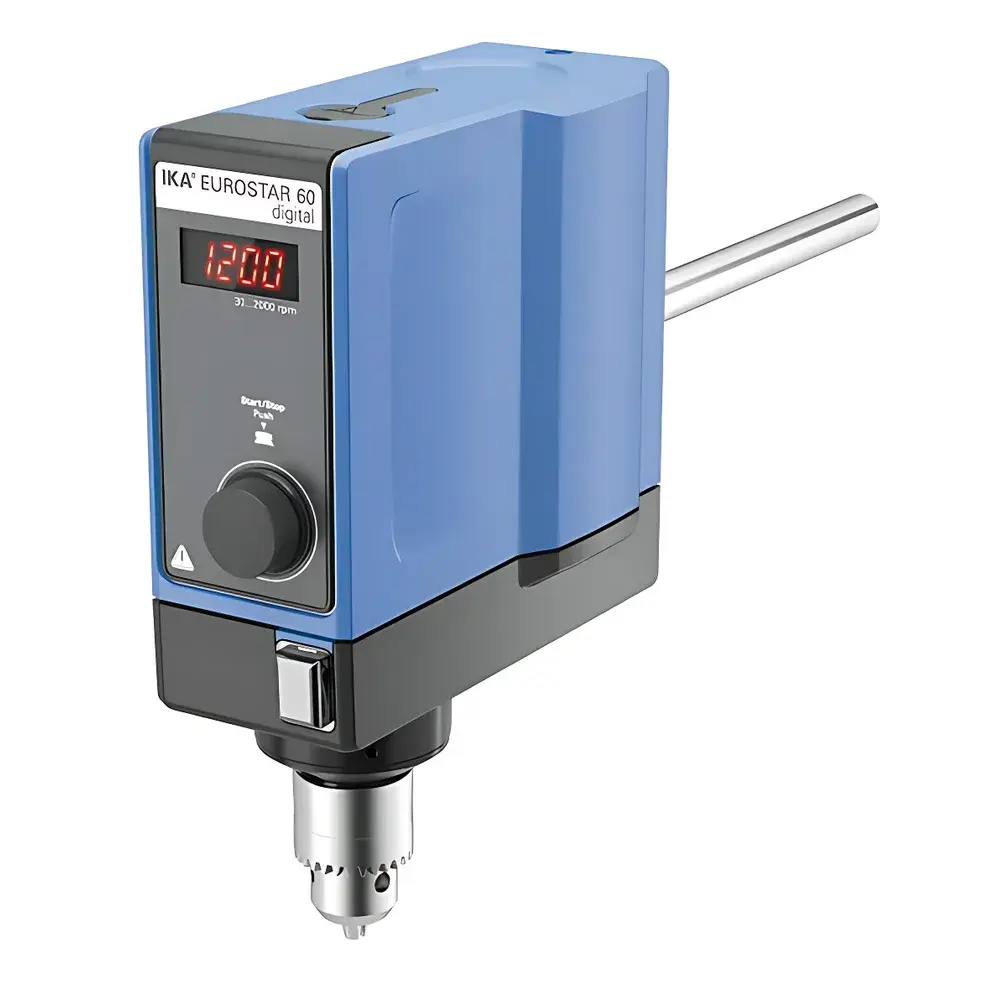
IKA EUROSTAR 60 digital Overhead Stirrer
| Brand | IKA |
|---|---|
| Origin | Germany |
| Model | EUROSTAR 60 digital |
| Max. Speed | 0/30–2000 rpm |
| Max. Viscosity | 100,000 mPa·s |
| Max. Volume (H₂O) | 40 L |
| Drive Type | Brushless DC Motor |
| Torque | 60 N·cm |
| Speed Control | Microprocessor-regulated, closed-loop feedback |
| Protection Class | IP21 |
| Dimensions (W×D×H) | 160 × 190 × 420 mm |
| Weight | 5.8 kg |
| Safety Features | Overload cut-off, stall detection, error code display |
| Noise Level | ≤65 dB(A) at 10 cm |
| Power Supply | 100–240 V, 50/60 Hz |
Overview
The IKA EUROSTAR 60 digital is a high-performance overhead stirrer engineered for precision, reliability, and long-term stability in demanding laboratory environments. Unlike magnetic stirrers—limited by vessel geometry, temperature constraints, and torque capacity—this brushless DC motor-driven overhead system delivers consistent mechanical agitation across a broad range of viscosities and volumes. It operates on the principle of direct mechanical coupling between the drive unit and the stirring shaft, enabling precise control over rotational energy transfer into heterogeneous or highly viscous samples. Designed for applications requiring reproducible shear input—including polymer dissolution, suspension homogenization, enzymatic reactions, and crystallization studies—the EUROSTAR 60 digital integrates real-time speed monitoring and closed-loop regulation to maintain setpoint accuracy regardless of load fluctuations. Its robust architecture supports continuous operation under variable process conditions, making it suitable for both routine QC testing and method development workflows in pharmaceutical, chemical, and materials science laboratories.
Key Features
- Microprocessor-Controlled Closed-Loop Speed Regulation: Continuously compares actual shaft speed with user-defined setpoint and dynamically adjusts motor output to compensate for viscosity-induced drag or mechanical resistance—ensuring ±1% speed stability across operating range.
- High-Torque Brushless DC Motor: Delivers 60 N·cm nominal torque with peak overload capability, supporting stable agitation of non-Newtonian fluids up to 100,000 mPa·s without thermal derating.
- Digital Speed Display & Precision Setting: Large LED interface shows real-time rpm with 1-rpm resolution; speed adjustment via rotary encoder enables intuitive, stepless parameter entry.
- Integrated Safety Architecture: Automatic shutdown triggered by motor stall, thermal overload, or excessive current draw; fault conditions reported via alphanumeric error codes (e.g., E01 = overload, E03 = sensor failure).
- Low-Noise, Compact Design: Optimized gear train and vibration-damped housing achieve ≤65 dB(A) acoustic emission—critical for shared lab spaces and noise-sensitive applications.
- Universal Shaft Compatibility: Accepts standard ISO 228/1 threaded stirring shafts (6–10 mm diameter); compatible with anchor, paddle, propeller, and helical impellers for scalable mixing geometries.
Sample Compatibility & Compliance
The EUROSTAR 60 digital accommodates glass, stainless steel, and PTFE-coated vessels from 50 mL to 40 L capacity, including jacketed reactors and pressure-rated systems when paired with appropriate shaft seals. Its IP21 ingress protection rating ensures safe operation in standard laboratory ambient conditions (IEC 60529). While not intrinsically rated for explosive atmospheres, it complies with EN 61000-6-3 (EMC emission limits) and EN 61000-6-2 (immunity standards), meeting essential requirements for CE-marked laboratory instrumentation. For regulated environments, its deterministic speed control, auditable error logging, and absence of analog potentiometer drift support alignment with GLP documentation practices and internal SOP validation protocols.
Software & Data Management
The EUROSTAR 60 digital operates as a standalone instrument with no proprietary software dependency. All operational parameters—including speed setpoint, runtime, and fault history—are retained in non-volatile memory and accessible via front-panel interface. While it lacks USB/Ethernet connectivity or PC synchronization, its deterministic behavior and repeatable mechanical response enable seamless integration into validated workflows where electronic data capture is managed externally (e.g., via PLC-linked timers or camera-based process monitoring). The error-code system provides traceable diagnostics for maintenance logs and root-cause analysis during equipment qualification (IQ/OQ/PQ).
Applications
- Preparation of high-viscosity polymer solutions and hydrogels in R&D and pilot-scale synthesis
- Homogenization of ceramic slurries and battery electrode pastes prior to rheological characterization
- Controlled agitation during dissolution testing per USP and pharmacopeial methods
- Stirring of microbial culture media in bioreactor seed trains under aseptic conditions
- Emulsion formation and phase inversion studies requiring constant shear input over extended durations
- Accelerated stability testing of suspensions and colloidal dispersions per ICH Q5C guidelines
FAQ
Is the EUROSTAR 60 digital compatible with temperature-controlled reactors?
Yes—when used with appropriate shaft extensions, PTFE-sealed bearings, and external cooling jackets, it maintains performance across –20 °C to +150 °C vessel operating ranges.
Can it be integrated into automated lab platforms?
It does not feature digital communication ports; however, its analog-ready start/stop and speed analog input (0–10 V) options—available via optional interface module—support basic PLC-level integration.
What impeller types are recommended for high-shear dispersion?
Turbine and disperser impellers with radial flow patterns (e.g., Rushton-type) are optimal when mounted on rigid shafts with minimal runout; maximum tip speed should remain below 8 m/s to limit cavitation risk.
Does it meet FDA 21 CFR Part 11 requirements?
No—this model lacks electronic audit trails, user access controls, or electronic signature capability; it is intended for use in non-GMP research settings or as a component within broader validated systems where data integrity is ensured externally.
How often does calibration verification need to be performed?
IKA recommends annual speed verification using an NIST-traceable tachometer; torque calibration is not user-serviceable and requires factory service if out-of-specification performance is observed.



