
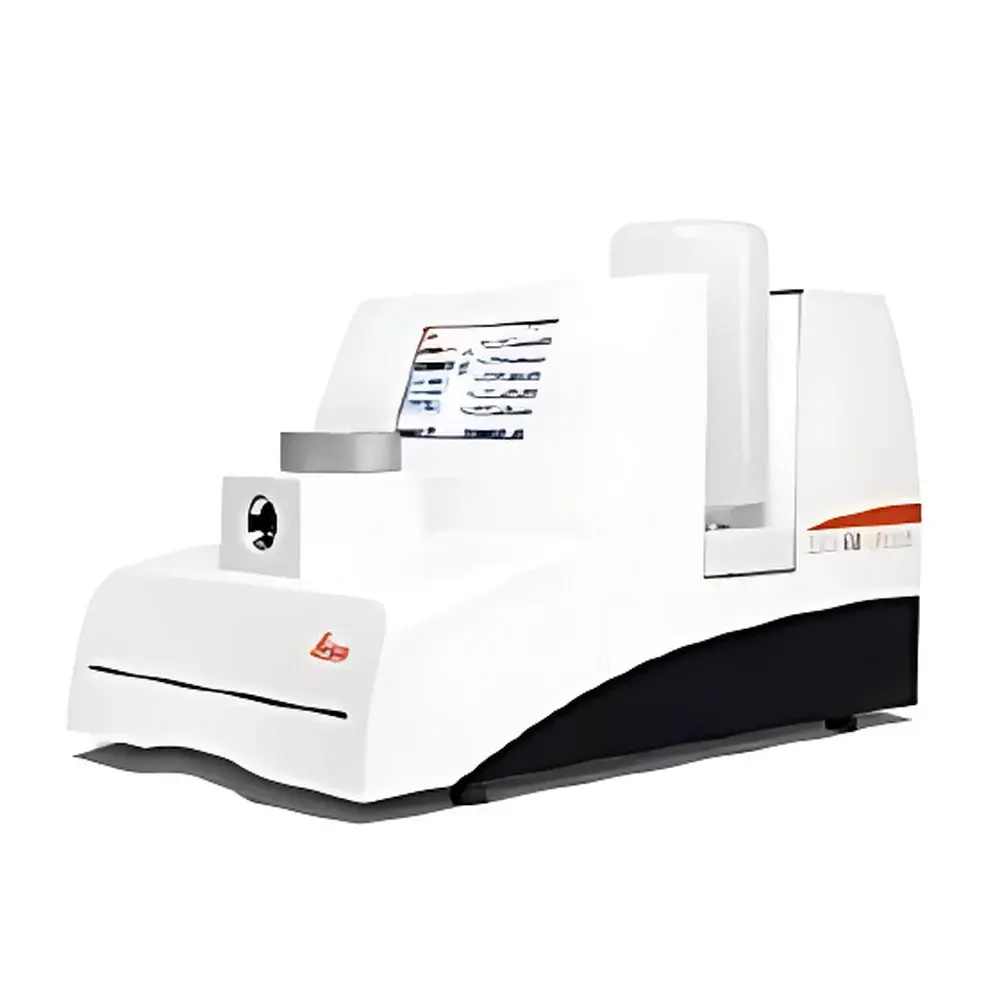
Leica EM CPD300 Automated Critical Point Dryer
| Brand | Leica |
|---|---|
| Origin | Austria |
| Model | EM CPD300 |
| Sample Chamber Volume | 175 mL |
| Control Interface | Touchscreen with Embedded Process Logic |
| CO₂ Efficiency | Optimized via Patented Fill Medium Design |
| Safety Systems | Dual-Pressure Interlocks, Integrated Waste Fluid Separation, Automatic Venting Safeguards |
| Compliance | Designed to Support GLP/GMP Workflow Integrity and ISO 13485-Aligned Lab Documentation Requirements |
| Pricing Range | USD 65,000 – 105,000 (FOB Austria) |
Overview
The Leica EM CPD300 is the world’s first fully automated critical point dryer engineered specifically for high-fidelity sample preparation in scanning electron microscopy (SEM) workflows. It operates on the thermodynamic principle of carbon dioxide (CO₂) phase transition at its critical point (31.1 °C, 73.8 bar), where liquid and gaseous phases become indistinguishable—eliminating interfacial surface tension during drying. This physical principle prevents collapse, shrinkage, or distortion of delicate ultrastructural features in hydrated biological specimens—including cells, tissues, biofilms, and soft polymers—preserving nanoscale morphology essential for accurate SEM imaging and quantitative morphometric analysis.
Unlike legacy semi-automated or manual CPD systems requiring operator intervention at multiple pressure/temperature transition stages, the EM CPD300 executes the entire process—from ethanol dehydration through CO₂ exchange, pressurization, heating, isothermal venting, and final purge—under embedded microprocessor control. Its architecture integrates real-time pressure and temperature feedback loops calibrated against NIST-traceable references, ensuring process repeatability across operators, shifts, and laboratories.
Key Features
- Fully automated drying cycle with pre-programmed, user-editable protocols for diverse specimen types (e.g., plant tissue, cultured neurons, bacterial colonies)
- 175 mL stainless-steel sample chamber enabling batch processing of up to 12 standard 12-mm SEM stubs or 6 multi-well carriers
- Patented fill-medium geometry that reduces CO₂ consumption by up to 35% compared to conventional basket designs—minimizing operational cost and environmental footprint
- 10.1-inch capacitive touchscreen interface with multilingual support (English, German, French, Japanese, Chinese), intuitive icon-driven navigation, and context-sensitive help overlays
- Dual redundant pressure sensors and temperature probes with automatic fault logging and emergency depressurization sequence
- Integrated waste fluid separator with hydrophobic membrane filtration, preventing solvent carryover into exhaust lines and complying with local VOC emission guidelines
- Three-tier safety architecture: hardware interlocks (door, pressure, temperature), firmware-enforced parameter limits, and audit-trail-enabled event logging
Sample Compatibility & Compliance
The EM CPD300 accommodates a broad spectrum of specimen formats—including standard aluminum stubs, silicon wafer chips, TEM grids mounted on specimen carriers, and custom 3D-printed holders—via interchangeable sample baskets (optional accessories: mesh-basket, porous ceramic disc, and low-profile grid holder). All wet chemistry steps (e.g., ethanol series, acetone, hexamethyldisilazane pre-treatment) are performed externally; the CPD300 accepts only solvent-exchanged samples ready for CO₂ infiltration. The system meets mechanical safety requirements per EN 61010-1 and electromagnetic compatibility standards per EN 61326-1. Its deterministic process logic and timestamped operational logs support compliance with ISO/IEC 17025, FDA 21 CFR Part 11 (when paired with Leica’s optional EM DRIFT software module), and GLP documentation frameworks.
Software & Data Management
While the EM CPD300 operates as a standalone instrument with embedded firmware, it supports data export via USB 2.0 port in CSV format—including cycle start/end timestamps, peak pressure/temperature values, CO₂ mass flow integrals, and alarm event codes. Optional integration with Leica EM DRIFT (Data Recording & Instrument Function Tracking) enables centralized protocol deployment, remote monitoring via Ethernet, electronic signature capture, and automated report generation aligned with laboratory quality management systems (QMS). Audit trails record all user actions, parameter modifications, and system state transitions—retained for ≥36 months unless manually purged under QMS-defined retention policies.
Applications
- High-resolution SEM imaging of cryo-fixed or chemically fixed biological specimens without structural artifacts
- Preparation of porous hydrogels, aerogels, and nanofibrous scaffolds for materials science characterization
- Stabilization of delicate diatom frustules, pollen grains, and insect cuticles for taxonomic and biomimetic studies
- Quality control of MEMS devices and microfluidic channel integrity prior to metallization
- Correlative light-electron microscopy (CLEM) workflows requiring morphologically preserved fluorescently labeled sections
FAQ
What solvents are compatible with the EM CPD300?
The system is designed exclusively for CO₂ as the transitional fluid. Samples must be dehydrated using graded ethanol or acetone prior to loading; no other solvents are permitted inside the chamber.
Can the EM CPD300 be integrated into a cleanroom environment?
Yes—the unit meets ISO Class 5 particulate limits when operated with HEPA-filtered exhaust routing and optional vibration-dampened mounting kits.
Is validation documentation available for regulated environments?
Leica provides IQ/OQ templates compliant with ASTM E2500 and EU Annex 15; full PQ support requires site-specific protocol development in collaboration with certified validation partners.
How often does the CO₂ supply require replacement?
A standard 10-L CO₂ cylinder (liquid phase, 99.995% purity) typically supports 40–55 drying cycles depending on chamber fill level and protocol stringency.
Does the EM CPD300 support remote diagnostics?
Firmware version 3.2+ enables encrypted SSH access for authorized service engineers; end-user remote operation is intentionally disabled for safety and regulatory reasons.





