
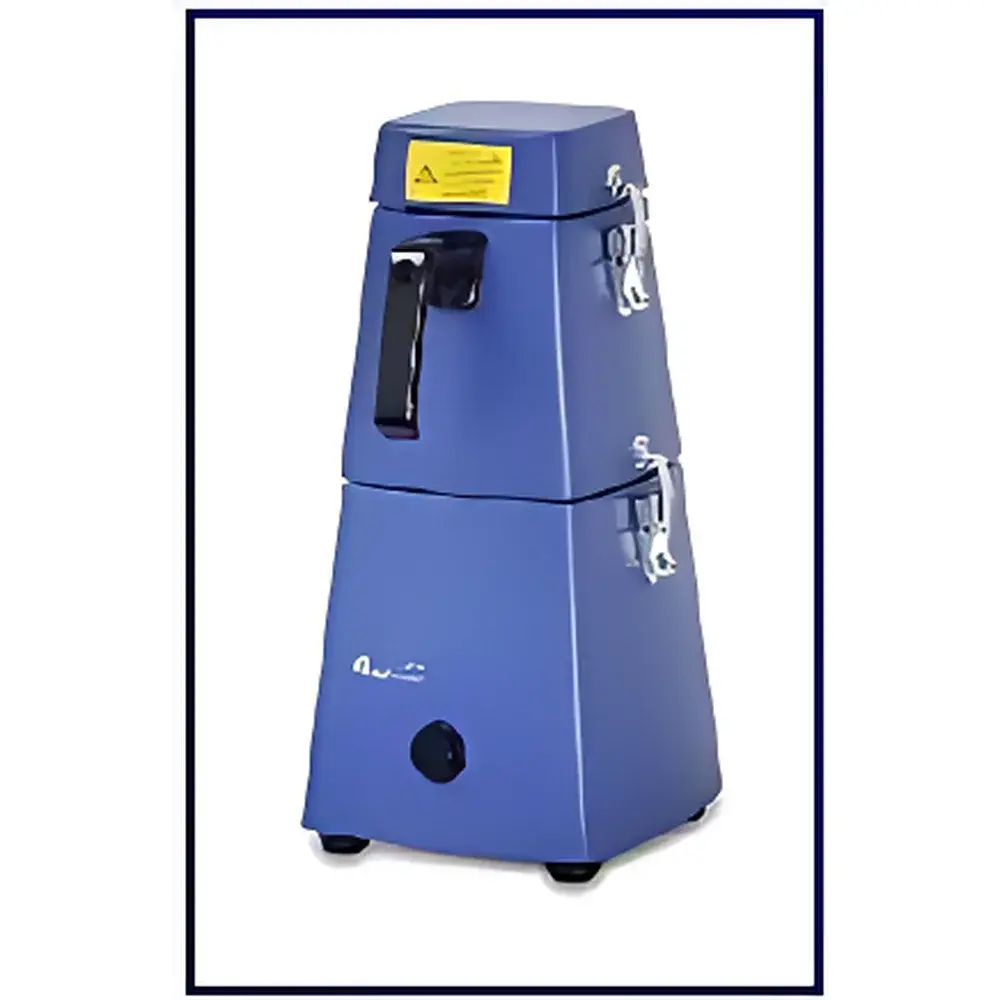
IKA M20 Universal Grinder
| Brand | IKA |
|---|---|
| Origin | Germany |
| Manufacturer Type | Authorized Distributor |
| Origin Category | Imported |
| Model | M20 |
| Price | Upon Request |
| Grinding Principle | Shear/Impact |
| Motor Input Power | 440 W |
| Motor Output Power | 225 W |
| Max Speed | 20,000 rpm |
| Max Peripheral Speed | 72 m/s |
| Max Working Volume | 250 mL |
| Max Feed Hardness | 5 Mohs |
| Max Feed Particle Size | 7 mm |
| Rotor Material | Stainless Steel 1.4034 |
| Grinding Chamber Material | Stainless Steel 1.4301 |
| Duty Cycle | 7 min ON / 10 min OFF |
| Jacketed Chamber with Water Cooling | Yes |
| Dry Ice Cooling in Chamber | Yes |
| Liquid Nitrogen Cooling in Chamber | No |
| Dimensions (W × H × D) | 170 × 350 × 170 mm |
| Weight | 6.6 kg |
| Ambient Temperature Range | 5–40 °C |
| Relative Humidity Limit | 80 % |
| Ingress Protection | IP21 |
| RS232 Interface | No |
| Analog Output | No |
| Voltage | 230 / 115 V |
| Frequency | 50 / 60 Hz |
| Instrument Input Power | 440 W |
Overview
The IKA M20 Universal Grinder is a high-performance benchtop grinding instrument engineered for reproducible, controlled size reduction of hard and brittle materials under dry conditions. Based on a robust shear/impact comminution principle, the M20 utilizes a high-speed rotating rotor (up to 20,000 rpm) interacting with a fixed stator to generate intense mechanical forces—primarily shear stress and impact energy—that fracture particles through controlled mechanical attrition. Its design prioritizes thermal management and operational safety: the stainless steel grinding chamber (material 1.4301) features an integrated cooling jacket for external water circulation, and optional in-chamber dry ice cooling enables temperature-sensitive sample processing without cryogenic hazards associated with liquid nitrogen. With a maximum feed particle size of 7 mm and compatibility with materials up to 5 Mohs hardness (e.g., chalk, limestone, dried plant tissue, pharmaceutical excipients), the M20 serves as a foundational unit for sample homogenization prior to elemental analysis, XRD, SEM, or dissolution testing.
Key Features
- High-efficiency dual-mode comminution: optimized shear and impact action ensures uniform particle size distribution in batch mode
- Jacketed grinding chamber with standardized hose connections for continuous water cooling—critical for heat-sensitive or thermolabile samples
- Quick-release, fully detachable chamber (stainless steel 1.4301) enabling rapid cleaning, cross-contamination prevention, and full visual inspection
- Pre-installed M21 cutting head (stainless steel 1.4034) with precisely balanced geometry for stable operation at 20,000 rpm and minimal vibration
- Dual-chamber configuration support: one motor drives two interchangeable grinding chambers, increasing throughput flexibility without hardware duplication
- Thermally managed duty cycle (7 min ON / 10 min OFF) aligned with motor thermal limits and long-term bearing integrity
- Compact footprint (170 × 350 × 170 mm) and lightweight construction (6.6 kg) suitable for shared lab benches and mobile analytical workstations
- IP21-rated enclosure provides protection against vertically falling drips and solid objects ≥12.5 mm—meeting standard laboratory environmental requirements per DIN EN 60529
Sample Compatibility & Compliance
The M20 is validated for dry grinding of non-fibrous, non-sticky, low-moisture materials including minerals, ceramics, polymers, freeze-dried biological tissues, and pharmaceutical tablets. It is not intended for wet milling, fibrous matrices (e.g., raw cellulose), or highly elastic substances. Sample compatibility is constrained by Mohs hardness ≤5 and initial particle size ≤7 mm to ensure mechanical integrity of the rotor/stator interface and avoid premature wear. The device complies with EU Machinery Directive 2006/42/EC and Low Voltage Directive 2014/35/EU. While it lacks built-in data logging or electronic audit trail capabilities, its mechanical operation supports GLP-aligned manual recordkeeping when used within documented SOPs. It does not meet FDA 21 CFR Part 11 requirements for electronic records due to absence of digital interfaces (RS232, analog output, or software control).
Software & Data Management
The IKA M20 operates as a standalone electromechanical instrument with no embedded microprocessor, firmware, or digital control interface. All operational parameters—including speed, runtime, and cooling status—are set manually via front-panel controls. Consequently, it produces no electronic data streams, requires no driver installation, and introduces zero cybersecurity surface area. This architecture simplifies validation in regulated environments where deterministic, non-software-dependent operation is preferred (e.g., QC labs performing ASTM D297–19 for rubber grindability or ISO 13320:2020 laser diffraction sample prep). Process documentation must be maintained externally using paper-based logbooks or LIMS-integrated manual entry.
Applications
- Preparation of homogeneous powders for X-ray fluorescence (XRF) and inductively coupled plasma (ICP) sample digestion
- Size reduction of geological specimens (e.g., shale, dolomite) prior to geochemical assay per ASTM D3682
- Homogenization of dried herbal extracts and botanicals for HPLC or GC-MS analysis
- Particle size conditioning of polymer granules before melt flow index (MFI) testing (ASTM D1238)
- Routine QC grinding of pharmaceutical tablets for content uniformity testing (USP <905>)
- Lab-scale comminution of ceramic precursors prior to sintering or rheological slurry formulation
FAQ
Can the M20 be used for cryogenic grinding with liquid nitrogen?
No. The grinding chamber is not rated for direct liquid nitrogen immersion or pressurized cryogenic vapor exposure. Only dry ice–based in-chamber cooling is supported.
Is the M20 compliant with FDA 21 CFR Part 11?
No. It lacks electronic records, user authentication, audit trails, or digital signature capability—making it unsuitable for Part 11–governed electronic data submission.
What maintenance intervals are recommended for the M21 cutting head?
Inspect visually before each use for edge deformation or corrosion. Replace the rotor/stator assembly after 500 hours of cumulative operation or if peripheral speed deviation exceeds ±2% during calibration verification.
Does the M20 require calibration?
Speed verification using a certified tachometer is recommended quarterly. No torque or power calibration is specified by IKA, as output is fixed and non-adjustable.
Can abrasive materials like silica sand be processed?
Not recommended. Silica sand exceeds the 5 Mohs hardness limit and will accelerate wear of the stainless steel 1.4034 cutting head, potentially compromising particle size reproducibility and introducing metallic contamination.



