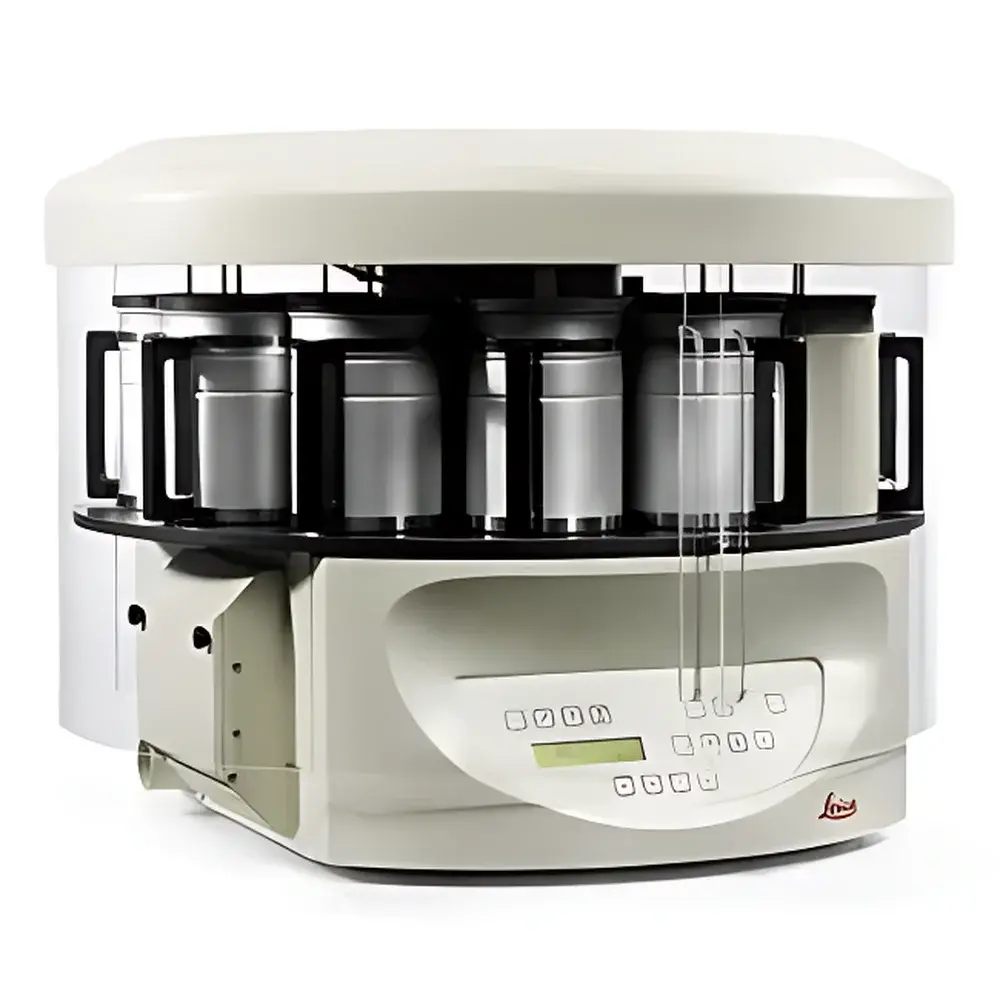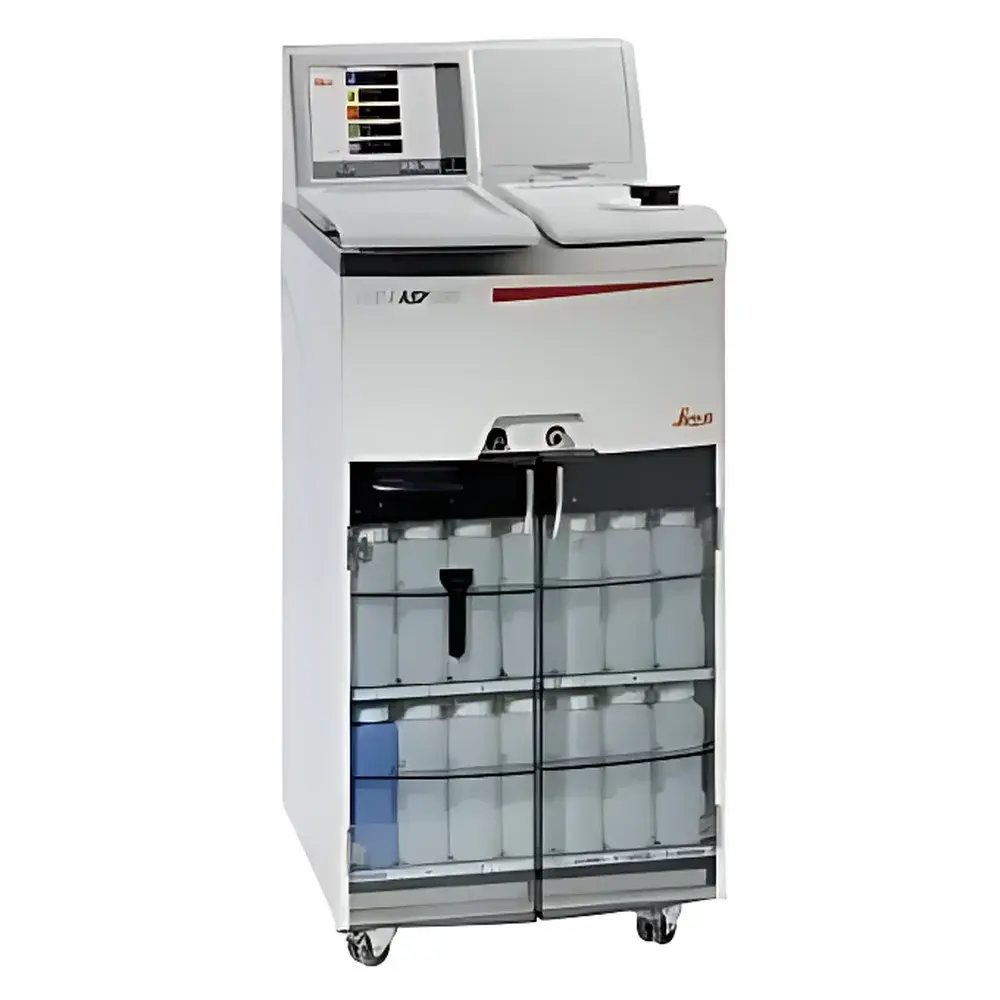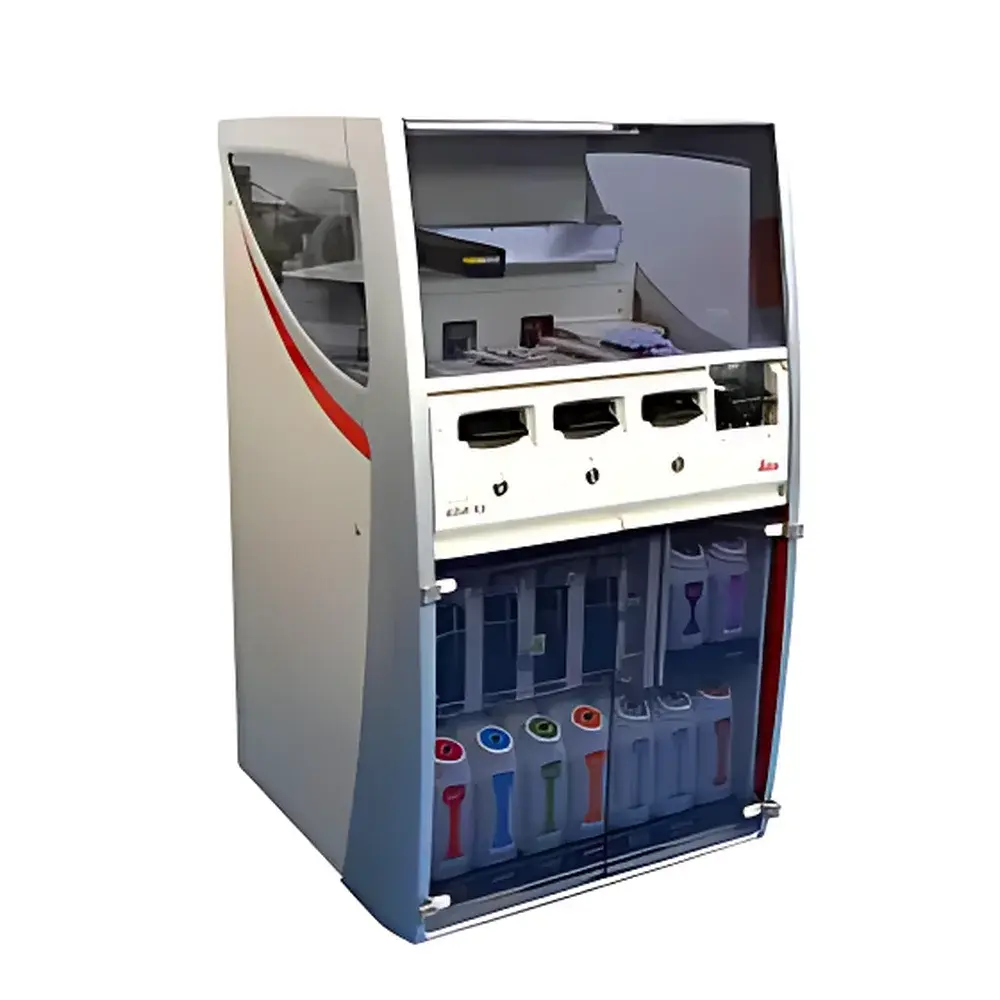
Leica BOND RX Automated IHC and ISH Staining System
| Brand | Leica |
|---|---|
| Origin | Germany |
| Model | BOND RX |
| Instrument Type | Fully Automated Immunohistochemistry (IHC) and In Situ Hybridization (ISH) Stainer |
| Regulatory Status | CE-IVD, FDA-cleared for in vitro diagnostic use (where applicable) |
| Throughput | Up to 3 independent slide racks simultaneously |
| Cycle Time | ~50% faster than predecessor BOND III platform |
| Tissue Protection | BOND CoverTILE™ patented reagent delivery and incubation system |
| Software Platform | BOND iView and BOND RX Controller v6.1+ |
| Compliance | Designed to support GLP/GCP workflows |
Overview
The Leica BOND RX is a fully automated, high-throughput staining platform engineered for precision immunohistochemistry (IHC) and in situ hybridization (ISH) applications in clinical pathology and translational research laboratories. Built upon Leica Biosystems’ proprietary BOND chemistry architecture, the system integrates closed-system fluidics, temperature-controlled incubation, and programmable protocol sequencing to deliver reproducible, high-fidelity molecular staining across diverse tissue types—including formalin-fixed paraffin-embedded (FFPE), frozen, and decalcified specimens. Its core operational principle relies on controlled reagent delivery via the BOND CoverTILE™ technology, which applies reagents as a uniform, low-shear film over tissue sections—minimizing mechanical stress, edge effects, and antigen masking while ensuring consistent penetration and binding kinetics. Unlike open-bath or dip-based automation, the BOND RX employs a dynamic, localized microenvironment for each slide, enabling stringent control over pH, ionic strength, and dwell time during epitope retrieval, blocking, primary/secondary antibody binding, detection, and counterstaining.
Key Features
- BOND CoverTILE™ Technology: Patented reagent application system that forms a protective, conformal layer over tissue sections—reducing evaporation, preventing cross-contamination, and preserving delicate morphology during extended incubations.
- Triple Rack Architecture: Three independent slide racks operate in parallel, allowing concurrent processing of up to 72 slides per run (24 slides/rack) with distinct protocols, enabling true batch flexibility without manual intervention.
- Enhanced Throughput & Efficiency: 50% reduction in average cycle time versus BOND III; optimized heat transfer and rapid reagent exchange enable same-day turnaround for STAT cases and high-volume routine diagnostics.
- Integrated Epitope Retrieval: On-board pressure-controlled steam-based antigen retrieval with programmable temperature ramping (90–120°C) and precise dwell timing, compatible with both citrate and EDTA-based buffers.
- Modular Scalability: Up to five BOND RX units can be networked to a centralized BOND iView data hub, supporting coordinated scheduling, remote monitoring, and unified QC reporting across multi-instrument labs.
- Regulatory-Ready Architecture: Full 21 CFR Part 11 compliance with electronic signatures, role-based user permissions, immutable audit trails, and instrument-level calibration logs traceable to ISO/IEC 17025 standards.
Sample Compatibility & Compliance
The BOND RX supports standard 1–4 µm FFPE tissue sections on charged or APES-coated glass slides, including whole-mount and tissue microarray (TMA) formats. It accommodates common slide sizes (25 × 75 mm, 26 × 76 mm) and accepts both pre-cut and custom-cut sections. The platform is validated for use with Leica’s Novocastra portfolio of primary antibodies, polymer-based detection systems (e.g., Bond Polymer Refine Detection), and ISH probes (DNA/RNA, chromogenic and fluorescent). All reagents are supplied in sealed, barcoded cartridges with lot-specific calibration data embedded for traceability. The system meets CE marking requirements under IVDR (Regulation (EU) 2017/746) and carries FDA 510(k) clearance for diagnostic IHC and ISH applications in the U.S. Lab environments operating under CAP, CLIA, or ISO 15189 accreditation may deploy the BOND RX within documented SOPs for assay validation, reagent qualification, and preventive maintenance scheduling.
Software & Data Management
Controlled by BOND RX Controller software (v6.1 or later), the system provides intuitive protocol authoring, real-time status dashboards, and granular event logging. Protocols are stored as encrypted XML files with version history and user attribution. BOND iView serves as the enterprise data aggregation layer—enabling centralized review of staining metrics (e.g., signal intensity, background uniformity, slide position consistency), QC flagging, and integration with LIS/HIS via HL7 v2.5 or ASTM E1384 interfaces. All user actions—including login/logout, protocol edits, run initiation, and error acknowledgments—are captured in an immutable audit trail compliant with FDA 21 CFR Part 11 Subpart C requirements. Data backups adhere to NIST SP 800-88 Rev. 1 guidelines for media sanitization and retention.
Applications
The BOND RX is routinely deployed in diagnostic histopathology for tumor classification (e.g., ER/PR/HER2 in breast cancer, PD-L1 in immuno-oncology), infectious disease detection (EBV, HPV), and neurodegenerative marker profiling (tau, α-synuclein). In research settings, it supports multiplexed ISH workflows (RNAscope®, BaseScope™), dual-probe co-detection, and spatially resolved transcriptomics preparation. Its robustness in handling challenging samples—including bone marrow biopsies, renal allografts, and pediatric CNS tissues—makes it suitable for reference laboratories conducting external quality assessment (EQA) programs aligned with UK NEQAS or CAP IHC surveys.
FAQ
Does the BOND RX support third-party antibodies?
Yes—while optimized for Novocastra reagents, the platform allows manual protocol customization for validated non-Leica antibodies, subject to internal verification of dilution, incubation time, and detection compatibility.
Can the system perform both IHC and ISH on the same run?
No—each run is dedicated to either IHC or ISH due to divergent buffer chemistries and temperature profiles; however, back-to-back runs can be scheduled automatically via the controller.
What maintenance intervals are recommended?
Daily cleaning of fluidic paths and waste reservoirs; quarterly preventive maintenance by Leica-certified engineers; annual performance verification using Leica’s BOND QC Slide Set.
Is remote troubleshooting supported?
Yes—the system includes secure, encrypted remote access capability for Leica Field Application Specialists, with customer consent and session logging enabled per HIPAA and GDPR requirements.
How is reagent consumption tracked?
Each cartridge contains an RFID tag storing lot number, expiration date, and remaining volume estimate; usage data is logged in real time and reported in BOND iView analytics dashboards.